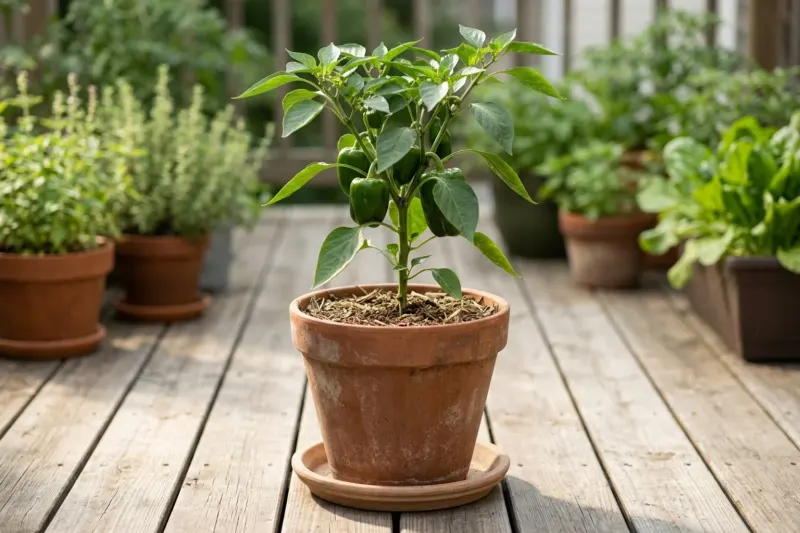
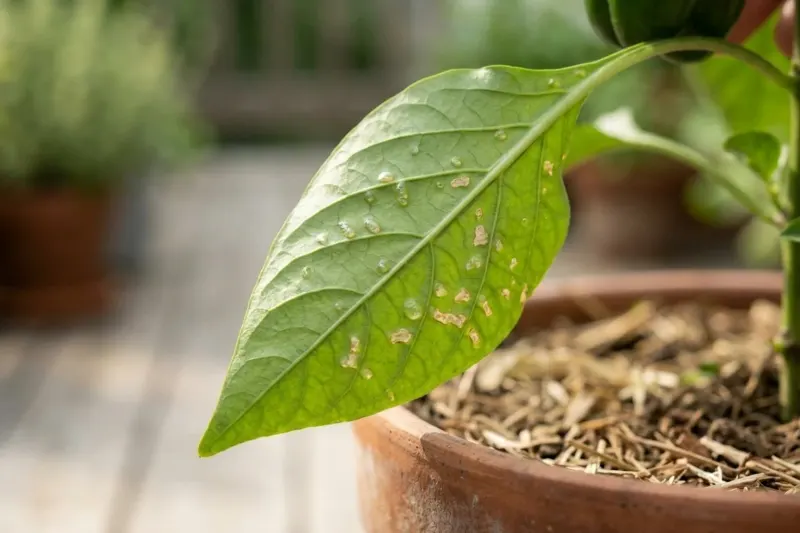
If you spot raised, watery blisters or crusty tan bumps spreading across the undersides of your potted pepper leaves, hold off on reaching for insecticidal soaps, neem oil, or copper fungicides. Those irregular swellings are not insect eggs, scale pests, or bacterial infections. Instead, they are the classic symptoms of edema—a nonpathogenic physiological disorder that occurs when container pepper roots absorb moisture much faster than the leaves can transpire it. Spraying horticultural oils in this situation only makes matters worse by coating the leaf pores and trapping even more moisture inside plant tissues. Your immediate corrective path is simple: pause all watering until the top 2 inches (5 cm) of potting mix dries out completely, give crowded containers extra breathing room to restore air circulation around the canopy, and resist the urge to clip off blistered foliage. Keeping those damaged leaves in place gives the plant the surface area it needs to vent internal water pressure while the root zone recovers.
Differentiating Edema Blisters from Pests and Blight
Before changing your container care routine, confirm that the bumps on your pepper foliage stem from internal moisture pressure rather than a contagious pathogen or an active insect infestation. Edema appears primarily on the lower surfaces (the abaxial side) of pepper leaves, along petioles, and occasionally on stems and developing fruit, as documented by University of Delaware Cooperative Extension. The disorder starts as tiny, water-soaked, translucent blisters clustered between the secondary veins. As internal cell walls stretch and fail under pressure, these blisters rupture, dry out, and cure into rough, tan, white, or rust-colored corky scabs. In persistent cases, the leaves curl upward into an exaggerated cup shape, turn pale yellow, and shed early. To distinguish edema from common container pests, run a clean fingernail gently across a bump. Pests such as soft scale insects or mealybugs sit on the exterior plant cuticle and scrape off cleanly without tearing the leaf blade. Edema bumps, by contrast, are integrated directly into the cellular architecture of the leaf; scratching them tears open the epidermal layer. Furthermore, bacterial leaf spot (caused by Xanthomonas species) produces distinct, water-soaked dark lesions that are typically bordered by bright yellow halos and can exude bacterial ooze in damp conditions. Edema lesions never form yellow halos or bacterial exudate. UMass Amherst Center for Agriculture, Food, and the Environment also distinguishes true edema from intumescence, a related physiological galling disorder driven by specific ultraviolet light deficiencies rather than moisture imbalances. In outdoor container gardening, these bumps are almost always true hydraulic edema tied to root moisture and vapor pressure deficits.
Why Confined Root Zones and Overwatering Drive the Pressure
Edema develops when the hydraulic equilibrium inside a pepper plant breaks down. Pepper root tips actively take up water from the surrounding soil through osmosis, generating positive hydrostatic pressure within the vascular system. Under standard growing conditions, the plant vents this moisture into the atmosphere through microscopic leaf pores (stomata) in a process known as foliar transpiration. When soil moisture is abundant and the root zone remains warm while the surrounding air is cool, still, or humid, root uptake continues at full throttle while foliar transpiration stalls completely. As research from the University of Wisconsin–Madison Division of Extension and the University of Kentucky Cooperative Extension explains, this physiological mismatch forces excess water to back up into the parenchyma and mesophyll cells of the foliage. These cells swell, crowd adjacent tissue, and eventually rupture through the outer epidermis, forming the rough, corky periderm scars characteristic of the disorder. Potted peppers are especially vulnerable to this dynamic because container root zones behave very differently from in-ground soil beds. Peat- and coconut-coir-based potting mixes hold substantial capillary moisture in the bottom third of the container, creating a perched water table. When a pot sits in a sheltered balcony corner during a cool, cloudy stretch, the root zone stays saturated while the canopy has no heat or air movement to drive transpiration. Applying foliar horticultural oils during this window compounds the issue; as UW–Madison Extension notes, oil applications create a physical film over stomata, blocking gas exchange and driving internal hydrostatic pressure to damaging levels.
Watering Protocols for Saturated Container Mixes
Resolving active edema requires bringing root moisture uptake back into balance with foliar transpiration. University of Maine Cooperative Extension and Utah State University Extension recommend allowing the top 2 inches (5 cm) of container growing media to dry out thoroughly before introducing any additional water. In practical container gardening, you should never irrigate potted peppers on a fixed calendar schedule. Instead, test moisture depth using your finger or monitor container weight by tipping the pot slightly. A waterlogged 5-gallon container feels noticeably heavy and dense; wait until the pot feels distinctly light before considering irrigation. Drainage mechanics also demand immediate scrutiny. Inspect the base of your container to confirm that drainage holes remain open and unobstructed by compacted roots or potting mix. If your pepper pot rests inside an ornamental cachepot or on top of a drainage saucer, immediately dump all pooled runoff after rain or watering. Leaving a pot sitting in standing drainage water maintains capillary saturation at the base of the root ball, guaranteeing that roots stay engorged with water overnight. When you do resume watering, apply moisture directly to the surface of the potting mix at the base of the stem rather than wetting the foliage, and water early in the morning so that any excess soil moisture has the warmth of midday daylight to evaporate before evening cooling sets in.
Balcony Airflow and Canopy Spacing Standards
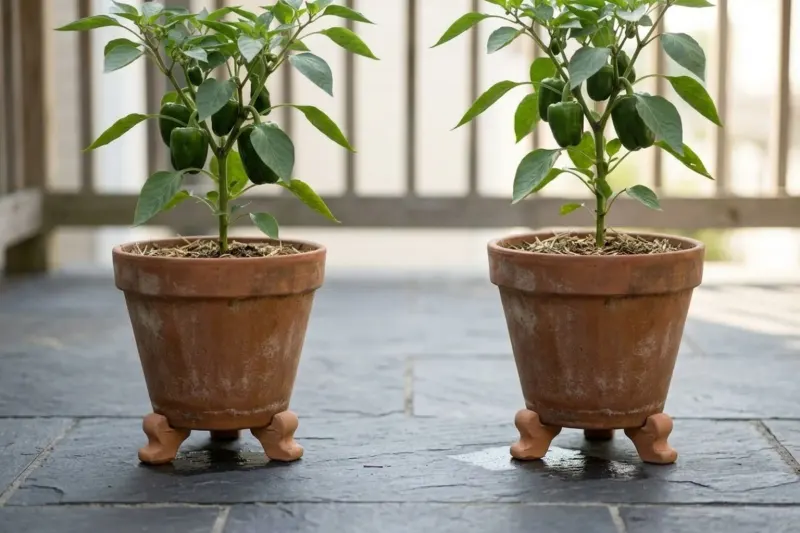
Regulating container moisture solves only half of the hydraulic equation; you must also improve the air surrounding the plant canopy so leaves can release moisture vapor. Utah State University Extension highlights that ambient relative humidity exceeding 70% drastically suppresses foliar transpiration rates, creating ideal environmental conditions for edema development. On enclosed patios, sheltered balconies, or against deep exterior walls, microclimates form where cool air pools and relative humidity spikes well above open-air baseline levels. Packed arrangements of balcony containers exacerbate this problem by creating a dense, continuous boundary layer of humid air around the foliage. To restore transpirational lift, space individual containers so that their outer leaves do not touch neighboring plants. Maintaining a clearance of 12 to 18 inches (30 to 46 cm) between container rims allows gentle ambient breezes to penetrate the inner canopy and sweep away saturated air pockets. Elevating containers onto 1-inch (2.5 cm) terracotta feet or composite pot risers provides dual benefits: it prevents water from backing up around the drainage holes and allows air to circulate underneath the container base, helping lower media temperatures equalize with ambient air.
Managing Scarred Foliage Without Damaging Plant Vigor
When confronted with extensive corky scabs on their pepper plants, many container gardeners mistakenly reach for pruning shears to remove all affected leaves. Stripping blistered foliage is counterproductive and often worsens the disorder. As guidance from the Royal Horticultural Society (RHS) points out, removing damaged leaves reduces the total leaf surface area available for transpiration, concentrating existing hydrostatic root pressure into fewer remaining leaves and tender shoot tips. While ruptured cells and corky periderm scars are permanent and will not heal, the intact green mesophyll tissue on those leaves remains metabolically active and continues to transpire moisture. UMass Amherst and University of Maine Extension confirm that edema is self-limiting: once soil moisture levels stabilize and relative humidity drops, newly expanding leaves will emerge flat, smooth, and blemish-free. Leave older, scarred foliage intact as long as it retains green photosynthetic pigment. Only prune leaves that turn completely yellow, brown, or naturally detach from the petiole. If the plant sheds a few severely blistered lower leaves on its own, clean them from the soil surface to deter opportunistic molds, and trust the plant to direct its energy into vigorous, balanced upper growth.
Diagnostic and Operational Decisions for Potted Pepper Edema
| Situation | Consider | Why |
|---|---|---|
| Bumps are raised, translucent blisters or tan corky scabs on leaf undersides, firmly attached to plant tissue. | Halt all foliar sprays, withhold irrigation until the top 2 in (5 cm) dries, and maintain container spacing. | Sourced from UW-Madison and Univ. of Maine; confirms nonpathogenic edema requiring transpiration recovery rather than chemical treatment. |
| Bumps flake off cleanly when scraped with a fingernail, revealing intact epidermis underneath, with sticky honeydew on foliage. | Inspect for soft scale or mealybugs and employ mechanical insect removal rather than altering water regimes. | Edema lesions are ruptured internal leaf cells that cannot be separated from tissue without tearing the leaf blade. |
| Ambient humidity exceeds 70% in a sheltered balcony corner with containers grouped closely together. | Spread containers at least 12 to 18 in (30 to 46 cm) apart and elevate pots onto risers. | Utah State Univ. identifies relative humidity above 70% as an edema trigger; spacing reduces boundary layer humidity around leaves. |
| Older lower foliage shows extensive corky scarring while new top growth is smooth and expanding normally. | Retain the scarred leaves; do not prune them away. | RHS guidance notes that removing functional transpiring leaf area concentrates hydrostatic pressure into remaining foliage, worsening edema on new shoots. |
Hypothetical Recovery Workflow for a Saturated Patio Bell Pepper
Consider a hypothetical scenario involving a mature bell pepper grown in a 5-gallon (19-liter) plastic container measuring 12 inches (30 cm) in diameter on a partially enclosed urban balcony. Following three consecutive overcast spring days with temperatures averaging 64°F (18°C) and relative humidity lingering around 78%, the gardener spots pale blisters and upward leaf curling across the lower canopy. Step 1: The grower removes the standing water from the drainage saucer, discarding the tray entirely and setting the pot on four 1-inch (2.5 cm) terracotta feet. Step 2: Irrigation is stopped for 7 days until the top 2 inches (5 cm) of the soilless potting mix tests completely dry and the pot feels light when lifted. Step 3: The container is shifted 18 inches (46 cm) outward toward the open balcony balustrade to expose the foliage to moving ambient air. By day 12, the scarred lower leaves remain corky but active, while newly unfurling terminal leaves show zero blistering or distortion.
- Bell Pepper Container (30 cm)
- Airflow and Drainage Buffer
- Jalapeño Container (30 cm)
When this approach is not a good fit
This moisture-reduction and spacing approach is unsuitable when leaf lesions exhibit dark, water-soaked margins surrounded by bright yellow halos, or when fruit develops soft black lesions, which indicate infectious bacterial leaf spot (Xanthomonas) requiring sanitizing sprays or plant culling. It is also unsuitable if the potting medium emits a sour rot odor and roots appear black, mushy, and hollow, signaling advanced fungal root rot (Pythium or Phytophthora) that requires root pruning and fresh media rather than atmospheric air-drying alone.
PUT THIS GUIDE TO USE
Work with your own measurements
Sources & further reading
- University of Delaware Cooperative Extension
- University of Wisconsin-Madison Division of Extension
- UMass Amherst Center for Agriculture, Food, and the Environment
- University of Kentucky Cooperative Extension Service
- Utah State University Extension
- University of Maine Cooperative Extension
- Royal Horticultural Society
AI-assisted writing and concept images. Sources and automated checks support the process; they do not replace checking your own measurements.
How we create our guides · Suggest a correction