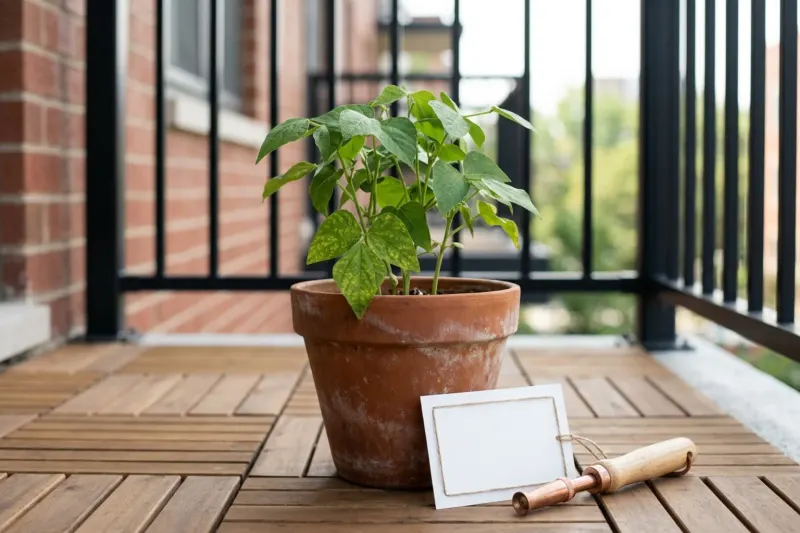
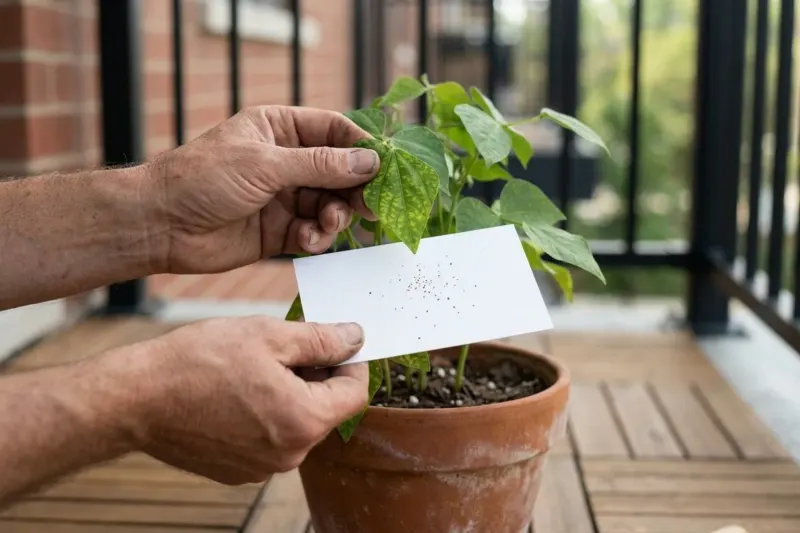
Before discarding a pale container bean plant or spraying an all-purpose pesticide, hold a sheet of plain white paper beneath a discolored leaf and tap the stem firmly. If tiny specks begin crawling across the sheet within a few seconds, twospotted spider mites (Tetranychus urticae) have established a colony on your balcony. Pressing your thumb across those moving specks gives you an immediate diagnostic answer: a faint greenish or yellowish streak confirms sap-feeding spider mites, whereas an orange or reddish streak indicates beneficial predatory mites. Your next action depends entirely on the condition of your plant canopy. Early stippling calls for mechanical washing with plain water to dislodge nymphs while preserving natural predators. When fine webbing covers the growing tips and foliage turns dry, bronze, and brittle, potted beans lack the root volume to recover. In that stage, prompt bagging and culling protects neighboring balcony crops from severe infestation.
Confirming Mites with the Paper Tap Test
Spider mites are arachnids rather than true insects, and their minute size makes early visual detection difficult without magnification. Adult females measure roughly 0.3 to 0.4 mm long, which is under 1/60 of an inch, according to Utah State University Extension. They have oval bodies that typically display two dark lateral feeding spots. Newly hatched larvae emerge with six legs, whereas subsequent nymphal stages and mature adults have eight legs. Because colonies congregate along the primary veins on the undersides of leaves, inspecting only the upper leaf surface often leads container growers to misdiagnose early damage as a nutrient shortage or root drought stress. Twospotted spider mites feed using piercing-sucking mouthparts called stylets. They pierce individual plant cells on the lower leaf surface and extract cellular contents, including chlorophyll. This feeding causes fine, pale yellow or white speckling—known as stippling—across the upper leaf surface, as documented by Iowa State University Extension and UC IPM. Unlike nitrogen deficiency, which produces uniform yellowing across older lower leaves, spider mite damage appears as localized, sand-like mottling that clusters around leaf midribs before spreading across the entire leaf blade. The paper tap test provides a reliable field diagnosis described by Kansas State University Extension and Ask Extension. Hold a stiff white index card or sheet of paper under a suspect bean leaf and strike the leaf blade sharply three to four times. Wait three to five seconds for debris to settle. Soil particles and dust remain stationary, while living mites begin crawling across the paper. Smear the crawling specks with your thumb: a green or yellowish streak confirms plant-feeding spider mites, while an orange or reddish streak indicates predatory mites that should be protected.
Balcony Microclimates and Reproduction Rates
Balcony environments frequently create ideal microclimates for rapid spider mite population spikes. Urban terraces, high-rise railings, and masonry walls absorb solar radiation during the day and re-radiate thermal energy throughout the evening. These localized heat sinks elevate leaf temperatures well above ambient street-level weather forecasts. In addition, overhead balcony overhangs shield container vegetables from natural rain showers, allowing ambient urban dust to settle on bean foliage. Dust and hot, arid air accelerate mite reproduction. Research from Iowa State University Extension and UC IPM indicates that at moderate temperatures around 70°F (21°C), a twospotted spider mite generation requires three to four weeks to develop from egg to reproductive adult. However, when ambient temperatures rise above 85°F to 90°F (29°C to 32°C) combined with dry air, the entire lifecycle compresses to just 5 to 7 days. Under these conditions, an undetected population can multiply hundreds of times within two weeks. Container fertilization practices also influence plant vulnerability. Balcony gardeners frequently apply water-soluble synthetic fertilizers to compensate for nutrient leaching in fast-draining potting mixes. As noted by Washington State University Extension and UMass Amherst Extension, heavy doses of soluble nitrogen saturate leaf tissues with free amino acids and simple proteins. This enriched foliage accelerates female mite egg production. Maintaining moderate, balanced nutrition rather than pushing aggressive vegetative growth helps slow pest proliferation.
Washing Foliage and Applying Contact Sprays
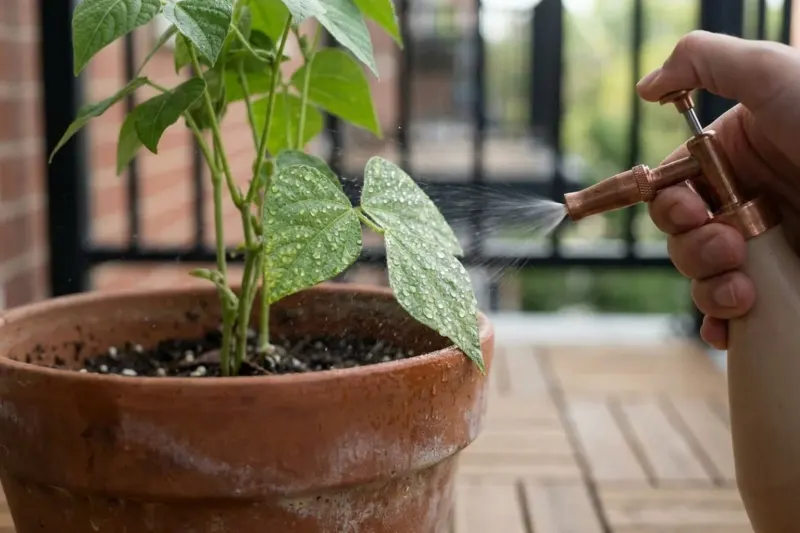
When early stippling is detected, physical removal should serve as the primary response. Washington State University Extension and Ask Extension recommend syringing foliage with a firm, targeted stream of water. On an apartment balcony, this can be achieved using a pressurized hand pump sprayer or a hose wand set to a narrow fan spray. Direct the water specifically at the undersides of the bean leaves. The physical force dislodges feeding nymphs and adult mites, knocks down fine webbing, and temporarily raises relative humidity around the plant canopy, disrupting their preferred dry microclimate. If active mites persist after two physical washings spaced two days apart, apply a contact horticultural spray such as insecticidal soap (potassium salts of fatty acids) or a refined horticultural oil. According to the University of New Hampshire Extension and the University of Minnesota Extension, these materials control mites purely through physical contact: soaps dissolve the protective outer cuticle, causing desiccation, while oils coat and smother respiratory spiracles. They leave no toxic chemical residue on edible bean pods and break down quickly in the environment. Application timing dictates success. Contact soaps and oils kill motile nymphs and adults, but they exhibit minimal efficacy against unhatched spider mite eggs. The University of New Hampshire Extension emphasizes that a single treatment will fail because surviving eggs hatch within days. A second application must be applied 7 to 10 days later—or 5 to 7 days later during hot weather above 85°F (29°C)—to intercept newly emerged nymphs before they reach reproductive maturity. Spray exclusively during the early morning or after sunset; applying oils or soaps in direct sunlight when temperatures exceed 90°F (32°C) risks severe foliar phytotoxicity and leaf scorch.
Treatments to Avoid on Confined Balconies
When facing a stubborn mite infestation, balcony growers often consider broad-spectrum synthetic insecticides containing active ingredients like bifenthrin, permethrin, or malathion. Extension specialists from the University of Minnesota and the University of Nebraska–Lincoln caution strongly against these products for spider mite management. Twospotted spider mites have developed widespread resistance to many common synthetic pyrethroids and organophosphates. Applying them frequently triggers a severe secondary pest flare-up rather than control. This secondary explosion occurs because broad-spectrum synthetic chemicals kill beneficial predatory insects—such as minute pirate bugs (Orius spp.), green lacewing larvae, and naturally occurring predatory phytoseiid mites—while leaving resistant spider mites largely unharmed. In the confined ecosystem of an outdoor balcony, predatory insects are already limited. Eliminating them allows surviving spider mites to reproduce without biological resistance. Releasing purchased biological controls, such as predatory mites (Phytoseiulus persimilis), is another method that requires caution outdoors. While UMass Amherst Extension highlights P. persimilis as highly effective in commercial greenhouses where relative humidity remains consistently above 60% to 70%, outdoor balcony conditions differ substantially. Exposed, breezy balconies with hot, dry air cause purchased predatory mites to desiccate or disperse away from the pots, leading to inconsistent control and wasted expense compared to mechanical washing and insecticidal soap.
Knowing When to Cull Container Beans
Unlike perennial shrubs or deep-rooted garden beds, container-grown annual beans have restricted root zones and a short productive window. A standard bush snap bean produces the bulk of its harvest within a two- to three-week flush. If an infestation goes unnoticed until more than half of the foliage turns brown, brittle, and encased in dense webbing, the plant's vascular and photosynthetic systems are fundamentally compromised. Damaged leaves cannot produce the carbohydrates required to develop bean pods, and existing blossoms will abort. Attempting to rescue a severely colonized potted bean consumes unnecessary time and spray materials while endangering neighboring balcony plants. Spider mites produce silken threads that catch urban air currents, allowing them to balloon onto adjacent tomatoes, peppers, and decorative containers. When webbing blankets the growing tips, the plant has crossed the practical threshold of recovery. To cull safely, avoid shaking or ripping the plant out in open air. Slide a large plastic garbage bag over the entire plant and its support stake, gently cinching the bag around the base of the main stem before cutting the plant off at soil level. Tie the bag shut securely before carrying it through the home or disposing of it in the trash. Never compost mite-infested foliage in an unmanaged home compost pile, as ambient heat levels rarely reach temperatures high enough to destroy remaining adults and dormant eggs.
Intervention Decision Matrix for Potted Beans
| Situation | Consider | Why |
|---|---|---|
| Isolated white stippling on 1 or 2 lower leaves; no webbing visible. | Wash under foliage with a pressurized water stream every other morning for three applications. | Dislodges early nymphs and temporarily raises local humidity without applying chemicals or disrupting natural predators. |
| Stippling spread across several leaves; crawling mites confirmed on paper test. | Apply insecticidal soap or 1% horticultural oil thoroughly at dusk; re-spray in 5 to 7 days. | Soap smothers active motile mites; a timed second spray eliminates newly hatched nymphs before they mature. |
| Webbing covers growing tips; over 50% of foliage is yellow, bronze, and crispy. | Enclose plant in a plastic bag, cut at base, and dispose of it in household trash. | Severely damaged foliage cannot support pod production, and the plant serves as a vector for surrounding containers. |
| Sudden population spike following use of an all-purpose synthetic bug killer. | Cease synthetic insecticide use immediately; syringe plants with plain water and shade roots. | Pyrethroids kill natural predatory insects and induce rapid mite flare-ups through pesticide-induced resurgence. |
Hypothetical Balcony Bush Bean Treatment Routine
Consider a hypothetical balcony planting of two bush snap beans ('Provider') growing in a 5-gallon (19-liter) fabric container measuring 12 inches (30 cm) wide and 10 inches (25 cm) deep. Situated against an east-facing brick wall in mid-July, afternoon temperatures regularly reach 88°F (31°C). On Day 1, the grower notices light stippling on three lower leaves. A paper tap test confirms six green-streaking mites. The grower immediately elevates the container on pot feet to improve drainage and sprays the undersides of all foliage with 1 quart (0.95 liters) of water using a pressure sprayer. On Day 3, a follow-up paper test reveals four remaining active mites. On Day 4 at 7:30 PM (well out of direct sun, with ambient temperature down to 78°F / 26°C), the grower applies a ready-to-use insecticidal soap spray, thoroughly coating leaf undersides. Because high ambient heat accelerates egg hatching, the grower schedules and completes a second soap application on Day 10 (six days later). By Day 14, a paper test yields zero crawling specks, and new trifoliate leaves emerge clean without foliar scorch.
- 1Step 1: Paper Tap Test
- 2Step 2: Water Rinse
- 3Step 3: Contact Soap
- 4Step 4: Re-spray Day 7
When this approach is not a good fit
This management sequence is unsuitable for large-scale agricultural bean fields where tractor-mounted boom sprayers and registered selective miticides are necessary. It is also unsuitable for fully enclosed commercial greenhouses equipped for environmental humidity control and beneficial predatory mite releases (Phytoseiulus persimilis). Plants suffering from systemic bean common mosaic virus or advanced fungal root rot should be removed rather than treated for mites.
PUT THIS GUIDE TO USE
Work with your own measurements
Sources & further reading
- Utah State University Extension: Spider Mites on Legumes
- Iowa State University Extension: Twospotted Spider Mites
- UC IPM: Spider Mites on Dry Beans
- Washington State University Extension: Bean Spider Mites
- Ask Extension: Spider Mite Paper Test
- Kansas State University Extension: Twospotted Spider Mites
- University of New Hampshire Extension: Twospotted Spider Mite Fact Sheet
- University of Minnesota Extension: Spider Mites in Home Gardens
- University of Nebraska–Lincoln CropWatch: Managing Spider Mites
- UMass Amherst Extension: Twospotted Spider Mites
AI-assisted writing and concept images. Sources and automated checks support the process; they do not replace checking your own measurements.
How we create our guides · Suggest a correction