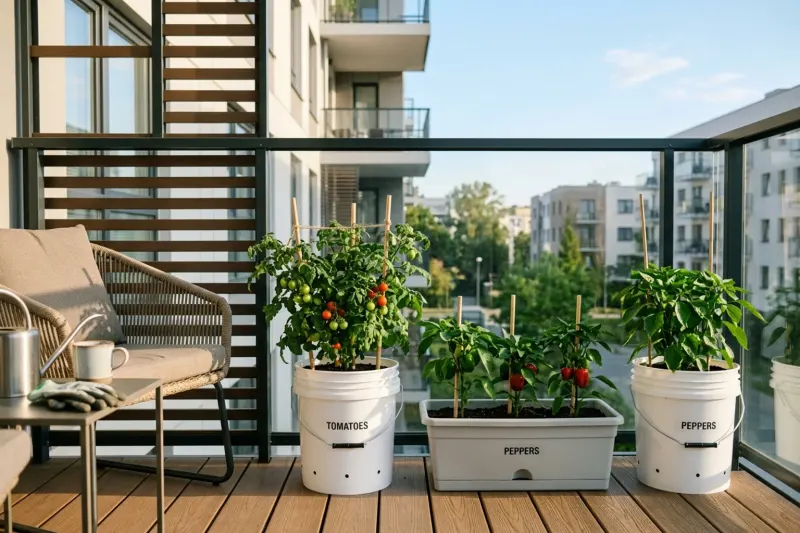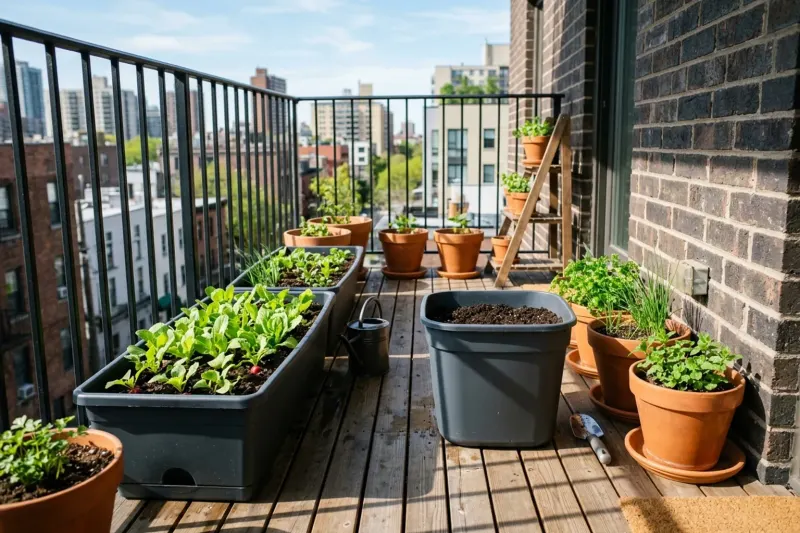
Setting young vegetable starts out on a sunlit balcony during the first warm afternoon of April feels like an intuitive start to the season. Yet moving pots outdoors based on a spell of pleasant weather or a fixed calendar date frequently results in stalled root systems or blackened foliage. In container gardening, timing depends on your local freeze probabilities and the unique way potting soil responds to shifting air temperatures. Working backward from local freeze records allows you to schedule indoor sowings, plant cool-season crops early, and protect frost-sensitive vegetables from sudden thermal shock.
Understanding Freeze Probabilities Over Arbitrary Calendar Dates
Every vegetable species functions within distinct physiological temperature boundaries. Cooperative extension services classify kitchen garden crops into cold-hardy, semi-hardy, tender, and very tender groups based on minimum germination thresholds and susceptibility to freezing. Cold-hardy leafy greens such as spinach and kale survive light frosts down to 28°F (-2°C). Tender warm-season crops like tomatoes and peppers, however, suffer cellular collapse or severe stunting whenever ambient temperatures dip below 32°F (0°C).
Retail garden centers routinely stock warm-season transplants weeks before local weather stabilizes. Staged displays under nursery heat create an artificial sense of security, but relying on them invites frost damage because seasonal shifts vary year to year. Instead, growers should consult station records from the National Oceanic and Atmospheric Administration (NOAA) National Centers for Environmental Information (NCEI), which tabulates 30-year U.S. Climate Normals.
The published average last spring frost represents the date when the statistical probability of a 32°F (0°C) event drops to 50 percent based on multi-decade station observations. Because a 50 percent probability means freezing temperatures occur after that date in one out of every two years, container gardeners aiming for safety often wait an additional 10 to 14 days before setting tender crops outdoors permanently.
Related guide: Choosing Food-Safe Plastic Pots for Vegetables
The Crucial Difference Between Frost Dates and Hardiness Zones
New container growers often conflate seasonal frost dates with the USDA Plant Hardiness Zone Map. USDA Hardiness Zones measure only the average annual extreme minimum winter temperature, divided into 10°F bands. These zones exist to indicate whether woody perennials, fruit trees, or perennial landscape shrubs can survive the coldest winter night in an average year.
USDA zones offer virtually no actionable data for scheduling annual container vegetables. Two regions sharing USDA Zone 7 can experience entirely different spring conditions. For example, an elevated valley in the interior West and a coastal plain in the mid-Atlantic may both record winter minimums between 0°F and 10°F (-18°C to -12°C). Yet the maritime coastal site might see its average last spring frost in early April, while the elevated valley continues to register sub-freezing nights well into late May.
For annual food crops grown in containers, the outdoor growing season is dictated by the frost-free window—the number of consecutive days between the last spring freeze and the first autumn freeze—rather than the severity of midwinter low temperatures.
Container Soil Thermodynamics Versus In-Ground Beds
Roots in containers exist in a radically different thermal environment than root systems anchored in the ground. In-ground soil benefits from the massive thermal inertia of the earth, which buffers against sudden temperature drops. Native soil warms slowly in the spring, but it also stores latent heat when air temperatures plummet overnight.
A container, by contrast, sits elevated in open air. Ambient air circulates freely around its side walls and underneath its drainage holes. This dynamic creates two distinct conditions for the grower:
- **Early-Season Warming:** Dark plastic pots or fabric containers situated on sunny masonry, stone, or composite decking absorb ambient solar radiation and warm up fast during bright spring afternoons. Potting soil temperatures can rise 10°F to 15°F (5.5°C to 8.3°C) above native ground temperatures, speeding seed germination for cool-season crops like radishes and lettuces.
- **Rapid Heat Loss:** Because containers lack subterranean thermal buffering, their soil volume cools rapidly once direct sun departs. During a clear, radiant freeze event, container root balls can drop to ambient freezing temperatures within hours. Fine feeder roots are generally far less cold-tolerant than top foliage, meaning a container plant can suffer fatal root damage during a freeze even if the upper leaves show minimal initial injury.
Accounting for this thermal exposure requires choosing container volumes that match the crop. A 5-gallon (19-liter) bucket holds sufficient thermal mass to moderate daytime heat and nighttime chills far better than a shallow 1-gallon (3.8-liter) nursery pot.
Back-Calculating Indoor Sowing and Outdoor Potting Schedules
A reliable container vegetable schedule treats the localized average last spring frost date as baseline zero ($T_0$). Indoor sowing, seed starting, transplant hardening, and permanent patio placement are calculated by counting weeks backward or forward from this reference point. Extension research from institutions such as Virginia Cooperative Extension, Cornell Cooperative Extension, and Purdue University Extension establishes standard timelines for common crop categories.
| Crop & Container Need | Growth Category | Timing Relative to Last Frost ($T_0$) | Sowing Method |
|---|---|---|---|
| **Onions & Leeks** (Deep boxes, 8–10 in / 20–25 cm) | Hardy | 8 to 10 weeks before $T_0$ | Sow indoors under grow lights |
| **Peppers & Eggplants** (5 gal / 19 L pot) | Very Tender | 7 to 9 weeks before $T_0$ | Sow indoors with seedling heat mat |
| **Bush Tomatoes** (5–10 gal / 19–38 L pot) | Tender | 6 to 8 weeks before $T_0$ | Sow indoors under intense light |
| **Kale & Swiss Chard** (2–3 gal / 7.5–11 L pot) | Hardy | 4 to 6 weeks before $T_0$ | Sow indoors or direct-sow into pots |
| **Radishes, Spinach, Lettuce** (4–8 in / 10–20 cm trough) | Semi-Hardy to Hardy | 2 to 4 weeks before $T_0$ | Direct-sow into outdoor containers |
| **Cucumbers & Summer Squash** (5–7 gal / 19–26 L pot) | Tender | 1 to 2 weeks after $T_0$ | Direct-sow outdoors once soil is $\ge$ 60°F (16°C) |
Transplants started indoors cannot move directly into full outdoor exposure. One to two weeks before their outdoor planting date, seedlings must undergo a hardening-off process. Set pots in a sheltered, shaded outdoor spot for 2 hours on the first day, gradually increasing exposure to direct wind, temperature fluctuation, and full sunlight over 7 to 10 days. Skipping this step leads to leaf scorch, stem breakage, and transplant shock.
Balcony Microclimates and Frost Defense Strategies
Urban and suburban small spaces rarely match regional weather-station readings. Balconies, sheltered verandas, and high-walled courtyard patios generate microclimates influenced by thermal mass, wind elevation, and artificial heat sources. Brick masonry, stone facades, and poured-concrete decking absorb solar energy through the day and radiate heat outward throughout the night, often keeping attached outdoor spaces 2°F to 5°F (1°C to 3°C) warmer than an open field.
Conversely, upper-story balconies face heightened wind exposure. Strong winds increase evaporative cooling from container walls and rapidly desiccate foliage, worsening the impact of borderline cold temperatures. When NOAA models project a marginal frost (30°F to 34°F / -1°C to 1°C), small-space growers can use practical mitigation strategies:
- **Clustering Vessels:** Grouping multiple containers tightly together against a warm interior wall reduces the exposed surface area of individual pots and conserves root-zone heat.
- **Elevating and Insulating:** Elevate smaller pots off cold metal railings or uninsulated steel decking onto cedar slats or pot feet, or wrap container perimeters in burlap or horticultural fleece to buffer roots against rapid convective heat loss.
- **The Mobility Advantage:** The greatest physical advantage of container gardening is portable shelter. If an anomalous hard freeze (below 28°F / -2°C) threatens after warm-season crops have been potted up, move containers into an unheated garage, entryway, or mudroom overnight, returning them outside once daytime temperatures climb above 50°F (10°C).
Crop Timing and Frost Window Decision Guide
| Situation | Consider | Why |
|---|---|---|
| 4 to 6 weeks before local average last spring frost; night lows hover between 32°F and 40°F (0°C to 4.4°C) | Sow hardy greens (spinach, kale, radishes) directly outdoors in troughs; start warm crops indoors under lights | Hardy brassicas and greens germinate in cold media, while tender crops like tomatoes will die or stall if placed outside. |
| 1 to 2 weeks before last frost; indoor tomato and pepper seedlings are 6 to 8 inches (15 to 20 cm) tall | Begin hardening off seedlings in partial outdoor shade for 2 to 4 hours daily, returning them inside nightly | Gradual exposure thickens cuticle wax and acclimates plant vascular systems to wind and sun without exposing roots to night freezes. |
| 2 weeks after last spring frost; soil temperature in pots reliably measures 60°F (15.5°C) or higher | Transplant warm-season crops into final 5-gallon (19 L) pots outdoors; direct-sow beans and summer squash | The statistical freeze risk is nearly zero, and warm container media prevents root rot while driving rapid vegetative growth. |
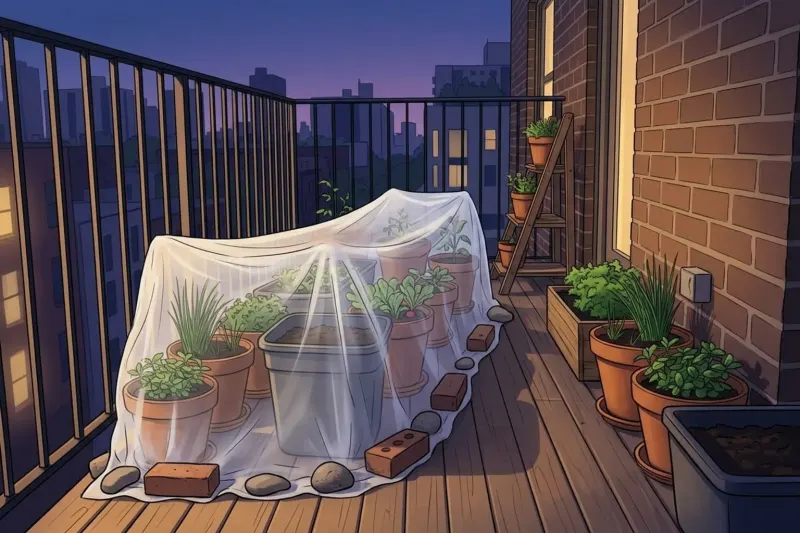
| Sudden late freeze warning (29°F / -1.6°C) forecast after warm-season pots have already been transplanted | Move portable pots indoors overnight, or push them flush against the building wall and cover with a cloth drop sheet | Container walls transmit freezing ambient temperatures directly to vulnerable root tissue unless sheltered or insulated. |
Hypothetical Worked Schedule: Mid-Atlantic Balcony (Last Frost: April 25)
Consider a hypothetical grower managing a 6 ft × 10 ft (1.8 m × 3.0 m) south-facing balcony in an area where local NOAA historical normals place the 50 percent last spring freeze date at April 25 ($T_0$).
- **March 1 (8 weeks before $T_0$):** Sow sweet pepper seeds indoors in seed trays placed on a seedling heat mat set to 75°F (24°C). Peppers require warm media to germinate and take 8 weeks to develop a sturdy root system.
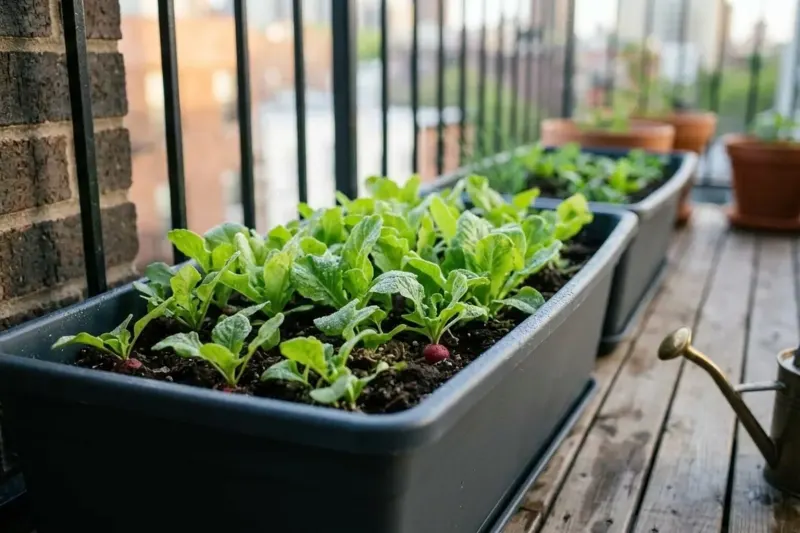
- **March 28 (4 weeks before $T_0$):** Direct-sow looseleaf lettuce, radishes, and spinach into a shallow rectangular trough (60 cm wide × 20 cm deep / 24 in × 8 in). Nighttime temperatures reach 35°F to 40°F (1.7°C to 4.4°C), which supports healthy cool-season root growth without damaging foliage.
- **April 15 (10 days before $T_0$):** Move the indoor pepper seedlings outside for 2 hours during mid-afternoon in a dappled-light location, increasing by 1 to 2 hours each day to complete the hardening-off cycle.
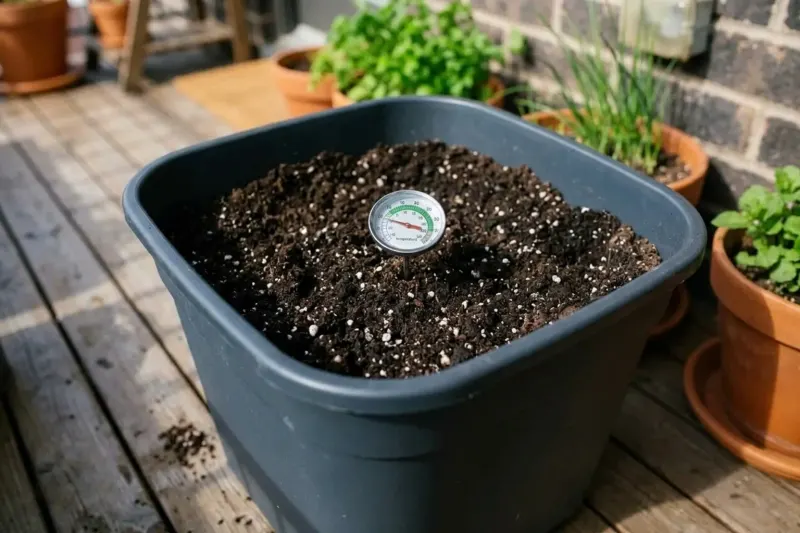
- **May 9 (2 weeks after $T_0$):** Move hardened pepper seedlings into their permanent 5-gallon (19-liter) container outdoors. Soil thermometers confirm the container medium reads 64°F (17.8°C) by mid-morning, well above the 55°F (12.8°C) minimum root threshold.
- Direct-Sown Greens Trough (Spinach, Lettuce, Radish)
- Kale & Chard Planter (Semi-Hardy Greens)
- Staged 5-Gallon Pot (Hardening-Off Peppers, Daytime Only)
- Staged 5-Gallon Pot (Hardening-Off Tomatoes, Daytime Only)
- Open Deck Space for Airflow and Worker Access
When this approach is not a good fit
This frost-date-driven timing framework is unsuitable for year-round temperature-controlled indoor grow tents, automated hydroponic benches, or subtropical microclimates (such as coastal USDA Zones 10b to 11) where sub-freezing temperatures never occur. In frost-free zones, container planting timing is dictated primarily by summer heat spikes, fungal disease pressures, and seasonal rainfall patterns rather than spring freeze probabilities.
PUT THIS GUIDE TO USE
Work with your own measurements
Sources & further reading
AI-assisted writing and concept images. Sources and automated checks support the process; they do not replace checking your own measurements.
How we create our guides · Suggest a correction