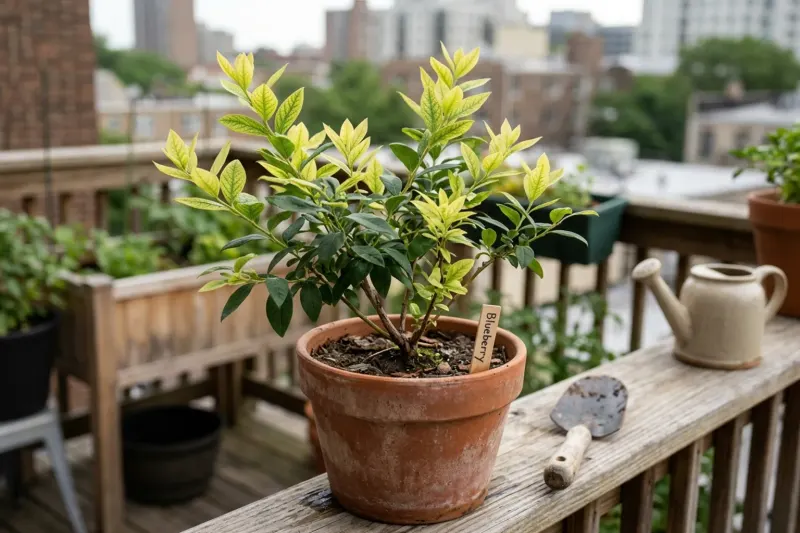
When blueberry foliage turns pale in a patio container, check the pattern and location of the discoloration before buying fertilizers or acidifiers. If the newest leaves at the shoot tips develop bright yellow blades while the veins stay distinct and deep green, the plant is dealing with iron chlorosis. If yellowing starts evenly across the oldest leaves near the base of the bush, the problem is usually nitrogen deficiency or roots suffocating in soggy media. Iron chlorosis in containers rarely means the potting soil has no iron. High substrate pH and waterlogged conditions chemically bind the mineral into insoluble forms that blueberry roots cannot absorb. Fixing the issue takes a two-step approach: an immediate foliar spray or targeted chelate drench to rescue the current foliage, followed by careful adjustments to pot drainage, water sources, and soil pH for lasting root health.
Pinpointing Interveinal Chlorosis on New Growth
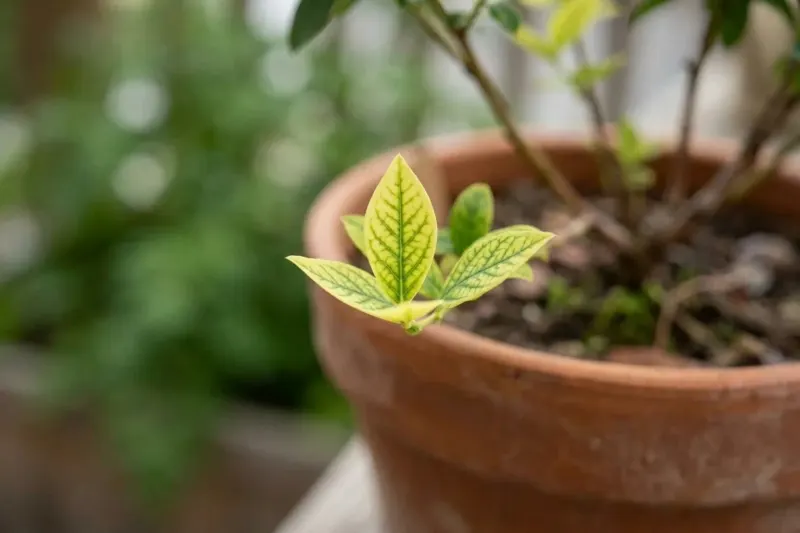
Accurate diagnosis starts by recognizing how nutrients move through blueberry tissue. Iron is an immobile element inside the plant. Once incorporated into cellular structures, the bush cannot move stored iron from mature leaves to support newly expanding shoots. Because of this physiological trait, iron deficiency always appears first on the youngest growth at the tips of upright branches. According to the University of Kentucky Cooperative Extension (publication HO-60), iron deficiency produces classic interveinal chlorosis, where the tissue between the veins fades to pale green or bright yellow while the vein network stays dark green. This distinct pattern sets iron lockout apart from mobile nutrient deficiencies. When container blueberries run low on nitrogen, the plant draws nitrogen reserves out of older foliage to feed tender shoots, turning mature lower leaves evenly yellow while top growth remains green. Left unaddressed, iron chlorosis worsens steadily. Young leaves emerge ivory or bleached white, develop brown, scorched margins, and eventually drop off. Because leaves without green chlorophyll cannot perform photosynthesis, severe chlorosis stalls branch elongation, leads to tip dieback, and weakens the plant over the growing season.
How High Substrate pH Locks Up Available Iron
Blueberry plants have shallow, fibrous root systems that lack root hairs and require an acidic, porous growing medium. Research from the University of Missouri Extension demonstrates that highbush blueberries thrive in a root-zone pH between 4.5 and 5.2. When container potting mix climbs above pH 5.5, the chemical availability of iron drops sharply. Under higher pH conditions, soluble ferrous iron (Fe2+) oxidizes into insoluble ferric compounds (Fe3+) that precipitate out of the soil water solution. The iron remains physically present inside the container, but the roots cannot take it up. Container blueberries are especially vulnerable to rising pH because of routine tap water. While mixes formulated from aged pine bark and sphagnum peat moss typically start at an ideal pH of 4.5 to 5.0, municipal tap water often contains dissolved calcium and magnesium carbonates. The University of Florida IFAS Extension (publication HS1356) notes that watering with alkaline, bicarbonate-rich tap water functions like a continuous light top-dressing of agricultural lime. Over two to three months of regular summer watering, these dissolved minerals neutralize natural peat acidity, driving the potting substrate pH above 6.0 and locking up iron.
Substrate Aeration and Drainage Obstacles
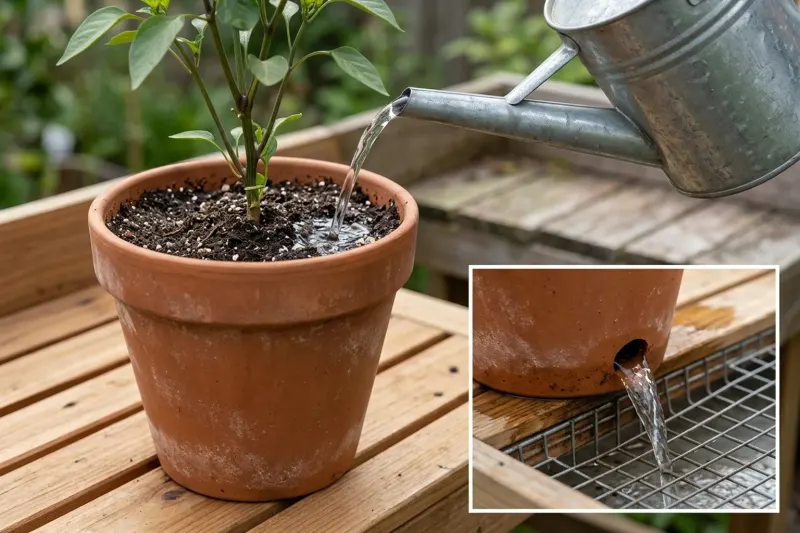
Elevated substrate pH is not the only reason container blueberries develop yellow leaves. Dense, waterlogged potting mixes trigger identical chlorotic symptoms even when the substrate pH sits perfectly between 4.5 and 5.2. As the University of Florida IFAS Extension emphasizes, saturated media starves the root zone of oxygen. This lack of aeration shuts down the root respiration needed to actively convert insoluble ferric iron into soluble ferrous iron at the root surface. Blueberries require steady moisture, but their fine root networks drown quickly in stagnant water. Common container issues include drainage holes clogged by compacted bark, saucers left full of runoff water, and heavy mixes that retain too much moisture. When potting mix stays saturated, root tips decay and lose their ability to absorb both water and essential micronutrients. Before applying chelated iron or soil acidifiers, check the moisture profile in the container. Push a wooden moisture dowel or finger three inches into the mix. If the potting soil feels dense, cold, and dripping wet, restoring container drainage and air circulation must come before any chemical corrections.
Related guide: Flushing Fertilizer Salts from Container Potting Mix
Fast Foliar Rescue Versus Root Drenches
While adjusting substrate pH takes several weeks to show results, a chlorotic blueberry bush needs quick relief to keep photosynthesizing and prevent leaf drop. The University of Minnesota Extension recommends chelated iron products to deliver immediately usable micronutrients. Chelates are organic molecules that encapsulate iron ions, shielding them from oxidation and soil lockout. Your choice of product depends on whether you treat the foliage or the potting mix. Foliar Sprays serve as a fast temporary bridge. Applying a foliar spray of chelated iron such as Fe-EDTA or Fe-DTPA supplies iron directly through the leaf surface. Product labels for 10 percent chelated iron generally calibrate foliar applications around 1 teaspoon per gallon (approximately 5 ml per 3.8 liters) of water. Sprayed in the early morning to prevent leaf burn, this solution often greens treated leaves within 7 to 14 days. However, as the University of Minnesota Extension cautions, foliar iron does not move systemically through the bush. Any new leaves that emerge after spraying will still show chlorosis until the root zone recovers. Root Drenches offer longer-lasting soil delivery. For root applications, Fe-EDDHA is the most dependable chelate because it stays stable in alkaline conditions up to pH 9.0, whereas Fe-EDTA breaks down above pH 6.5. Ohio State University Extension (factsheet HYG-1422) also notes that applying 2 to 3 ounces of ferrous sulfate or iron chelate around the base of established plants provides available iron, though Utah State University Extension cautions that unchelated iron sulfate locks up rapidly if substrate pH remains elevated.
Related guide: Can You Reuse Potting Mix for Container Vegetables?
Lowering Root-Zone pH for Permanent Recovery
Durable recovery requires bringing the container mix back into the target 4.5 to 5.2 pH range. According to the University of Illinois Extension, elemental sulfur and acid-forming nitrogen fertilizers are the primary tools for restoring proper substrate acidity. Elemental sulfur depends on warm, moist soil and naturally occurring Thiobacillus bacteria to convert into sulfuric acid, a biological process that takes several weeks to months. In container culture, apply elemental sulfur with care. Extension rate charts are calibrated for field acreage or broad garden beds; container gardeners must follow product package directions formulated for specific pot volumes to avoid root burn or manganese toxicity. Support long-term acidity through daily management: Select Acid-Forming Nitrogen by fertilizing with ammonium sulfate or acid-formulated plant foods. When blueberry roots take up ammonium ions, they release hydrogen ions into the medium, maintaining low root-zone pH. Avoid Nitrate Nitrogen fertilizers such as calcium nitrate or sodium nitrate, which push media pH higher. Address Irrigation Chemistry by switching to harvested rainwater whenever possible. If using alkaline municipal tap water, monitor the potting soil with a pour-through or slurry test every four to six weeks to catch upward pH drift before chlorosis returns.
Diagnostic and Action Decision Pathways
| Situation | Consider | Why |
|---|---|---|
| Bright yellow leaf blades with dark green veins on shoot tips; potting mix drains freely. | Apply a chelated iron foliar spray immediately, then test media pH with a pour-through or slurry kit. | Indicates classic pH-induced iron chlorosis; foliar chelates restore photosynthesis quickly while substrate testing guides acidification. |
| Uniform pale yellowing starting on oldest lower foliage; new branch tips remain green. | Feed with an acid-formulation liquid fertilizer containing ammonium sulfate rather than iron chelates. | University of Kentucky Extension indicates mobile nitrogen deficiency starts on mature basal leaves, whereas immobile iron deficiency begins on new shoots. |
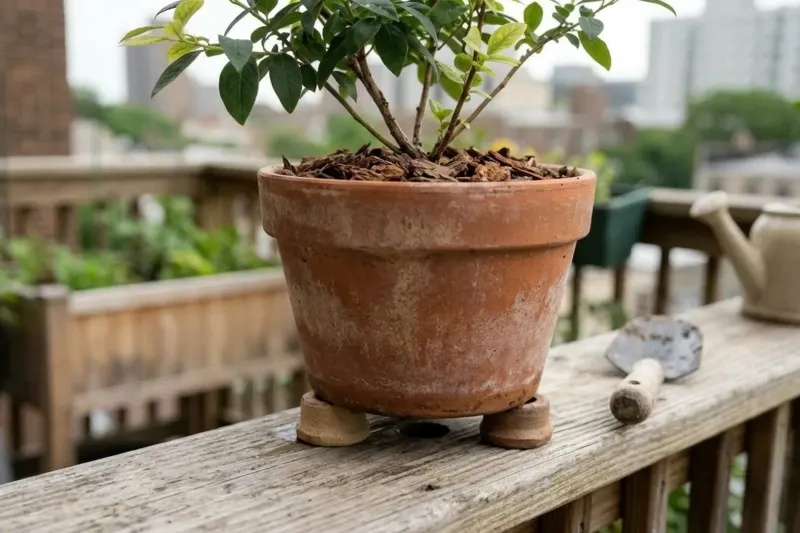
| Interveinal yellowing accompanied by heavy, waterlogged substrate or standing water in saucers. | Elevate the container on pot feet, empty standing saucer water, and allow the top two inches of mix to dry. | UF IFAS research confirms root-zone saturation deprives roots of oxygen, blocking iron uptake regardless of substrate nutrient levels. |
| Substrate pH tests above 5.5 after prolonged irrigation with alkaline municipal tap water. | Top-dress with elemental sulfur according to container label rates and switch routine watering to rainwater. | Municipal bicarbonates raise substrate pH over time; elemental sulfur and neutral rainwater restore the 4.5 to 5.2 range needed for iron solubility. |
Hypothetical Scenario: Restoring a Potted 'Patriot' Highbush Blueberry
In this hypothetical example, a home gardener growing a three-year-old 'Patriot' highbush blueberry in a 15-gallon resin pot (approximately 57 liters, 45 cm or 18 inches in diameter) noticed pronounced yellowing across new shoot tips in early summer. The potting substrate was a standard blend of 60 percent aged pine bark and 40 percent sphagnum peat moss. A 1:2 volume substrate-to-water slurry test showed a potting mix pH of 6.2, caused by three months of irrigation with alkaline tap water at pH 7.9. To supply immediate photosynthetic relief, the gardener applied an early-morning foliar spray of chelated iron diluted at 1 teaspoon per gallon (approximately 5 ml per 3.8 liters) of water according to product label directions. Within 12 days, the treated yellow foliage greened noticeably. For durable root-zone correction, the gardener applied 0.5 ounce (approximately 14 grams) of elemental sulfur granules across the surface mulch following the container label dosage, scratched it into the top inch of mix, and switched routine irrigation to collected rainwater. Over the following eight weeks of warm weather, the substrate pH gradually shifted down to 5.1, allowing late-summer growth to emerge deep green without ongoing foliar sprays.
- 11. Foliage Audit: Check shoot tips for green veins and yellow blades
- 22. Root Check: Inspect container drainage holes and mix moisture
- 33. Rescue: Mist current leaves with chelated iron solution
- 44. pH Correction: Apply sulfur per pot label and switch to rainwater
When this approach is not a good fit
This diagnostic and correction guide is unsuitable for field blueberries planted directly in alkaline in-ground clay soils without site excavation, plants infected with Phytophthora root rot displaying soft black decaying roots, or foliage suffering from fertilizer burn characterized by necrotic, crispy leaf tips following excessive granular applications.
PUT THIS GUIDE TO USE
Work with your own measurements
Sources & further reading
- University of Kentucky Cooperative Extension
- University of Missouri Extension
- University of Florida IFAS Extension
- University of Minnesota Extension
- Ohio State University Extension
- University of Illinois Extension
- Utah State University Extension IPM
AI-assisted writing and concept images. Sources and automated checks support the process; they do not replace checking your own measurements.
How we create our guides · Suggest a correction