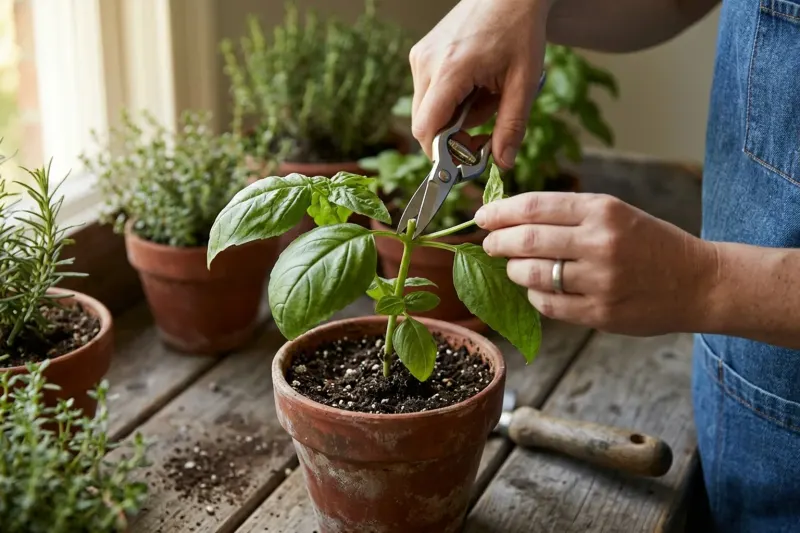
When a potted herb stretches toward the window on a single thin stem, cutting off its top leaf pair can feel like a setback. Many container gardeners hesitate, worried that snipping off fresh growth will stunt a young plant or waste precious balcony space. In a pot, however, leaving that upright shoot alone actually works against you. An unchecked stem grows tall, turns spindly, and flops over under wind gusts or the weight of its own leaves. It also leaves the lower half of your container bare while consuming limited root space and moisture. Taking off the growing tip redirects the plant's natural hormone flow, waking up dormant buds tucked into the lower leaf joints and prompting them to form two leafy branches where you once had one. With a few deliberate cuts above healthy leaf nodes, you can shape fragile starter herbs into compact, self-supporting mounds that produce steady harvests all season.
How Apical Dominance Shapes Container Herbs
Every leafy herb grows according to a basic botanical rule known as apical dominance. The active bud at the very tip of an upright shoot produces auxin, a growth hormone that travels downward through the stem tissue. As auxin flows past lower leaf joints, it chemically suppresses the dormant buds sitting in those junctions. In an open garden bed, a tall plant might eventually branch once side lighting improves. In a container, where root space is strictly bounded and light often comes from one side, unchecked apical dominance leads to a single spindly stalk with sparse lower foliage and early, unwanted flowering.
Removing that terminal shoot tip eliminates the primary source of auxin. Without that downward chemical brake, the dormant axillary buds at the leaf node directly beneath your cut wake up, divide, and push outward as new stems. Within a week or two under good light, one vertical stalk splits into two vigorous lateral branches. When you repeat that process across secondary shoots as the container fills out, the plant builds a sturdier canopy that shades its potting soil, cools root zones, and resists patio wind drafts.
Related guide: Timing Container Vegetables Using Local Frost Dates
Pinching Soft Tips Versus Heading Back Stems
Shaping herbs involves two main techniques: soft pinching and structural pruning. Choosing between them depends on the maturity of the stem and how much canopy you need to manage.
- **Soft Pinching:** This technique removes only the tender, immature terminal bud along with its uppermost pair of tiny emerging leaves. You do not need heavy tools; clean fingernails or small floral snips work well. Soft pinching takes almost no stored energy from the root system, creates a microscopic wound that dries in a few hours, and suits young seedlings once they reach 6 inches (15 cm) in height with three to four sets of true leaves.
- **Pruning and Heading Back:** Pruning cuts deeper into firmer, semi-woody, or mature herbaceous stems using clean bypass shears. This approach lowers an overgrown canopy, clears out dead or crowded inner growth, or harvests full sprigs for kitchen use.
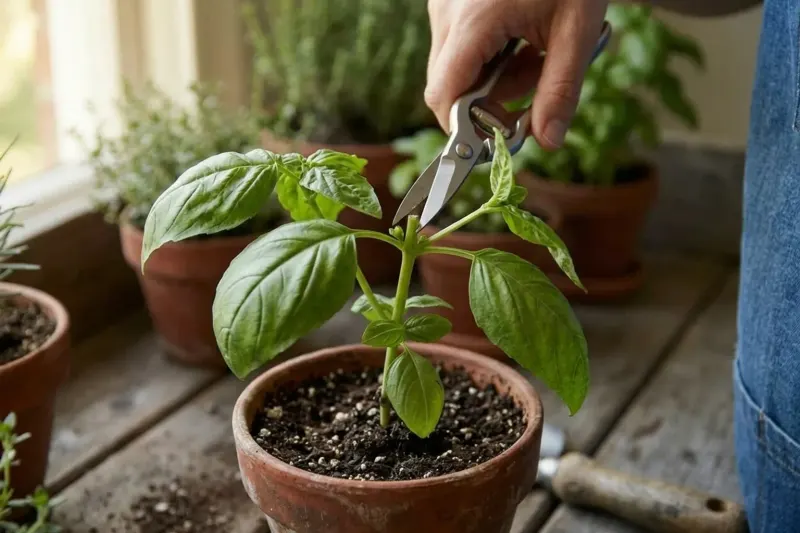
No matter which cut you make, position the blades roughly 1/8 to 1/4 inch (3 to 6 mm) directly above an active leaf node. That node is the structural joint where leaves and hidden lateral buds meet the stem. Leaving a long, leafless stub above the node invites dieback and fungal rot, while cutting flush against the joint or nicking the node itself can destroy the very buds you are trying to activate.
Related guide: Choosing Food-Safe Plastic Pots for Vegetables
Managing Soft Upright Annuals Like Basil
Fast-growing annual culinary herbs respond rapidly to regular trimming, but container size and remaining leaf area dictate how quickly they bounce back. Annuals like sweet basil (*Ocimum basilicum*) or summer savory should be potted into containers at least 6 inches (15 cm) in diameter with functional drainage holes to provide adequate root volume before you begin aggressive harvesting. Wait until seedlings reach 6 inches (15 cm) in height and show multiple true leaf tiers before giving them their first pinch. Trimming the central leader right above the second or third leaf node encourages two sturdy side stems to take over.
| Herb Group | First Pinch Height | Safe Harvest Removal | Critical Structural Limit |
|---|---|---|---|
| Annuals (Basil, Summer Savory) | 6 in (15 cm) | 50% to 75% of seasonal growth | Maintain 4–6 in (10–15 cm) green base foliage |
| Woody Perennials (Rosemary, Thyme) | Well-rooted potted start | Up to 20% to 33% green canopy | Never cut into bare, leafless brown wood |
| Herbaceous Perennials (Oregano, Mint) | 4–6 in (10–15 cm) | Up to 33% total canopy volume | Leave multiple active nodes above root crown |
During peak midsummer growth, established annual herbs can easily handle losing 50% to 75% of their top growth during a kitchen harvest, provided healthy green leaves remain below the cuts. Never shear an annual herb down to the potting soil line. Always preserve at least 4 to 6 inches (10 to 15 cm) of lower stem carrying functional foliage so the root system can maintain water uptake and fuel new shoots.
Watch closely for flower buds at branch tips. As soon as annual herbs bloom, their energy shifts toward seed production, and leaf texture turns tough and bitter. Pinch off flower buds the moment they form to keep the plant in its leafy vegetative state.
Protecting the Old Wood on Shrubby Perennials
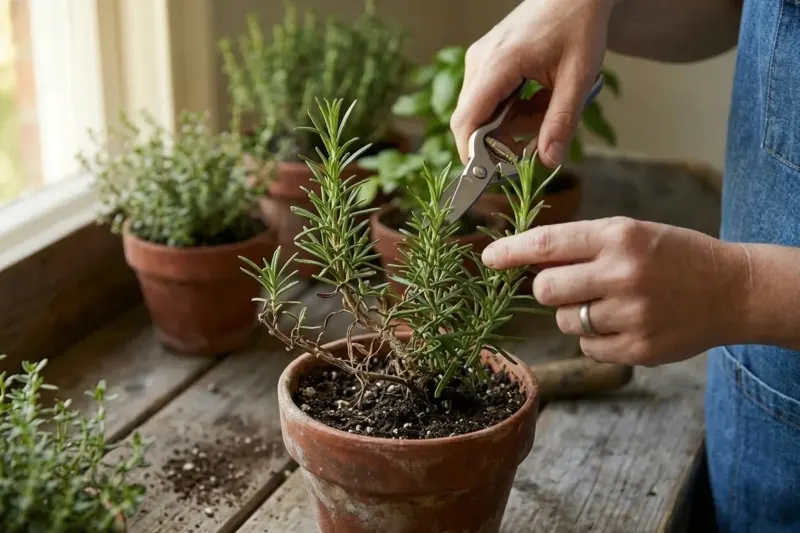
Woody Mediterranean perennials such as rosemary (*Salvia rosmarinus*), garden sage (*Salvia officinalis*), and thyme (*Thymus vulgaris*) follow very different rules from soft annuals. The most important rule for woody perennials in containers is simple: never cut back into bare, leafless brown wood.
Unlike deciduous shrubs in a garden border, the thick, older hardwood of potted rosemary and lavender rarely carries dormant adventitious buds beneath the bark. If you prune into bare lower sections that have already dropped their green leaves, that branch will not send out fresh green shoots. Instead, it will dry out and die back completely to the main crown. Keep all heading cuts inside flexible, green-barked stem sections that still carry active leaves or needles.
Woody container herbs also require conservative harvesting. Pruning removes stored energy from the plant, so restrict routine seasonal trimming to no more than one-third (33%) of the overall canopy at one time. For slower-growing plants like potted rosemary, taking no more than 20% of the active green shoot tips in a single session keeps root activity and water demand in balance.
Timing Cuts and Keeping Tools Clean
Cutting potted herbs alters moisture retention and cold tolerance, making daily and seasonal timing important on exposed balconies and windowsills.
- **Morning Trimming:** Harvest and prune in the morning after dew dries but before midday sun hits your pots. Essential oil concentrations peak during early morning hours, delivering the best culinary aroma. Cutting early also allows fresh stem wounds to begin callousing before intense afternoon heat accelerates moisture loss.
- **Late-Season Hardening:** If your perennial container herbs stay outside or in an unheated shelter through winter, stop pruning approximately 30 days before your area's average first fall frost. Trimming late in the season triggers a flush of tender, moisture-rich shoots that cannot harden off before cold weather arrives. A sudden frost will kill that soft growth and can cause stem splits that damage the crown.
- **Tool Sanitation:** Clean blades prevent the spread of fungal and viral diseases between pots. Wash off sap and potting mix with soap and water first, then wipe blades with undiluted 70% isopropyl alcohol. Rubbing alcohol disinfects on contact without corroding the metal, making it an easy, practical alternative to prolonged bleach soaks.
Herb Pruning and Pinching Troubleshooting Matrix
| Situation | Consider | Why |
|---|---|---|
| A young upright herb seedling like basil reaches 6 inches tall with 3 to 4 leaf sets. | Pinch off the top central bud and smallest pair of leaves using clean fingernails or micro-snips. | This removes apical dominance early and forces the stem to split into two lateral branches without wasting plant energy. |
| Potted basil forms tight flower buds at the branch tips in midsummer. | Snip stems two to three nodes below the emerging flower heads immediately. | Removing flowers halts seed development, preserves sweet leaf flavor, and forces the plant back into vegetative foliage growth. |
| An established potted rosemary looks leggy with bare, thick brown stems near its base. | Trim only 10% to 20% of the pliable green tip growth, leaving all brown wood intact. | Old hardwood on rosemary rarely develops adventitious buds; cutting into bare wood causes branch dieback. |
| Potted oregano or mint stems sprawl over the container edge and thin out at the center. | Cut trailing stems back by up to one-third, targeting nodes that point toward the pot interior. | This rejuvenates dense growth in the center of the pot while staying within safe perennial removal limits. |
Hypothetical Scenario: Pruning an Overgrown 8-Inch Container Basil
Consider a hypothetical sweet basil plant grown in an 8-inch (20 cm) plastic pot filled with well-draining potting soil. After several weeks on a sunny balcony, the plant has formed a single central stalk 9 inches (23 cm) tall with four distinct leaf sets and no side branches.
- **Step 1: Sanitize your tool.** Clean the blades of a pair of bypass snips with soap and water, then wipe them with undiluted 70% isopropyl alcohol.
- **Step 2: Locate the target cut.** Inspect the stem from the soil line upward. Identify the third leaf node, roughly 5 inches (13 cm) above the soil, where two healthy side leaves and small green bud points sit in the junctions.
- **Step 3: Make the cut.** Snip the central stem 1/4 inch (6 mm) directly above that third node. The 4-inch (10 cm) shoot tip you remove can go directly to the kitchen.
- **Step 4: Support recovery.** Check soil moisture through the bottom drainage holes and let the cut surface dry without heavy overhead spraying. Within 10 to 14 days under good sunlight, the two dormant buds at that node will expand into two separate, upright stems. Once those secondary branches develop three leaf sets of their own, pinch their soft tips to turn two branches into four.
- 1Single 6-Inch Stem with Terminal Tip
- 2Clean Cut 1/4 In Above Node 3
- 3Two Active Side Branches Emerge
When this approach is not a good fit
This pinching and heading strategy is unsuitable for herbs grown primarily for seed or decorative flower heads, such as dill grown for pickling umbels or coriander grown for seed harvest, where removing terminal shoots prevents the desired crop. It is also unsuitable for rosette-forming herbs like parsley, cilantro grown for quick single-cut harvests, or chervil. Rosette herbs produce new foliage from a central basal crown at the soil surface rather than branched aerial nodes; harvest them by trimming individual outer leaf stems at the base instead of topping the plant.
PUT THIS GUIDE TO USE
Work with your own measurements
Sources & further reading
- Clemson University Cooperative Extension - Pruning Shrubs
- University of Illinois Extension - Growing Herbs in Containers
- North Carolina State University Extension - Harvesting and Preserving Herbs
- University of Wisconsin-Madison Extension - Rosemary
- University of California Master Gardeners - To Pinch or Not to Pinch
- University of Minnesota - Shoots: The Science of Plants
AI-assisted writing and concept images. Sources and automated checks support the process; they do not replace checking your own measurements.
How we create our guides · Suggest a correction