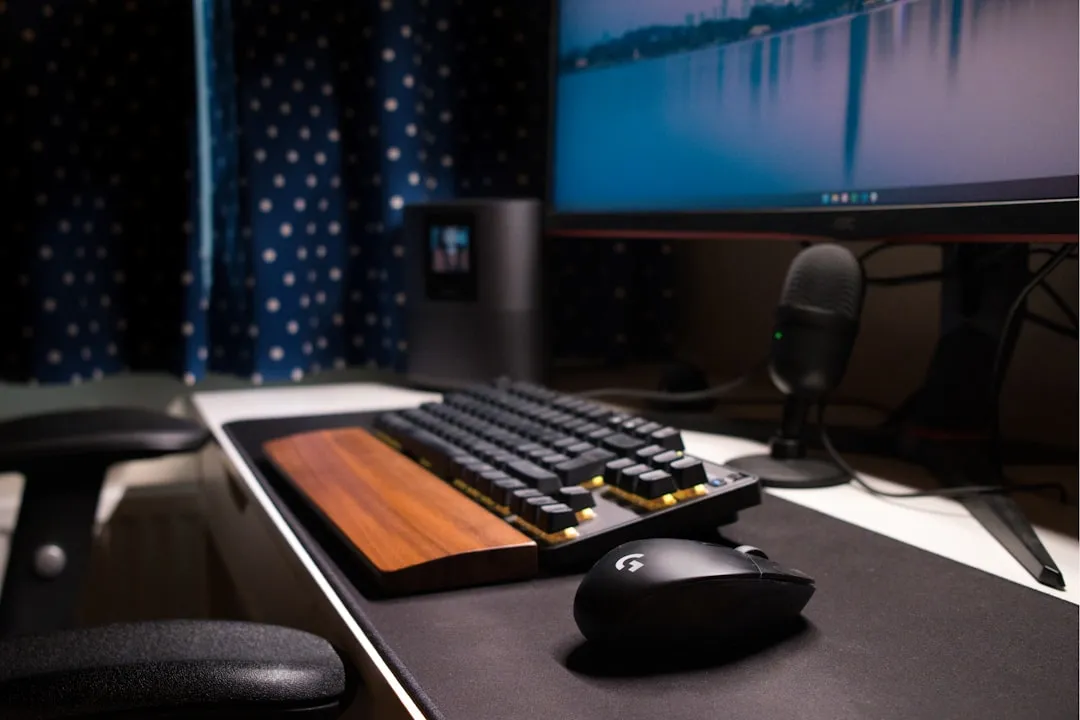
The Logitech MX Master 3S, despite its status as the de facto "king of productivity mice," remains a polarizing piece of hardware for precision-obsessed users. At its core, the 8,000 DPI Darkfield sensor is a marvel of engineering, capable of tracking on glass and high-gloss surfaces where traditional optical sensors fail. However, users frequently encounter a subtle, nagging issue: cursor jitter. This isn't usually a hardware defect; it is a complex interplay between surface physics, high-polling-rate interference, wireless congestion, and the aggressive post-processing algorithms baked into Logi Options+.
If your cursor feels "floaty," micro-stuttering, or exhibits erratic jumps, the solution rarely lies in a simple driver update. It requires a forensic-level investigation of your workspace environment, your USB bus topography, and the specific way your OS handles High-DPI input.
The Physics of Darkfield and Surface Interaction
The MX Master 3S uses a proprietary sensor that tracks microscopic irregularities on a surface to calculate movement. Unlike traditional gaming mice that might struggle on a glass desk, the 3S thrives there. However, this technology comes with a catch: surface texture density.
On highly reflective, polished wooden desks, the sensor can sometimes "over-read" the depth of microscopic scratches or light diffractions. This manifests as jitter. A common workaround involves switching to a high-quality, matte-finished fabric mousepad. It isn't just about friction; it’s about providing the sensor with a consistent pattern of contrast that doesn't trigger the onboard DSP (Digital Signal Processor) to constantly recalculate the cursor position.
Wireless Congestion: The 2.4GHz Noise Floor
The MX Master 3S relies on either the Logi Bolt receiver or Bluetooth Low Energy (BLE). In 2026, the 2.4GHz spectrum is more saturated than ever, which can exacerbate connectivity issues or sync failures across various devices. If your PC tower is tucked under your desk, buried in a "metal cage" of chassis and other peripherals, your Bolt receiver is fighting for air.
- The USB 3.0 Interference Paradox: USB 3.0 ports and their associated cables are notorious for emitting electromagnetic interference in the 2.4GHz range. If your Bolt dongle is plugged directly into a port adjacent to an active USB 3.0 hard drive or a hub, you are essentially creating a noisy environment for your mouse.
- The Fix: Use a short USB extension cable to bring the Bolt receiver as close to the mouse as possible. It sounds like a "support tier one" script, but it is physically necessary for high-fidelity signal propagation.
Decoding Logi Options+ and Smoothing Algorithms
Logitech’s software suite, Logi Options+, is essentially a middleware layer that manages your custom button assignments and, more importantly, pointer ballistics. A frequent complaint found on communities like r/logitech or various GitHub issue trackers is the "Pointer Smoothing" effect.
Logitech engineers designed this to make the mouse feel "premium" on different surfaces, but for creative professionals or competitive-leaning users, this smoothing is the primary culprit behind the sensation of input lag or jitter. If you find the cursor "overshoots" when you stop moving, you are likely feeling the software’s artificial deceleration or smoothing curve.
Real Field Reports: The "Polished Desk" Nightmare
"I bought the 3S thinking it would be the last mouse I ever need," says a long-time user on the r/MouseReview sub-Reddit. "But on my $2,000 walnut desk, it was twitching like it was caffeinated. I spent three hours in the registry, reinstalled drivers twice, and finally, I just threw down a $10 cloth mat. The jitter vanished. The sensor isn't broken; it’s just too sensitive for its own good."
This highlights a recurring pattern: users blame the software or the firmware (the "broken-ness"), while the actual bottleneck is the environmental interface—the desk surface.
Technical Analysis: The Polling Rate Limitation
One of the most persistent criticisms of the MX Master series is the capped 125Hz polling rate. In an era where 1,000Hz, 4,000Hz, and even 8,000Hz gaming mice are common, 125Hz feels outdated. When you move the mouse rapidly across a high-resolution 4K or 5K display, the low polling rate can create a visual sensation of "micro-stuttering" or "jitter" because the monitor refresh rate (often 144Hz+) is effectively "outrunning" the sensor’s ability to report position.
- Counter-Criticism: Does a productivity mouse need 1,000Hz? Logitech argues that it would decimate battery life and isn't necessary for Excel or Adobe Premiere. However, for a user with a high-refresh-rate monitor, the math simply doesn't align. The discrepancy between a 144Hz panel and a 125Hz sensor is mathematically guaranteed to result in frame-timing issues.
The Firmware "Brick" Fear
Updates via the Logi Options+ app are often cited as a cause for sudden performance degradation. When an update fails or hangs, it can leave the mouse in a state of high power-draw or inconsistent sensor tracking.
Recommended Troubleshooting Workflow for 2026:
- Ditch the Hubs: Connect the Bolt receiver directly to a motherboard-integrated USB 2.0 port if possible.
- Clean Surface: Use compressed air to clear the sensor lens. Even a single human hair can cause the Darkfield sensor to jump wildly as it tries to track the irregular obstacle.
- Disable "Pointer Precision" in Windows: Always ensure "Enhance pointer precision" (Mouse Acceleration) is unchecked in the Windows Control Panel. It conflicts with Logitech’s internal smoothing, leading to a "fight" between the OS and the driver.
- The "Unpair/Repair" Cycle: If you are using Bluetooth, remove the device completely, restart, and re-pair. BLE handshake issues are common after major Windows or macOS kernel updates.
Industry Controversy: The "Planned Obsolescence" of Software
There is a long-standing debate regarding whether Logitech intentionally pushes updates that make older MX Master units feel "sluggish" to encourage upgrades to the "S" variant. While there is no empirical evidence of this, the community consensus on forums like Hacker News often leans toward the theory that as software becomes more "bloated" with features, the underlying hardware—which has a finite processing capacity—struggles to keep up with the bloat.
The "broken" feeling is often not a bug, but a result of hardware reaching the limits of its firmware capability while being tasked with heavy background telemetry and cloud-syncing duties.
Frequently Asked Questions
Why does my cursor jump whenever I use a glass desk?
While the Darkfield sensor is marketed for glass, it requires the glass to be perfectly clean. Fingerprint oils or microscopic dust buildup on the glass surface cause the sensor to track the oil pattern rather than the desk surface, leading to erratic jumps. Wipe your workspace with an isopropyl alcohol wipe before concluding the mouse is faulty.
Does the MX Master 3S work better on Bluetooth or Bolt?
The Bolt receiver is strictly superior for stability. Bluetooth, while convenient, is subject to OS-level power management policies that can put the radio to sleep or throttle the connection for energy efficiency. If you are experiencing jitter, switch to Bolt immediately and use an extension cable.
Is the 125Hz polling rate the reason my mouse feels "slow" on a 144Hz monitor?
Yes. The disparity between your display refresh rate and the mouse polling rate causes a phenomenon where the cursor doesn't land on a pixel during every single monitor frame refresh. This creates a perceived "stutter" that is most noticeable when dragging windows or performing high-speed flick gestures in creative apps.
My mouse jittered immediately after a Logi Options+ update. What now?
This is usually a cache issue. Uninstall Logi Options+, delete the leftover app data folders in
%AppData%/Local/Logitech, and perform a clean install. Often, old config files conflict with the new firmware parameters, causing the sensor’s logic gate to miscalculate the DPI scaling.
Can I fix the jitter with a third-party mouse driver?
While tools like RawAccel exist for gaming mice, they are often overkill for the MX Master 3S. However, using RawAccel to force a linear acceleration curve can sometimes "mask" the jitter by overriding the default Logitech smoothing algorithm. Use this only if you are comfortable with advanced sensitivity curves.
The Operational Reality The Logitech MX Master 3S is a device built for a generic, perfect office environment. When taken out of that context—or when used in a high-refresh, high-interference tech setup—it reveals its architectural compromises. The jitter you experience is rarely a sign that you have a "lemon" product. It is a sign that your mouse is failing to translate its sensor’s microscopic observations into the high-speed data stream your modern PC demands. By isolating the signal (using Bolt), cleaning your physical environment, and stripping away unnecessary software "smoothing," you can reclaim the control that the marketing hype promises but the physics of wireless peripherals sometimes denies.