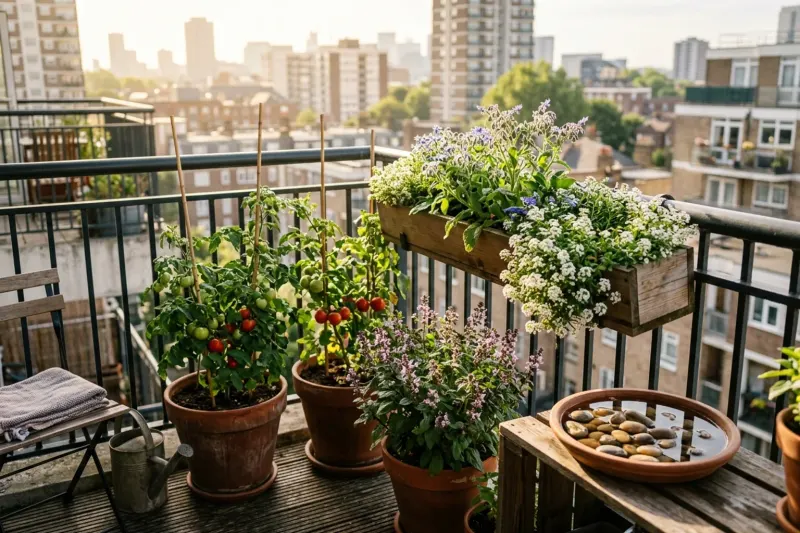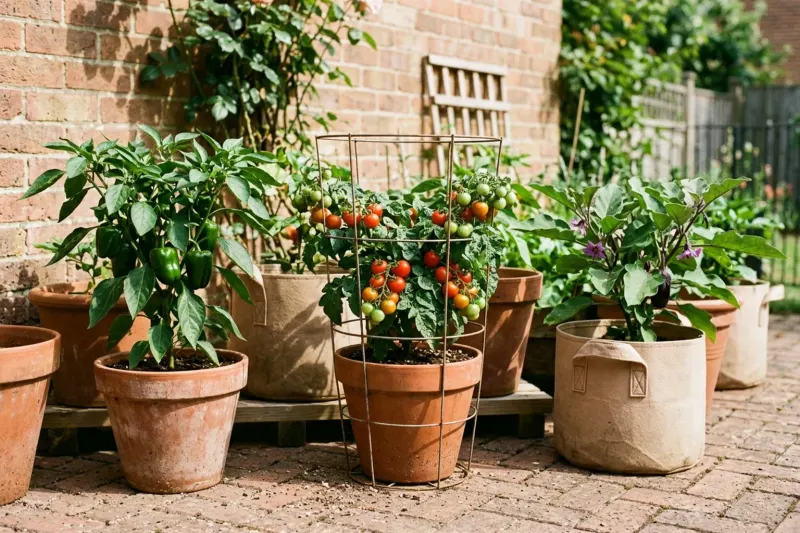
If you have a concrete slab, brick terrace, or paved patio exposed to six or more hours of direct sun, you can grow warm-season fruiting vegetables in containers where in-ground beds are not an option. Paved surfaces absorb heat during the day and warm the pots from the sides and base. For heat-loving crops like determinate tomatoes, peppers, bush squash, and eggplant, that extra warmth can accelerate growth, provided root systems have sufficient potting volume and consistent moisture. However, small containers dry out rapidly in direct sun, and trapped heat can stress roots if pots lack proper insulation and drainage. Selecting compact cultivars, using porous soilless potting mix, and choosing container sizes of at least 5 gallons (19 liters) gives warm-season crops the root buffer they need.
Patio Heat and Soil Choices
Fruiting crops need at least six to eight hours of direct sun daily to initiate blossoms and mature fruit, according to guidelines from Virginia Cooperative Extension and Clemson Cooperative Extension. Paved surfaces intensify this sun exposure by soaking up heat and reflecting warmth onto the sides of pots. While foliage generally handles warm ambient air, root zones in containers are vulnerable to temperature spikes above 90°F to 95°F (32°C to 35°C), which can stall nutrient uptake and cause temporary wilting.
Never fill patio containers with garden topsoil or native dirt. Field soil contains fine silt and clay particles that pack together tightly inside container walls, driving out the air pockets that roots need to breathe. As wet garden soil dries under hot patio conditions, it pulls away from container walls, allowing water to run straight down the gaps and escape without wetting the center of the root ball. Soilless potting mixes based on peat moss or coconut coir blended with perlite, vermiculite, and compost keep an open, spongy structure that holds moisture while letting excess water drain away.
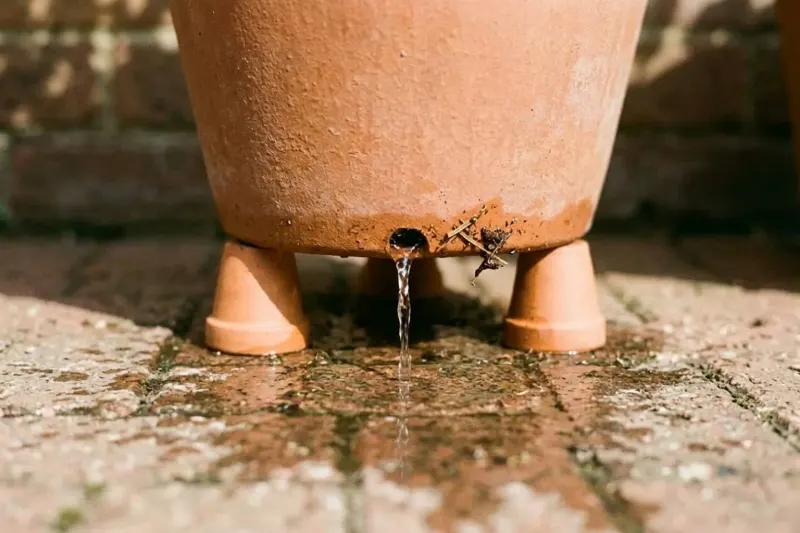
Adequate drainage holes are essential on flat hardscape surfaces. When pots sit directly on level paving stones, water can pool beneath the base and block bottom drainage holes, suffocating lower roots. Use pots with multiple drain holes at the bottom, and raise containers at least 0.5 inches (1.3 cm) on pot feet or rot-resistant wood slats to allow water to run off cleanly.
Related guide: Vertical Trellising for Potted Vegetables
Bush Tomatoes and Compact Peppers
Tomatoes (*Solanum lycopersicum*) and peppers (*Capsicum annuum*) perform well in full patio sun, but mature vine size determines container success. Standard indeterminate tomatoes grow continuously, often reaching 6 to 8 feet (1.8 to 2.4 m) tall with root systems that quickly outgrow typical household pots. Under intense patio heat, bound roots in undersized containers lead to rapid moisture loss, wilting, and blossom-end rot.
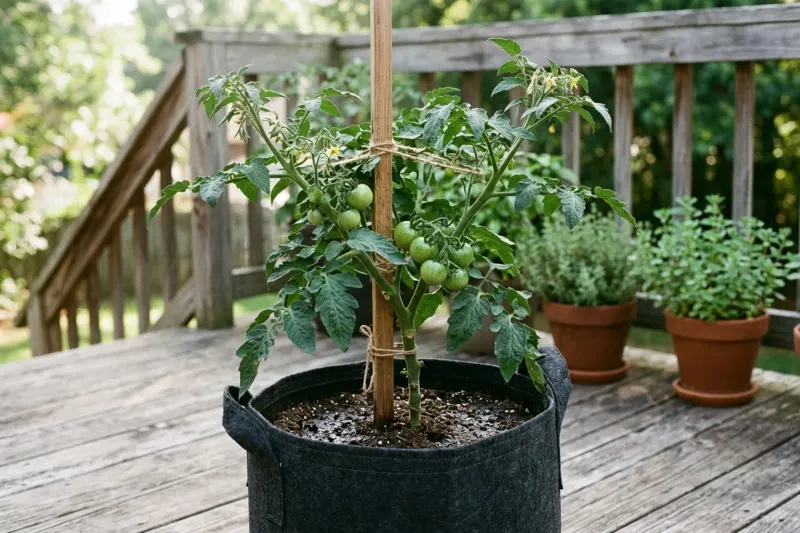
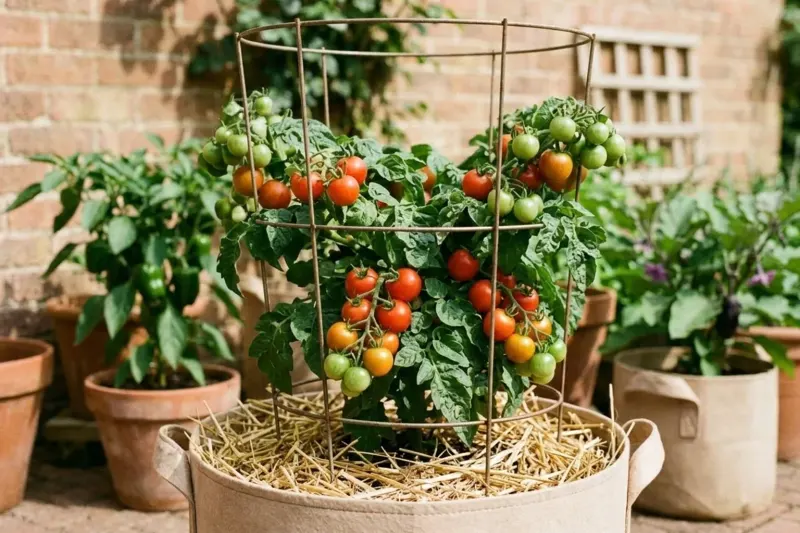
Determinate bush tomatoes and compact patio cultivars are much easier to manage. Varieties such as 'Patio Hybrid', 'Bush Early Girl', and 'Celebrity' stop growing once they reach roughly 3 to 4 feet (0.9 to 1.2 m) tall and ripen their crop over a defined window. Clemson Extension guidelines recommend a container with a capacity of at least 5 gallons (19 liters) for a single determinate tomato plant, with a diameter and depth of roughly 12 to 14 inches (30 to 36 cm). Even compact bush plants need a small wire tomato cage pushed into the potting mix at planting time to support heavy fruit clusters.
Peppers thrive in warm potting soil because their roots tolerate higher soil temperatures than tomatoes. Sweet bell peppers, jalapeños, and cayenne peppers do well in 3- to 5-gallon (11.4 to 19 L) containers with depths of 10 to 12 inches (25 to 30 cm). Dark plastic pots sitting on blazing south-facing stone can absorb excess heat; choosing light-colored plastic, glazed ceramic, or fabric aeration pots helps buffer root systems against midday temperature spikes.
Related guide: Diagnosing Blossom-End Rot in Container Tomatoes
Cucumbers, Squash, and Bush Beans
Cucurbits such as cucumbers (*Cucumis sativus*) and summer squash (*Cucurbita pepo*) produce broad leaves that lose moisture quickly in direct sun. Standard field varieties send out sprawling vines 6 to 10 feet (1.8 to 3 m) long, which can crowd patio walking areas and rest fruit against hot pavers. Compact bush cultivars keep vines manageable.
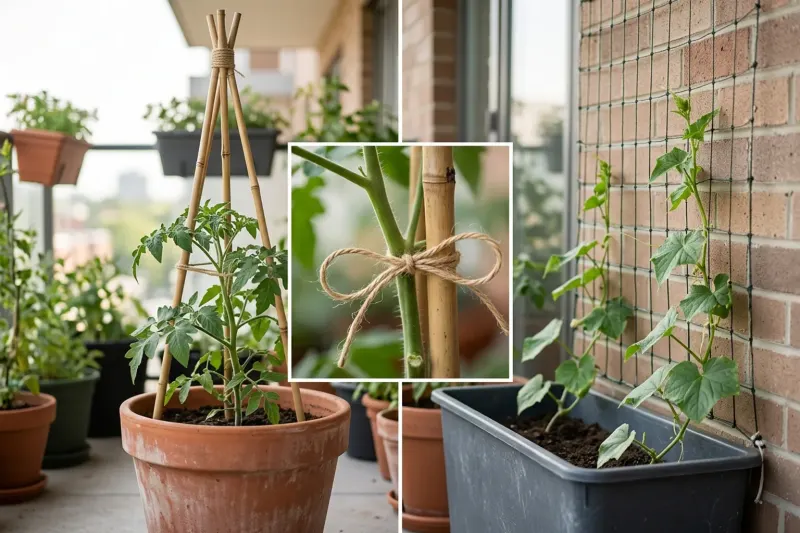
Bush slicing and pickling cucumbers, such as 'Spacemaster' or 'Bush Champion', produce short vines that stay within a 2-foot (60 cm) radius. They need a minimum 5-gallon (19 L) container per plant with a depth of about 12 inches (30 cm). Standard vining cucumbers can also grow successfully in a 5-gallon container if trained vertically onto a sturdy trellis anchored inside or directly behind the pot.
Bush zucchini and yellow summer squash need larger moisture reserves. A single bush squash requires a container holding 5 to 7 gallons (19 to 26.5 L) with a top diameter of 16 to 18 inches (41 to 46 cm). The broad leaves act like umbrellas, taking in sun while transpiring substantial amounts of water every afternoon.
Bush snap beans (*Phaseolus vulgaris*) suit wide, shallower planters like window boxes or rectangular troughs. Unlike pole beans, bush selections like 'Provider' and 'Contender' grow upright to about 12 to 18 inches (30 to 46 cm) without staking. They need a planting depth of 8 to 10 inches (20 to 25 cm) and can be spaced 3 to 4 inches (7.5 to 10 cm) apart, making them a practical choice along narrow patio edges.
Related guide: Attracting Pollinators to Balcony Vegetables
Eggplant and Dwarf Okra in High Heat
When midsummer heat causes tomato blossoms to drop temporarily, eggplant (*Solanum melongena*) and okra (*Abelmoschus esculentus*) continue growing actively. Both species handle strong sun and warm root conditions well.
Standard eggplants grow top-heavy, but compact cultivars like 'Patio Baby', 'Fairytale', and 'Hansel' produce small, tender fruit on compact stems. A single eggplant needs a 5-gallon (19 L) container with a depth of at least 12 inches (30 cm). Consistent watering is essential during fruit formation to prevent bitterness from developing in the skins.
Dwarf okra cultivars, such as 'Baby Bubba', stay around 2.5 to 3 feet (75 to 90 cm) tall, avoiding the 6-foot heights of garden okra. Okra develops a deep taproot that adapts well to a 5-gallon (19 L) container. Okra flowers open in full sun and set pods that grow quickly in warm weather. Check your local cooperative extension planting calendar for safe outdoor planting dates, as both eggplant and okra require substrate temperatures above 65°F (18°C) before setting out.
Watering Schedules and Feeding Routines
The main daily task for sunny patio containers is managing moisture. Because containers hold an isolated volume of potting mix, small pots dry out rapidly when temperatures climb above 85°F (29°C). In midsummer, 5-gallon (19 L) containers in full sun often require watering once every day, and smaller planters or fabric pots may need checking twice daily during dry, windy weather.
Frequent watering washes soluble nutrients out of the soil through the drainage holes. To maintain steady growth throughout the season, extension specialists recommend a two-stage feeding approach:
- **Controlled-Release Fertilizer at Planting:** Blend a balanced, coated slow-release fertilizer (such as 14-14-14 or 10-10-10) evenly through the potting mix according to package directions before planting.
- **Supplemental Liquid Fertilizer:** Once plants begin flowering and setting fruit, apply a water-soluble balanced plant food at half the recommended label strength every 10 to 14 days.
Always water containers until moisture drains freely from the base holes. Light surface watering leaves the lower root zone dry and causes fertilizer salts to build up near the soil surface. Adding a 1-inch (2.5 cm) layer of straw, untreated wood shavings, or bark mulch over the potting mix helps shade the soil surface and slow evaporation.
Sunny Patio Crop and Container Decisions
| Situation | Consider | Why |
|---|---|---|
| Reflective concrete patio with continuous 8+ hours direct sun and midday heat spikes | Dwarf eggplant ('Patio Baby') or bell peppers in 5-gallon (19 L) light-colored containers | Solanaceous crops tolerate warm air; light-colored containers help keep root-zone temperatures from climbing past 95°F (35°C). |
| Breezy or exposed upper-floor patio with wind-related tipping risks | Determinate bush tomatoes ('Patio Hybrid') in wide squat containers or compact bush snap beans | Tall vines catch the wind; compact bush varieties maintain a lower center of gravity and resist blowing over. |
| Narrow patio perimeter with less than 3 feet (0.9 m) of floor clearance | Vining cucumbers trained vertically on a sturdy container trellis | Bush cucurbits spread across walking paths; vertical trellising saves floor area while keeping leaves exposed to full sun. |
| Gardener away during midday heat and unable to check moisture midday | Increase squash and tomatoes to 7- to 10-gallon (26.5 to 38 L) containers with 1 to 2 inches (2.5 to 5 cm) of mulch | Greater soil volume retains more moisture between morning and evening waterings, reducing midday water stress. |
Hypothetical Worked Layout: 4-by-8-Foot South-Facing Patio
Consider a hypothetical south-facing patio space measuring 4 feet deep by 8 feet wide (120 cm by 240 cm), paved with brick and receiving full sun. The arrangement accommodates six planting containers while keeping walking space clear:
- **Rear Row (against wall):** Two 5-gallon (19 L) pots (each 14 inches / 36 cm wide) holding determinate bush tomatoes ('Bush Early Girl') with wire cages, flanking one 5-gallon (19 L) container holding a trellised cucumber.
- **Middle Row:** One 7-gallon (26.5 L) container (18 inches / 46 cm wide) holding a bush zucchini ('Eight Ball') and one 5-gallon (19 L) container housing a compact bell pepper.
- **Front Border:** A shallow rectangular trough planter (24 inches long by 10 inches wide by 9 inches deep / 60 cm x 25 cm x 23 cm) containing bush snap beans spaced 3 to 4 inches (7.5 to 10 cm) apart.
**Substrate and Resource Estimates (Hypothetical):**
* Total potting substrate required: approximately 4.8 to 5.0 cubic feet (135 to 140 liters) of soilless potting mix.
* Estimated material cost: $35 to $55 for potting soil and slow-release fertilizer granules, depending on regional retail prices.
* Water demand: Approximately 3.5 to 5 gallons (13 to 19 liters) of water daily during peak summer weather, applied until water drains from the base of each container.
- Determinate Bush Tomato (5-gal)
- Trellised Cucumber (5-gal)
- Determinate Bush Tomato (5-gal)
- Bush Zucchini Squash (7-gal)
- Compact Bell Pepper (5-gal)
- Bush Snap Beans (Trough Planter)
When this approach is not a good fit
This sunny container setup is unsuitable for cool-season greens like spinach, head lettuce, and cilantro during hot summer months, as heat triggers quick bolting and bitter leaves. It is also unsuitable for standard-length taproot vegetables like long carrots or parsnips that require deep, cool ground soil, and for unglazed pots smaller than 8 inches (20 cm), which dry out in hours under direct patio sun.
PUT THIS GUIDE TO USE
Work with your own measurements
Sources & further reading
- Virginia Cooperative Extension - Vegetable Gardening in Containers
- Clemson Cooperative Extension - Tomatoes in Containers
- University of Wisconsin-Madison Extension - Best Container Gardening Vegetable Varieties
AI-assisted writing and concept images. Sources and automated checks support the process; they do not replace checking your own measurements.
How we create our guides · Suggest a correction