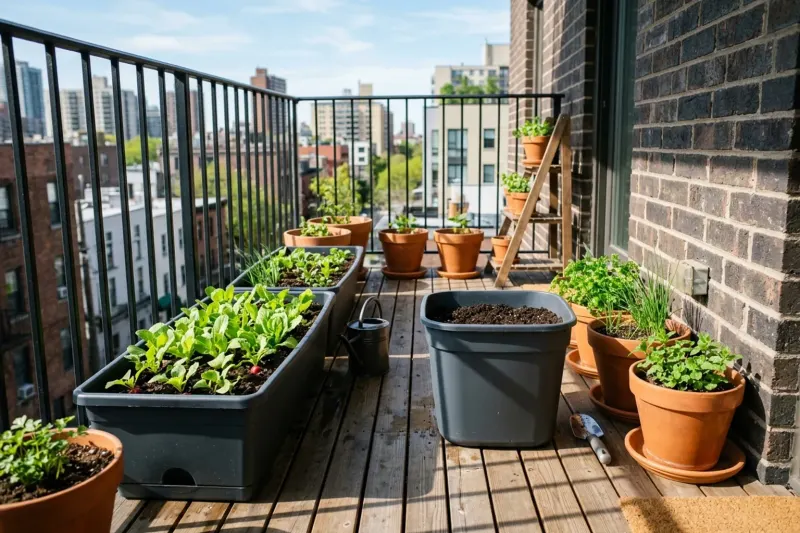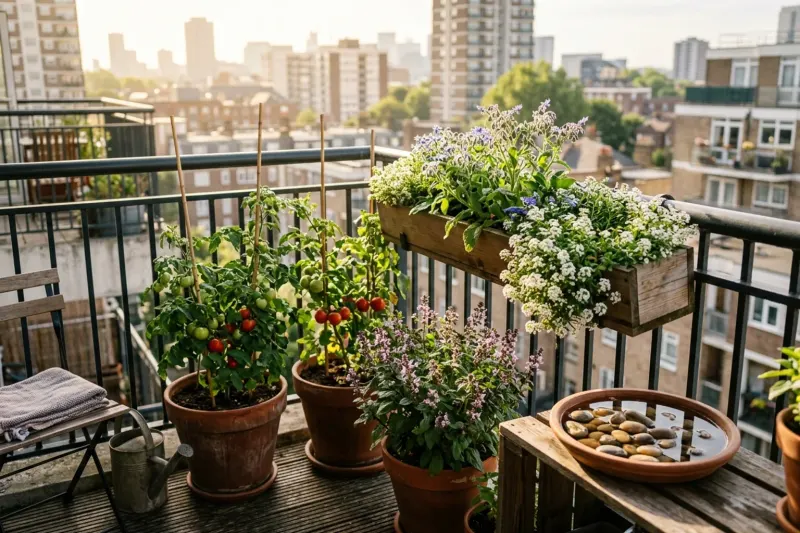
When floor area is tight on a balcony or patio, letting vining crops sprawl across the deck quickly produces trampled foliage, poor air circulation, and bruised fruit. Directing vines upward takes advantage of vertical airspace, but you cannot treat every climbing plant the same way. A pole bean twines its main stem around slender poles, a cucumber anchors itself with delicate coiled tendrils, and an indeterminate tomato lacks natural climbing mechanisms entirely, requiring manual ties along a rigid support. Growing heavy vines in potting soil also introduces stability issues that in-ground gardens do not face, especially the risk of wind catching a full canopy and tipping the container. Selecting a trellis matched to your crop's botanical habit and anchoring the frame before root systems develop keeps potted vines healthy and stable through harvest.
Matching Trellis Style to Botanical Climbing Habits
Vegetables climb using distinctly different botanical adaptations, and pairing a plant with the wrong support material is one of the most frequent reasons container trellises fail. Pole beans (Phaseolus vulgaris) are twining climbers. Their growing tips sweep in circular motions as they elongate, wrapping the main shoot directly around vertical supports. Pole beans climb effectively on slender uprights such as bamboo canes, narrow dowels, or vertical netting cord under 0.75 inches in diameter. If a wooden stake is too thick, the bean stem cannot make a tight turn around the perimeter, losing traction and sliding down the post. Pole beans generally require vertical clearance between 6 and 10 feet to reach full growth without bunching into a tangled canopy at the top.
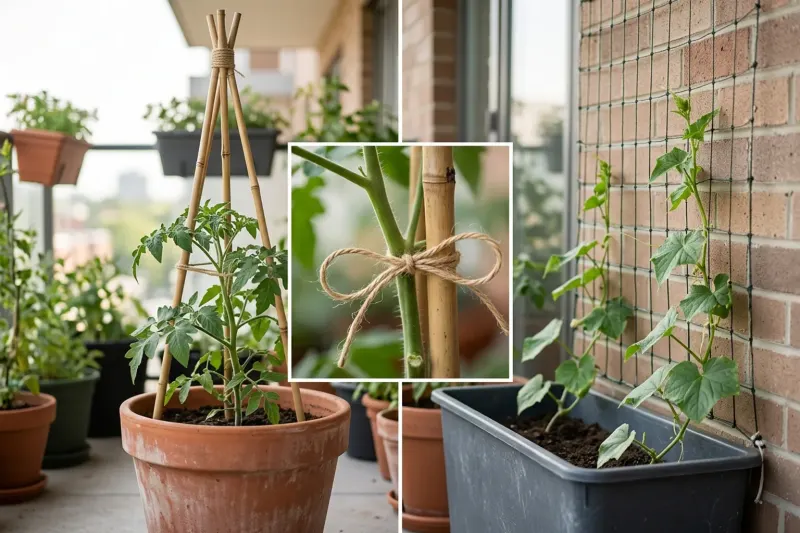
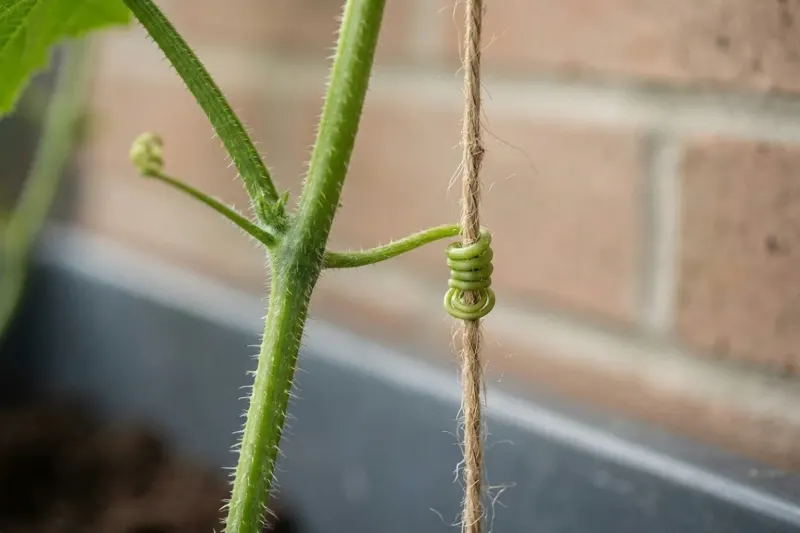
Cucumbers (Cucumis sativus) and garden peas (Pisum sativum) climb by producing tendrils. These specialized, touch-sensitive organs coil tightly around anything narrow they brush against. Peas develop tendrils at the ends of compound leaves, while cucumbers produce them at leaf axils. Both species need thin, grippable materials such as nylon trellis netting, wire mesh, or jute droplines. A wide 2-inch wooden post is too bulky for cucumber or pea tendrils to encircle. Tall vining pea cultivars often reach 5 feet and need netting or thin twine early in spring, whereas cucumbers climb rapidly through the warmth of summer. Training cucumbers upward keeps their leaves dry, lowering foliar disease pressure from powdery and downy mildew while keeping the fruit off damp soil where slugs feed.
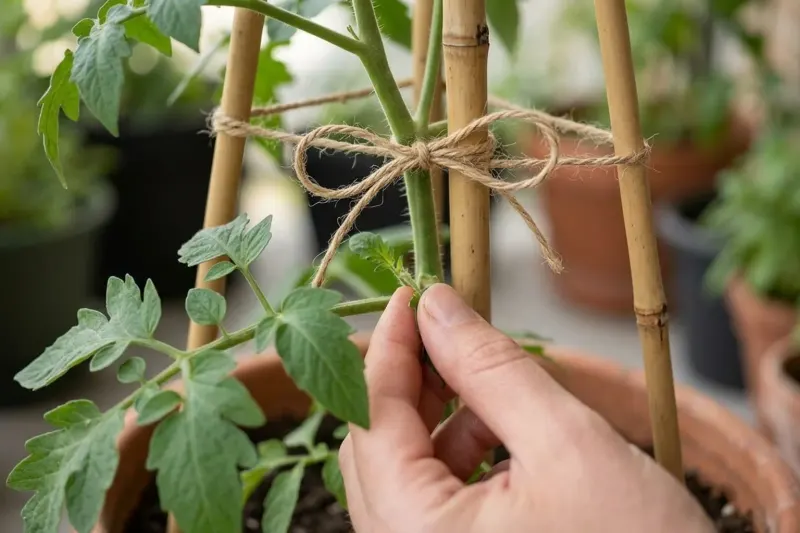
Indeterminate tomatoes (Solanum lycopersicum) are botanically scrambling vines rather than climbers. They possess neither coiled tendrils nor twining stems. Left unsupported, a vigorous indeterminate vine simply flops onto the potting mix and trails along the ground. To train tomatoes vertically, you must secure the main stems manually to a rigid wooden stake, a sturdy wire cage, or an overhead vertical dropline every 8 to 12 inches using loose, non-constricting ties or three-quarter-inch vine clips.
Related guide: Timing Container Vegetables Using Local Frost Dates
Container Sizing, Soil Depth, and Wind Stability
Trellising changes the physical balance of your planter. A leafy canopy standing 5 to 7 feet above the ground acts like a sail in gusty conditions. On elevated balconies and exposed patios, wind shear catches tall foliage and can easily flip lightweight or shallow pots. Stable vertical growing begins with matching container volume and base weight to mature plant size.
According to Colorado State University Extension, cucumbers require a container depth of at least 8 inches and roughly 3 or more gallons of potting mix per plant. Pole beans also need an 8-inch minimum depth, whether grown in individual pots or shared rectangular troughs. Sizing for tomatoes depends heavily on plant habit. Clemson Cooperative Extension and University of New Hampshire Extension note that while compact tomato cultivars can thrive in containers measuring 14 to 20 inches in diameter (roughly 4 to 5 gallons), large and vigorous indeterminate tomato vines demand at least 5 gallons or more of substrate per plant. Small-fruited vining melons similarly require at least 5 gallons of potting mix per plant to sustain their leaf area and root development.
Always fill containers with a lightweight, well-aerated potting mix formulated for container drainage rather than dense native garden soil, which compacts and drowns root systems in pots. Because commercial potting mixes are lightweight, a tall trellised plant can become top-heavy as it matures. To improve stability without impeding drainage, place a clean brick or flat paving stone at the base of the container before adding potting mix, making sure drainage holes remain clear. Where possible, push tall containers against an exterior wall or balcony railing and anchor the top of the trellis framework with weather-resistant ties to prevent tip-overs during summer storms.
Related guide: Pinching and Pruning Potted Herbs for Bushy Growth
Installing Supports Early to Protect Feeder Roots
A common mistake in container gardening is delaying support installation until a plant begins flopping over. By the time an indeterminate tomato or pole bean reaches 12 to 18 inches in height, its root system has already colonized the potting mix. Driving a wooden stake or metal post into an established root ball shears fragile feeder roots, causing transplant shock, reducing water uptake, and opening physical wounds where soil-borne pathogens can enter.
Extension specialists at the University of Missouri and North Carolina State University advise setting all stakes, cages, and vertical supports at planting time or within two to three weeks of transplanting at the absolute latest. When direct-seeding peas or beans, push your stakes or netting framework into the mix before sowing the seeds. If transplanting tomato starts, sink your stake into the potting soil first, roughly 4 inches away from where the root ball will sit, and then plant the seedling beside it.
For freestanding round containers such as 5-gallon buckets or whiskey barrels, a bamboo tripod or teepee made of three or four canes driven deep around the container rim provides self-bracing strength. Tying the canes securely together at the top distributes lateral wind loads across multiple base points, offering reliable structural stability without requiring wall fasteners.
Related guide: Attracting Pollinators to Balcony Vegetables
Pruning and Training Stems in Confined Spaces
Potting mix holds a finite volume of water and nutrients. Allowing a trellised plant to develop unchecked branches in a small container creates an overcrowded thicket of foliage that transpires water faster than the roots can replace it, causing severe midday wilting.
For container-grown indeterminate tomatoes, single-stem or double-stem training keeps growth orderly. Remove lateral shoots, commonly called suckers, which sprout from the leaf axils where the leaf stem joins the main stem. University of Missouri Extension recommends checking for and pinching suckers every 5 to 7 days while they are small and pliable. If you choose a two-stem system to increase fruit count, allow the vigorous sucker that develops directly below the first flower cluster to remain, and train it alongside the main vine on its own cane or vertical twine. Fasten stems to their uprights using sisal twine, soft cotton cord, or flexible garden ribbon tied in a loose figure-eight knot. The knot loop should grip the stake firmly while leaving a loose ring around the stem, cushioning the vine against friction and allowing room for the stem to expand in diameter.
With pole beans and cucumbers, vertical training improves airflow around the foliage, which reduces fungal infections and exposes flowers to visiting pollinators. Unlike indeterminate tomatoes, pole beans do not require shoot pruning or sucker removal; they climb continuously and naturally allocate growth along the support structure, provided the trellis offers 6 to 10 feet of vertical clearance as recommended by University of Minnesota Extension and University of California IPM.
Managing Fruit Weight and Sunlight Distribution
Vertical growing exposes crops to uniform sunlight and simplifies harvest, but fruiting climbers carry mechanical weight that can stress trellises. Small-fruited squash and vining melons can be grown vertically in containers, but University of Minnesota Extension notes that standard garden trellises should only support cultivars whose fruits mature at 3 pounds or less, such as delicata squash, acorn squash, or personal-sized cantaloupes. Large carving pumpkins and standard winter squashes are too heavy for standard container trellises and will tear loose from the vine or pull the support over.
When small melons or squashes reach the size of a tennis ball, support their weight by cradling each fruit in a flexible sling made of nylon pantyhose, mesh netting, or scrap cotton cloth. Tie the ends of the sling securely to the trellis framework rather than the plant vine, transferring the load directly to the vertical support.
Lighting orientation is equally important when arranging vertical planters. North Carolina State University Extension emphasizes that fruiting vegetables such as tomatoes, peppers, cucumbers, and beans require at least 6 hours of direct sunlight daily to flower and set fruit. Because tall trellises cast long shadows, position your tallest containers along the north or east boundary of your balcony or deck. This orientation ensures that towering vertical canopies do not shade lower-growing pots of compact peppers, bush herbs, or greens during peak afternoon sun exposure.
Trellis Selection by Crop Type and Upright Diameter
| Situation | Consider | Why |
|---|---|---|
| Growing indeterminate tomatoes in a 5-gallon container | Rigid 1- to 1.5-inch wooden stake or bamboo tripod with manual soft ties | Tomatoes have scrambling stems without tendrils or twining habits; they need sturdy vertical supports they can be physically tied to every 8 to 12 inches. |
| Growing slicing or pickling cucumbers in a 3- to 5-gallon pot | Nylon netting or thin wire cage with mesh openings | Cucumbers climb by curling touch-sensitive tendrils; they require slender cordage or wire under 0.5 inches that tendril coils can encircle. |
| Growing pole beans in an 8-inch deep trough | Vertical twine droplines or slender bamboo canes under 0.75-inch diameter | Twining bean stems climb by wrapping their main shoots around narrow uprights and cannot grip wide wooden stakes. |
| Growing small melons or delicata squash in a 5-gallon container | Sturdy welded wire frame supplemented with fabric fruit slings | Vines climb via tendrils, but individual fruits weighing between 1 and 3 pounds require supplemental slings tied to the frame to prevent vine damage. |
Hypothetical Balcony Planter Footprint and Spacing
In a hypothetical 120-by-60-centimeter (roughly 4-by-2-foot) balcony growing nook, space is planned to maintain wind security and full sunlight access. A deep rectangular planter measuring 65 cm wide by 25 cm deep holds two trellised cucumbers supported by vertical netting attached to wall hooks, positioned against the back perimeter where the tall canopy will not shade shorter crops. Beside it sits a 40-by-40-centimeter round pot housing a single indeterminate tomato plant supported by a three-cane bamboo tripod. The front floor space accommodates a 45-by-20-centimeter trough of compact bush herbs and a shallow 60-by-10-centimeter flat of loose-leaf greens, both receiving unshaded morning sun beneath the tall trellises.
- Trellised Cucumber Trough
- Teepee Tomato Pot
- Low Herb Container
- Greens Flat
When this approach is not a good fit
Vertical trellising is unsuitable for large winter squash varieties and standard pumpkins whose mature fruit weights exceed 5 to 10 pounds, as heavy fruit can collapse trellis frames and tear vines. It is also unsuitable for high-wind, unshielded rooftops when using lightweight, freestanding pots without wall tethering, as wind catching a full foliage canopy can topple containers regardless of pot volume.
PUT THIS GUIDE TO USE
Work with your own measurements
Sources & further reading
AI-assisted writing and concept images. Sources and automated checks support the process; they do not replace checking your own measurements.
How we create our guides · Suggest a correction