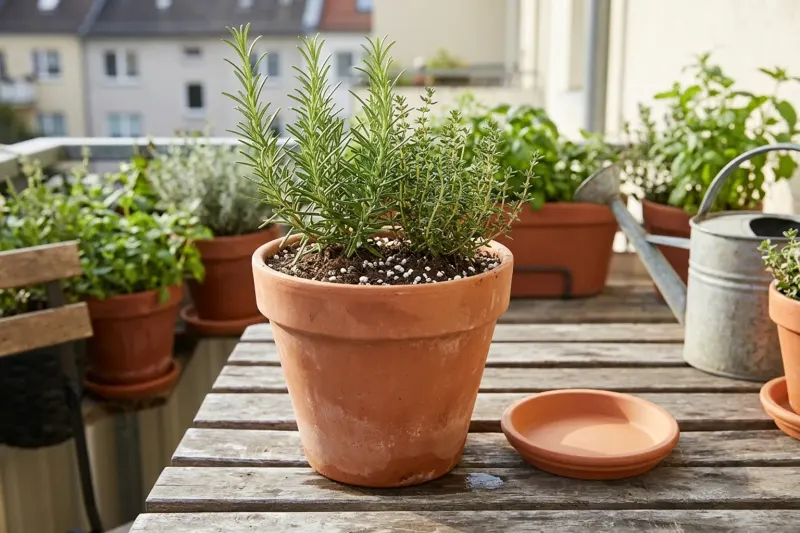
Choose a self-watering container only after grouping your herbs by their natural moisture tolerance. Sub-irrigated planters deliver continuous, bottom-up capillary moisture that suits soft-stemmed, leafy culinary annuals like basil, flat-leaf parsley, cilantro, and chives. If you plan to grow woody Mediterranean perennials such as rosemary, thyme, oregano, or lavender, bypass sub-irrigated planters entirely and choose standard containers with open bottom drainage holes. Mediterranean species require cyclical drying of their root zone; keeping their potting mix damp in an enclosed reservoir pot triggers fungal root rot within weeks. Once you separate moisture-loving herbs from drought-tolerant crops, selecting a balcony-ready self-watering planter comes down to three hardware requirements: an active overflow drain hole that prevents drowning from heavy rain, an isolated filling column, and a lightweight, porous potting mix engineered for capillary lift.
Herbs That Thrive with Sub-Irrigation Versus Those That Rot
Sub-irrigated planters operate through capillary action, where water stored in an isolated bottom reservoir moves upward into the potting medium through porous soil legs or synthetic wicking chambers. This capillary lift establishes a consistent moisture gradient throughout the root zone. Plants with high transpiration rates and fibrous root systems absorb this steady moisture without stress. According to the University of Minnesota Extension, culinary herbs vary sharply in their moisture preferences. Leafy annuals and biennials like sweet basil, flat-leaf parsley, cilantro, and chives develop tender foliage that loses moisture rapidly. On an exposed balcony where wind and afternoon sun accelerate evaporation, these leafy species often wilt within hours in conventional pots. In a sub-irrigated planter, their root systems continuously replenish moisture, sustaining steady vegetative growth without midday stress. In contrast, Mediterranean herbs evolved in thin, rocky soils that dry thoroughly between rains. Colorado State University Extension notes that herbs such as rosemary, thyme, culinary sage, and oregano demand well-drained media and suffer root suffocation when kept continuously damp. In a sub-irrigated planter, capillary wicking keeps the lower substrate near saturation, displacing oxygen from soil pores. Deprived of oxygen, woody root tips blacken and decay, leading to lower leaf drop and fatal fungal root rot. Never combine Mediterranean herbs with moisture-loving annuals in a shared sub-irrigated box.
Related guide: Preventing Root Rot in Container Herbs
Crucial Hardware: Overflow Holes and Reservoir Access
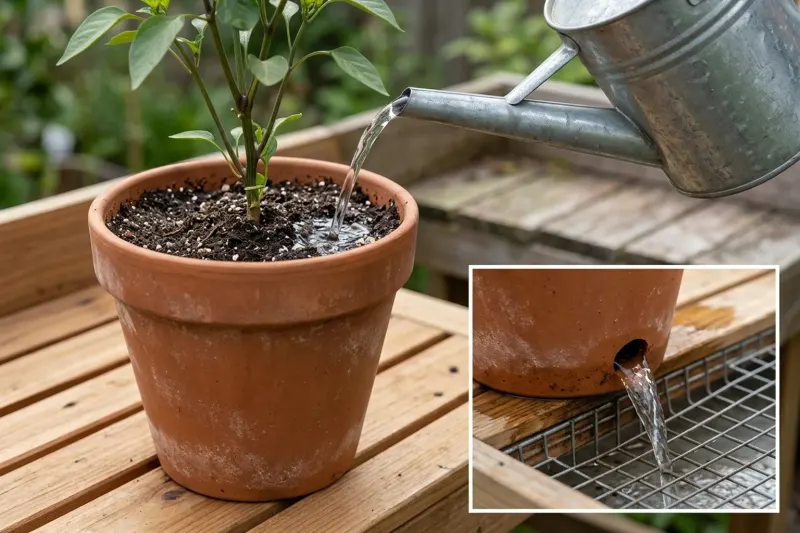
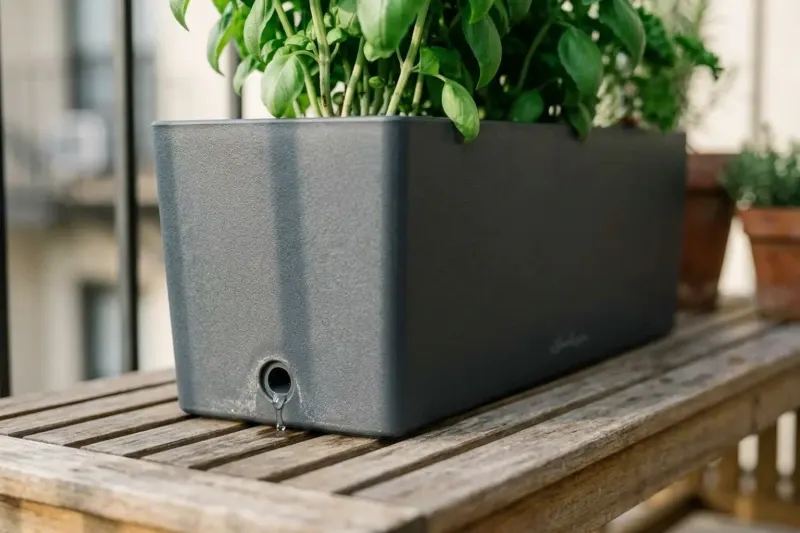
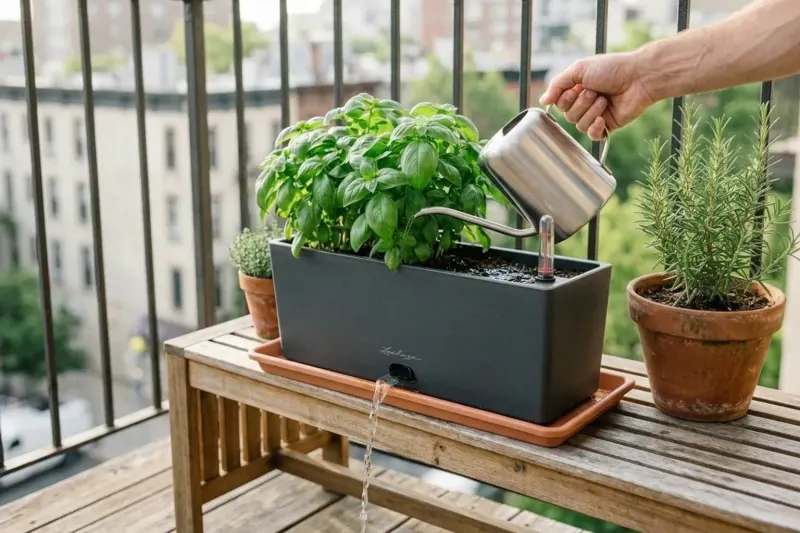
The single most critical mechanical feature of an outdoor self-watering planter is an active overflow drain hole. Indoor self-watering planters are often fully sealed tanks because irrigation is controlled entirely by the user. On an open balcony, however, seasonal rainfall pours directly into the top of the container. As explained by the University of Illinois Extension, container drainage is vital because waterlogged soils favor fungal root pathogens and suffocate root hairs. In an outdoor sub-irrigated planter, the overflow hole must sit through the planter sidewall precisely at or slightly below the level of the soil separator platform. When rain fills the reservoir to capacity, surplus water exits through the weep hole rather than backing up into the soil chamber. If you purchase a planter advertised for dual indoor and outdoor use, inspect the base carefully. You must remove the manufacturer rubber drainage plug or drill out the designated overflow knockout before setting the container on an exposed balcony. A functional planter also requires a dedicated fill pipe or visual water gauge. Pouring water directly down a vertical fill tube charges the reservoir without splashing water onto herb leaves. Fungal spores spread easily across wet foliage in confined balcony air, so bottom-filling helps keep leaves clean and dry. Floating water level indicators also eliminate guesswork, showing exactly when the reservoir needs replenishment.
Selecting Porous Soilless Media for Capillary Wicking
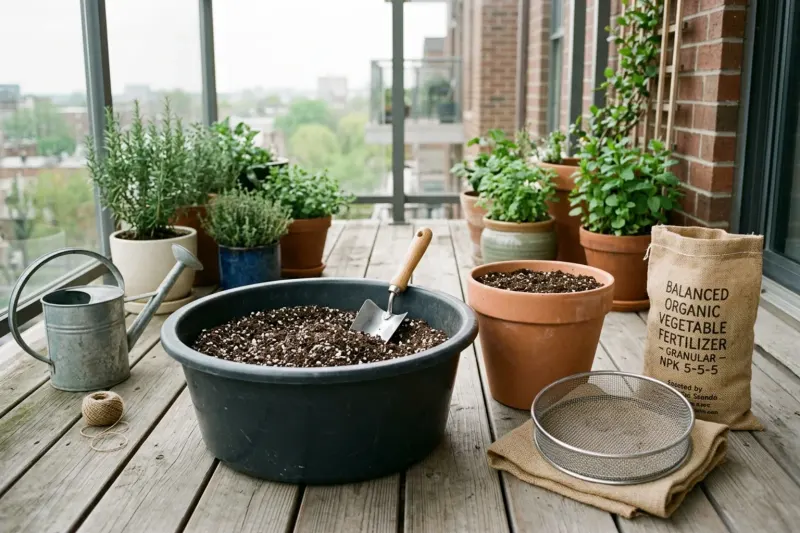
A self-watering container cannot function with ordinary garden topsoil or dense, unamended compost. Heavy mineral soil compacts under container conditions, collapsing macropores and halting capillary wicking. When wet, topsoil turns into a dense, muddy barrier that excludes air and drowns herb roots. Research from the University of Illinois Extension and K-State Research and Extension confirms that container herbs require a lightweight, porous soilless potting mix. For sub-irrigated planters, an optimal blend consists of coarse sphagnum peat moss or coconut coir blended with horticultural perlite or vermiculite. Coir and peat provide the micropores necessary to draw water upward against gravity from the reservoir, while perlite provides durable macropores that stay filled with oxygen even when the surrounding mix is moist. When loading the planter, pre-moisten the potting mix in a bucket before packing it into the wicking chambers or soil legs. Dry peat moss is naturally hydrophobic and repels water; if packed into wicking legs while bone dry, it will fail to start the capillary siphon. Firm the damp mix gently into the wicking wells to eliminate large air voids, then fill the remainder of the container loosely without excessive tamping.
Flushing Salts from Bottom-Fed Container Media
While sub-irrigated planters conserve water by cutting surface evaporation and eliminating runoff, their closed bottom design creates a specific chemical challenge: soluble fertilizer salt accumulation. In a traditional container with open drainage holes, every overhead watering leaches excess fertilizer salts, tap-water minerals, and sodium downward and out through the bottom. In a sub-irrigated planter, water only moves upward. As water wicks to the surface and evaporates, dissolved mineral salts remain behind in the top two to five centimeters (one to two inches) of the substrate. Over a few months of warm-weather feeding, these minerals build up into a visible white, crusty deposit on the soil surface. According to water management guidelines from the Resource Innovation Institute and container management data from Colorado State University Extension, unmanaged fertilizer salts elevate electrical conductivity in the root zone. High salt concentrations draw water backward out of root cells through osmosis, causing stunted growth and scorched, crispy leaf margins on tender herbs like basil. To prevent salt toxicity, establish a monthly top-down flushing routine: First, open the bottom reservoir drain plug or position the planter over an exterior balcony drain. Second, pour clean, unfertilized water evenly over the top of the potting soil until it thoroughly saturates the media. Third, continue pouring until roughly 10% to 20% of the applied volume drains freely out of the bottom overflow or service port. Finally, allow the planter to drain completely for thirty minutes before replacing the service plug and refilling the lower reservoir.
Related guide: Flushing Fertilizer Salts from Container Potting Mix
Balcony Structural Weight, Wind, and Material Limits
Small-space balcony gardening requires careful attention to physical loads and exposure limits. Sub-irrigated planters weigh significantly more than conventional dry pots because they hold both saturated potting mix and a standing reservoir of water at all times. NC State Extension points out that container materials affect root zone health, thermal fluctuations, and structural stability. Porous unglazed terracotta cannot be used for integrated self-watering reservoirs because the clay walls absorb and seep water outward, rapidly draining the reservoir. Commercial self-watering planters are typically fabricated from UV-stabilized polypropylene, high-density polyethylene, or glazed ceramics. For elevated balconies, food-grade polypropylene and resin troughs offer the best strength-to-weight ratio. Account for structural weight before setting up large planter boxes on older wooden decks or hanging planters from balcony railings. Water weighs approximately 1 kg per liter (8.34 lb per US gal). A 60 cm (24 in) planter holding 16 liters of saturated soilless mix and a 4-liter water reservoir will exert an operating load of roughly 15 to 18 kg (33 to 40 lb). If mounting planters directly onto a balcony railing, verify that the brackets are rated for this wet working weight and secure them with locking hardware to withstand balcony wind gusts.
Planter Selection Matrix for Balcony Herb Cultivation
| Situation | Consider | Why |
|---|---|---|
| Growing leafy culinary annuals (Sweet basil, flat-leaf parsley, chives, cilantro) in sunny balcony spots | Sub-irrigated planter (SIP) with integrated overflow weep port | Capillary action supplies uninterrupted root moisture to match high foliar transpiration and prevent midday wilting. |
| Growing woody Mediterranean perennial herbs (Rosemary, English thyme, culinary sage, oregano) | Standard terracotta or plastic pot with open base drainage holes | These species require a drying cycle between waterings; continuous bottom moisture leads to root rot (UMN Extension). |
| Growing vigorous, rhizomatous spreading herbs (Spearmint, peppermint) | Dedicated, isolated single-species sub-irrigated container | Mint thrives with constant reservoir moisture but will choke out companion herbs if planted in a shared box. |
| Mounting herb planters directly onto exposed apartment balcony railings | Lightweight UV-stabilized polypropylene trough with structural brackets | Reduces structural tare weight while the internal reservoir buffers against high wind desiccation. |
Hypothetical Balcony Setup: Calculating Water and Weight for a Two-Planter Herb Station
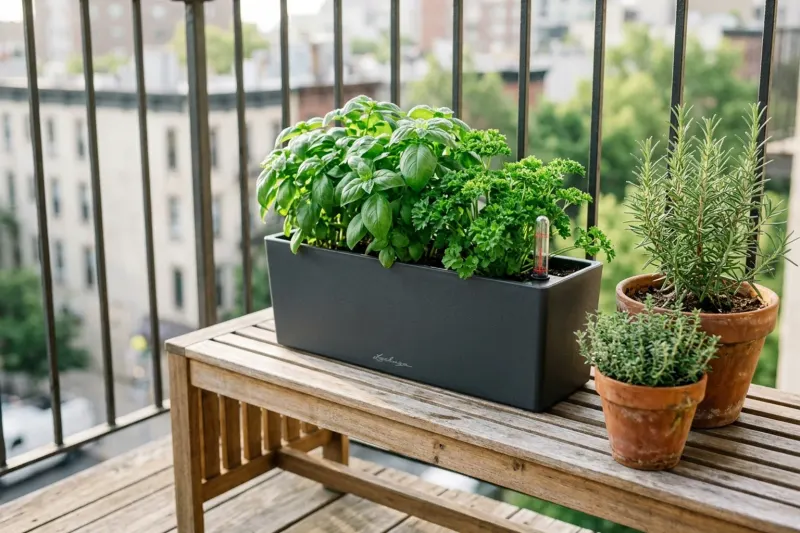
Consider a hypothetical small balcony setup on a sunny west-facing fourth-floor deck with a 120 cm (47 in) wide cedar planter shelf. To match herb physiology while managing weight limits, the gardener divides their herbs between two distinct systems: 1. Leafy Herb Station: One rectangular sub-irrigated planter measuring 60 cm wide by 25 cm deep by 22 cm tall (24 in x 10 in x 8.7 in). It features a perforated separator plate, a 4-liter (1.06 gal) bottom water reservoir, and a 16-liter (0.57 cu ft) potting mix chamber. The chamber is filled with a pre-moistened mix of 70% peat moss and 30% perlite. Saturated soilless mix weighs approximately 0.65 kg per liter (40.5 lb per cu ft), totaling 10.4 kg (22.9 lb). Adding the full 4.0-liter reservoir (4.0 kg / 8.8 lb) and the empty planter weight (1.6 kg / 3.5 lb) brings the total operating load to 16.0 kg (35.2 lb). Planted with three sweet basil starts and two flat-leaf parsley starts, this reservoir sustains uniform moisture through hot afternoons, requiring refills only every 3 to 4 days instead of daily top-watering. 2. Mediterranean Herb Station: Two standard 20 cm (8 in) diameter terracotta pots with open bottom drainage holes and matching catch saucers. Each pot holds 3.5 liters (0.12 cu ft) of potting mix amended with 30% coarse pumice or perlite, weighing roughly 2.8 kg (6.2 lb) when watered. Upright rosemary occupies one pot and English thyme occupies the other. These pots are watered manually from above only when the top 5 cm (2 in) of soil feels completely dry, preserving root aeration. The combined operating weight of both stations is approximately 21.6 kg (47.6 lb), safely distributed across the 120 cm shelf without overloading balcony railings.
- Sub-Irrigated Trough (Basil & Parsley)
- Clay Pot (Rosemary)
- Clay Pot (Thyme)
When this approach is not a good fit
Do not use self-watering containers for Mediterranean herbs (rosemary, thyme, lavender, sage) that require root-zone dry-down cycles. Avoid outdoor sub-irrigated planters that lack an integrated overflow weep hole, as unmonitored rainfall will flood the root aeration chamber. Do not install large reservoir planters on structural railings or suspended shelves without verifying that the total wet operating weight remains within structural safety ratings.
PUT THIS GUIDE TO USE
Work with your own measurements
Sources & further reading
AI-assisted writing and concept images. Sources and automated checks support the process; they do not replace checking your own measurements.
How we create our guides · Suggest a correction