You walk out to your patio or windowsill and notice your potted basil or rosemary wilting. Your first instinct might be to grab the watering can and drench the soil. But if the potting mix under the surface is already damp, pouring on more water only speeds up the plant's collapse. Container roots rely on open air pockets between soil particles just as much as they rely on moisture. When those pore spaces stay filled with water, dissolved oxygen disappears, root hairs suffocate, and soil-dwelling organisms attack the compromised tissue. Preventing root rot is not about keeping herbs parched. Instead, it is about balancing container drainage, substrate texture, pot depth, and sunlight so roots can take in oxygen between waterings. Understanding how moisture moves through pots helps you make confident adjustments before irreversible root damage occurs.
How Wet Soil Suffocates Roots
Plant roots are living tissues that breathe continuously. In a container, roots pull dissolved oxygen straight from the microscopic pores between particles of the potting substrate. When a pot receives water faster than it drains away or evaporates, gravitational water fills those void spaces completely, driving out ambient air. Without oxygen, cellular respiration stops. Within hours of sustained waterlogging, fine feeder root hairs begin to die, cutting off the plant's physiological ability to transport water and dissolved minerals upward into stems and leaves. This cellular collapse creates an ideal opening for opportunistic pathogens. Soil-dwelling water molds known as oomycetes, including species of Pythium and Phytophthora, thrive in cool, waterlogged growing media where root defenses are weakened. Opportunistic fungi like Rhizoctonia solani and Fusarium species can also invade decaying root tissues. According to Clemson University Cooperative Extension and Penn State Extension, these pathogens produce motile swimming zoospores and fungal threads that enter damaged root cells and destroy the root cortex. Once the vascular core of the root decays, the damage is irreversible. Fungicide drenches cannot restore collapsed vascular tissue in residential potted plants. The only effective defense is cultural prevention: providing open drainage paths and allowing the root zone to aerate thoroughly between water applications.
Related guide: Pinching and Pruning Potted Herbs for Bushy Growth
Telling Root Rot from Dry Soil
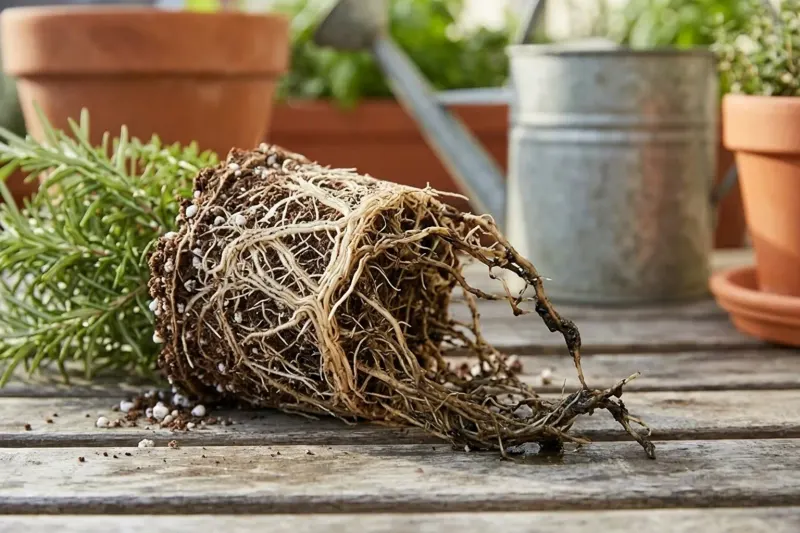
Because rotted roots can no longer pull moisture up into the plant, the foliage above ground wilts just as if the potting mix were parched. Container gardeners often mistake this drooping foliage for drought stress and immediately pour on more water, which accelerates the decay. Learning to spot the difference between underwatered and rotted herbs protects plants before root loss becomes terminal. Look closely at the foliage: an herb suffering from dry soil shows limp stems with dry, brittle, or curled leaf tips that recover after thorough watering, whereas an herb suffering from root rot displays soft, limp leaves accompanied by yellowing (chlorosis) that starts on older, lower leaves before advancing upward. Surface cues also tell a story: sustained dampness often encourages a greenish film of algae or small dark fungus gnats crawling across the top layer. Always perform a physical moisture test before watering by pushing your finger 1 inch (2.5 cm) into the growing mix; if the plant is wilting while the substrate feels cool, wet, and heavy, root rot is almost certainly the problem. Below ground, healthy herb roots are firm, fibrous, and white or cream-colored, while diseased roots appear dark brown or black, feel slimy, smell sour or swampy, and easily slough off when touched.
Related guide: Vertical Trellising for Potted Vegetables
The Perched Water Table Problem
Water behaves differently inside a pot than it does in open garden beds. In an open garden, gravity pulls water downward through deep soil layers unimpeded. Inside a container, downward gravitational pull is actively resisted by capillary tension—the physical attraction between water molecules and the surfaces of potting particles. Where gravitational pull and capillary tension reach equilibrium, a saturated layer of water settles at the very bottom of the pot. Horticulturists call this saturated band the perched water table. The height of this perched water table depends on the particle size of the potting medium, not the height or volume of the container. In a fine-textured peat mix, capillary pull is strong, often holding a saturated layer 2 to 3 inches (5 to 7.5 cm) deep at the base. In a deep 12-inch (30 cm) planter, that 2-inch saturated zone leaves 10 inches (25 cm) of well-aerated potting mix where herb roots can breathe and grow freely. In a shallow 4-inch or 6-inch (10 to 15 cm) container or window box, however, that exact same 2-inch saturated zone occupies half or more of the total soil volume. Adding a layer of gravel, broken pottery shards, or coarse stones to the bottom of the pot does not improve drainage. Research published by extension services, including the University of Illinois Extension, confirms that adding coarse material simply moves the perched water table higher up into the container, compressing the usable root zone even further. To maintain adequate root aeration in shallow containers, gardeners must rely on potting mixes with coarser particles like perlite or pine bark that create larger pores and reduce capillary lift.
Related guide: Flushing Fertilizer Salts from Container Potting Mix
Choosing Pots and Potting Mix
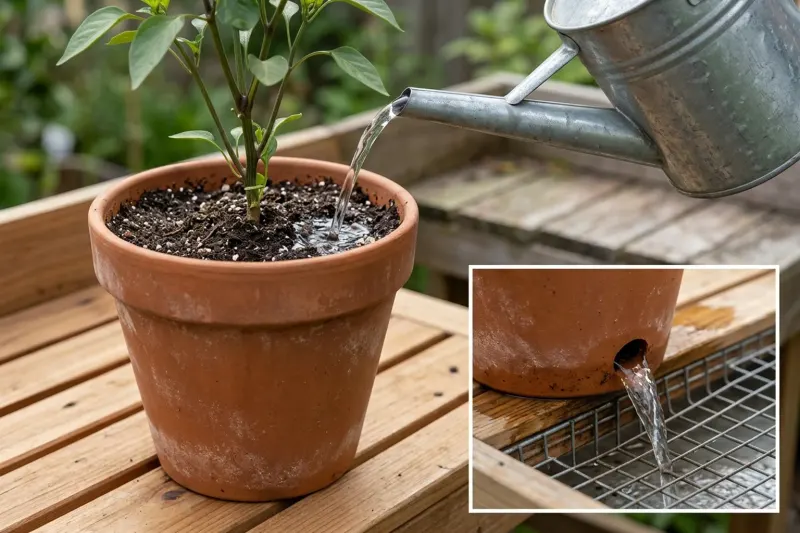
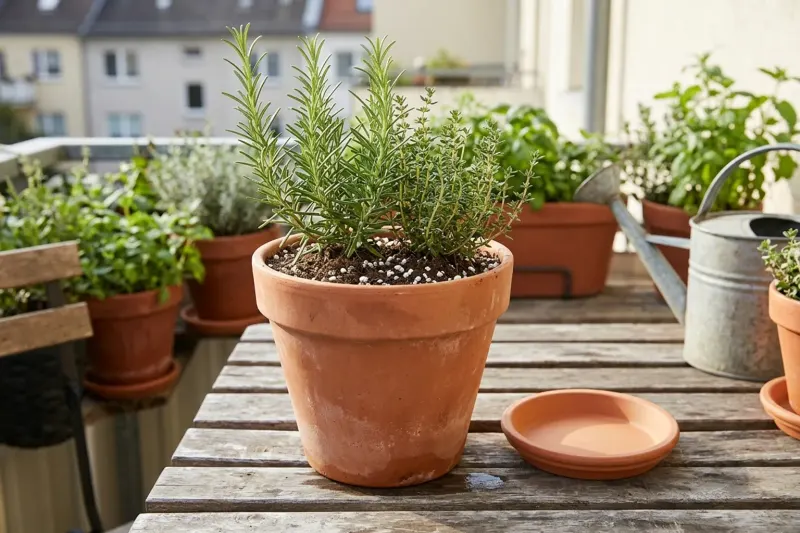
Preventing root rot begins with selecting the right container materials and potting mixes for your specific herbs. Never use native garden soil or heavy bagged topsoil in pots. Field soil contains fine silt and clay particles that pack together under repeated watering, sealing off pore spaces and suffocating root systems. Always use a loose, soilless potting blend made from sphagnum peat moss or coconut coir, combined with perlite, vermiculite, or aged pine bark to preserve aeration. Container materials directly influence how quickly moisture evaporates from the root zone: • Unglazed Terracotta: Porous clay allows air and moisture vapor to pass directly through the pot walls. Soil dries out more quickly and evenly, making terracotta an ideal match for drought-adapted Mediterranean perennials like rosemary, thyme, oregano, and sage. In hot, windy balcony locations, however, terracotta pots dry rapidly, requiring regular checks to avoid severe water deficits. • Plastic and Glazed Ceramic: Non-porous containers do not allow moisture to escape through their walls. Water leaves almost exclusively through bottom drainage holes and surface evaporation. These pots suit moisture-demanding leafy herbs like sweet basil, flat-leaf parsley, and cilantro, but they require disciplined watering habits because excess moisture lingers in the root zone. • Drainage Openings: Every herb container must feature functional, unobstructed drainage holes at the base. Pots without holes inevitably trap water, creating an anaerobic sump that destroys roots over time.
Saucers, Sun, and Daily Moisture Checks
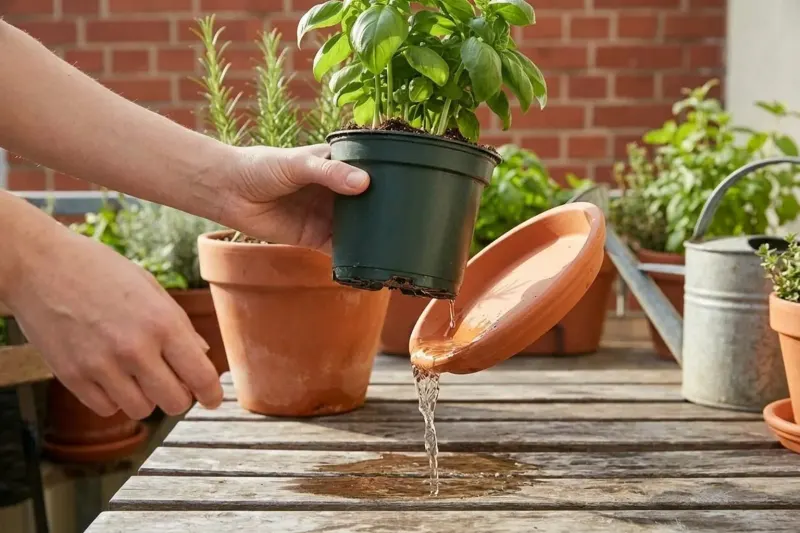
Even the most porous potting mix and well-drilled container will fail if daily watering practices let water sit. Catch trays and saucers protect indoor furniture and balcony decking from muddy runoff, but allowing a pot to rest in pooled water undoes your drainage efforts. Through capillary action, the lower soil column wicks standing water back up into the base of the pot, keeping the perched water table permanently saturated. Always empty saucers within 15 to 30 minutes after watering, or elevate containers slightly on pot feet so the pot base sits clear of standing runoff. Watering schedules should never be governed by a fixed calendar. Instead, monitor your microclimate and inspect the soil directly before watering. According to the University of New Hampshire Extension, most culinary herbs require at least 6 hours of direct sunlight daily. Strong sunlight and warm temperatures drive active plant growth and leaf transpiration, pulling water through the roots and opening soil pores quickly. On cloudy days, in cool autumn weather, or in shaded indoor spots, transpiration plummets, leaving potting soil saturated for days. Use the simple finger test: probe 1 inch (2.5 cm) deep into the potting mix. If the substrate feels cool, moist, and clings to your skin, delay watering. If the top inch feels dry, apply room-temperature water evenly across the soil surface until excess drips freely from the bottom holes, then empty the tray. For crop-specific planting and outdoor transition dates, consult your local county cooperative extension office, as microclimates and frost dates vary widely.
Drainage and Container Strategies by Herb Group
| Situation | Consider | Why |
|---|---|---|
| Woody Mediterranean herbs (rosemary, thyme, sage, oregano) | Unglazed terracotta pots with 25 to 30 percent coarse perlite blended into potting mix | Porous clay walls allow air exchange and moisture evaporation through the sides, matching the native dry-soil adaptations of Mediterranean perennials. |
| Tender annual herbs with high water use (sweet basil, cilantro, parsley) | Glazed ceramic or food-grade plastic containers with multiple base drainage holes | These herbs transpire water quickly, but non-porous pots still require free bottom drainage to prevent the perched water table from becoming stagnant. |
| Shallow planters and window boxes under 6 inches (15 cm) deep | Coarse, bark-heavy potting media and elevated pot feet under container corners | Shallow depth forces the saturated perched water zone to occupy a high percentage of container volume, requiring larger pore spaces for oxygen. |
| Pots with permanently attached plastic drip trays | Drill side drain holes along the tray rim or unclip and remove the saucer completely | Attached drip reservoirs trap stagnant water against bottom root tips, rapidly creating anaerobic conditions that kill herb roots. |
Hypothetical Scenario: Drainage Setup for a Balcony Herb Trough
Consider a hypothetical balcony window trough measuring 24 inches long by 10 inches wide and 7 inches deep (approximately 60 cm by 25 cm by 18 cm). This gives an internal volume of roughly 27 liters (0.95 cubic feet). To accommodate three separate culinary herbs—such as sweet basil, flat-leaf parsley, and cilantro—the grower plans the drainage system before adding soil. The grower drills four 0.5-inch (1.3 cm) drainage holes spaced evenly along the base. Instead of adding gravel to the bottom, which would push the perched water table higher into the root zone, the grower places small fiberglass mesh discs over each hole to hold the mix in place. The trough is filled with a custom blend: 60% peat or coconut coir potting mix, 25% coarse perlite to keep aeration channels open, and 15% composted fine pine bark. During warm summer weather, the grower waters thoroughly until water trickles out of the base, empties the drainage tray 20 minutes later, and checks that the top 1 inch (2.5 cm) feels dry before watering again.
- Sweet Basil Zone
- Flat-Leaf Parsley Zone
- Cilantro Zone
When this approach is not a good fit
These free-drainage techniques do not apply to sub-irrigated planter boxes (SIPs) or hydroponic systems, which use specialized water reservoirs, capillary wicking mats, or active air pumps. Furthermore, if an herb displays completely blackened, rotting root systems and collapsing main stems, cultural watering adjustments cannot revive it; discard the infected plant and potting mix to avoid spreading pathogens to neighboring containers.
PUT THIS GUIDE TO USE
Work with your own measurements
Sources & further reading
AI-assisted writing and concept images. Sources and automated checks support the process; they do not replace checking your own measurements.
How we create our guides · Suggest a correction