When summer sun beats down on an exposed balcony, dark plastic and resin containers act as heat sinks. Dark surfaces absorb solar radiation quickly, driving root-zone temperatures to levels that scald tender root hairs, stall nutrient uptake, and trigger sudden midday wilting. Gardeners often assume wilting plants need more water, but saturated potting mix combined with high root temperatures suffocates roots instead. You do not need to replace your black containers or attempt a risky midseason repotting. By applying targeted physical adjustments—double-potting with an insulating air gap, wrapping exposed container sidewalls, applying an organic surface mulch, and adjusting your watering timing—you can stabilize root-zone temperatures. These straightforward adjustments keep container crops healthy when balcony paving and railings heat up.
Why Dark Containers Overheat Roots
Container plants grow in a confined volume of growing medium elevated into ambient air and surrounded by reflective surfaces like glass doors, metal railings, and concrete decking. In an open garden bed, the surrounding earth disperses daytime heat, keeping sub-surface root temperatures moderate. An elevated container lacks that thermal buffer. Both the University of Illinois Extension and Oklahoma State University Extension emphasize that container color strongly affects soil temperature: dark pots absorb the majority of incoming solar wavelengths and convert them into heat, whereas light-colored vessels reflect solar radiation. When direct sunlight hits the thin wall of a dark container, thermal energy conducts straight into the outer perimeter of the potting mix. This perimeter is precisely where root tips and fine feeder hairs congregate to access oxygen. At elevated temperatures, these delicate tissues suffer damage and stop taking up water. When the plant cannot move water upward to replenish leaf transpiration, foliage droops and scorches even if deeper soil remains damp. Addressing exterior heat on the pot itself is the necessary first step.
Double-Potting with an Insulating Air Gap
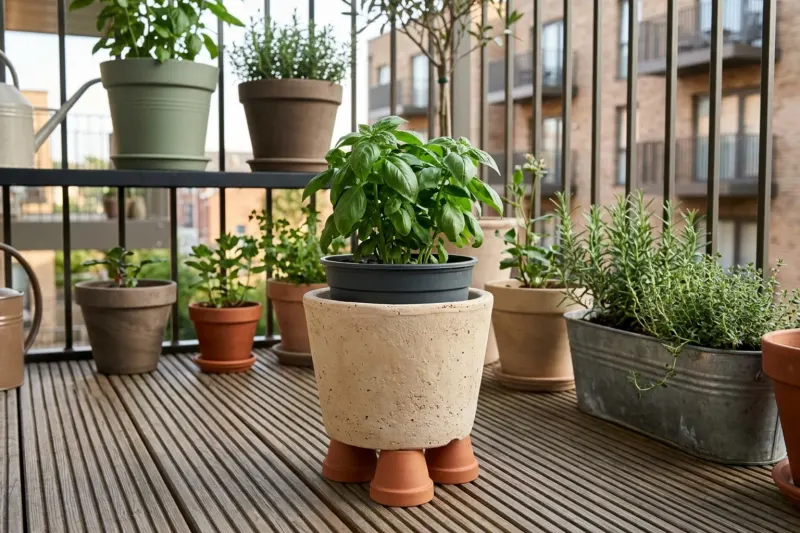
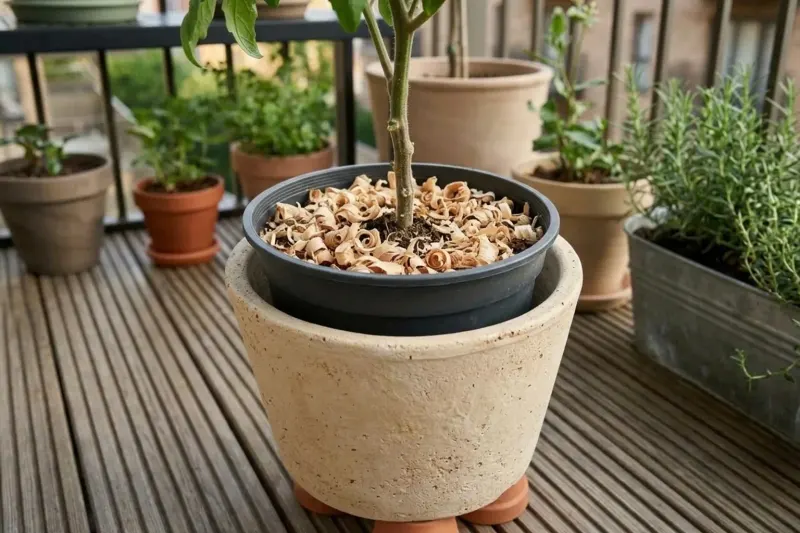
Double-potting, or nesting, shields roots without disturbing an established root ball. You keep the plant growing in its original dark plastic container and slip it inside a slightly larger, light-colored outer vessel, often called a cachepot. The pale outer wall reflects direct sunlight, while the space between the two containers forms an insulating dead-air buffer that slows heat transfer to the inner pot. This practice adapts a commercial nursery method. Research published by Rutgers New Jersey Agricultural Experiment Station (Rutgers NJAES Fact Sheet FS519, hosted by University of Tennessee Extension) evaluated pot-in-pot nursery production. Dr. Gladis Zinati demonstrated that nesting nursery containers reduced root-zone temperatures by 13°C to 19°C (23°F to 34°F) compared to single pots exposed above ground. Balcony growers should note an important distinction: the Rutgers study tested in-ground socket containers, where surrounding field soil absorbed excess heat. An above-ground cachepot on a balcony cannot deliver that same geothermal cooling, but it reliably shades the inner pot from direct solar radiation and limits conductive heat gain. Select an outer container that provides 1 to 2 inches (2.5 to 5 cm) of clearance around the inner rim. Confirm that both pots feature unobstructed drainage holes so irrigation water never pools around the base.
Shading Sidewalls and Elevating Pots
If a container is too wide, heavy, or irregularly shaped to double-pot, you can shade the sidewalls directly. Wrapping dark plastic containers in pale, breathable coverings offers an inexpensive, lightweight solution. Light-toned burlap, untreated canvas, or rolls of reed screening can be wrapped around the container perimeter and tied securely with natural jute twine. These materials reflect direct sunlight and create a small exterior air cushion without adding substantial dead weight to balcony load limits. Avoid wrapping containers in dark plastic sheeting or solid rubber wraps, which absorb heat and trap warm air against the pot wall. Balcony layout also provides natural shade. Group your containers so that broad, heat-tolerant crops growing in pale containers—such as bush squash, rosemary, or upright ornamental grasses—sit along the sunniest forward edge. Place your dark pots holding sensitive crops behind them. The foliage canopy and outer vessel of the front plant cast moving shade across the dark sidewalls of the rear containers throughout the afternoon. Floor contact is another overlooked heat path. Concrete slabs, stone pavers, and dark composite decking absorb heat all day and radiate it into the night. Elevating containers on terracotta pot feet, cedar shims, or wheeled plant caddies creates a 0.5- to 1-inch (1.3 to 2.5 cm) air gap underneath, breaking direct thermal conduction and maintaining airflow beneath drain holes.
Related guide: Protecting Balcony Container Vegetables from Wind
Top-Dressing with Mulch
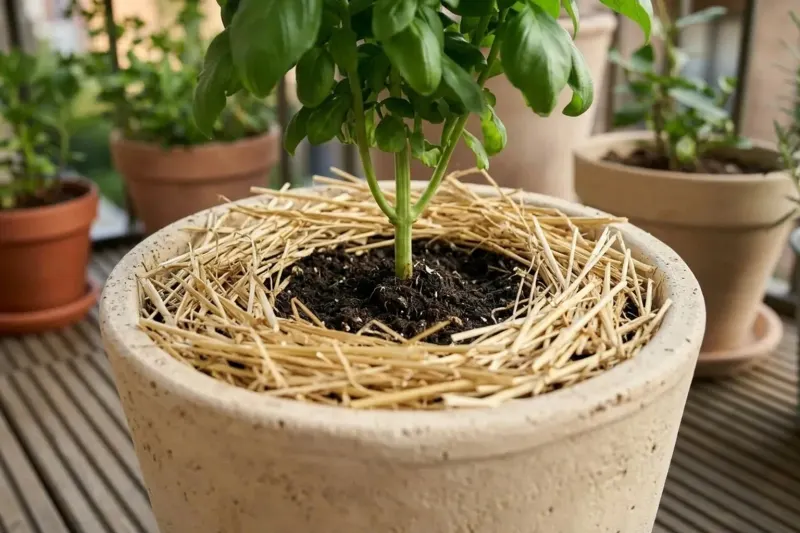
Direct sun beating down on bare potting mix bakes the top two inches of substrate, forming a dense crust that sheds water and overheats shallow feeder roots. Both the University of California Agriculture and Natural Resources (UC ANR) and South Dakota State University Extension recommend applying organic mulch over soil surfaces to shield root zones from temperature extremes and conserve soil moisture. In-ground garden beds often use 4 to 6 inches of mulch, but container gardeners must calibrate mulch depth to container volume. Adding too much mulch reduces usable air space and can bury the plant's root crown. A 1-inch (2.5 cm) layer of light-colored organic material—such as shredded cedar shavings, clean straw, or coarse pine bark chips—provides ample thermal insulation for containers 5 gallons (19 liters) and larger. Pale mulch reflects incoming solar energy away from the substrate surface and sharply reduces evaporative water loss. Pull the mulch back at least 0.5 inches (1.3 cm) away from the main stem, crown, or root flare. Resting wet organic mulch against tender green stems traps moisture and creates conditions that invite fungal crown rot.
Watering Timing and Hose Temperature Hazards
Shading and mulching stabilize container soil, but your watering practices determine whether roots survive prolonged summer heatwaves. UC ANR advises watering container plantings deeply in the early morning before peak daytime temperatures arrive. Morning irrigation charges the root zone with moisture before ambient heat rises, allowing plants to cool their foliage through natural transpiration throughout the afternoon. Avoid automatic watering schedules during high heat. Always test the growing medium first by inserting a finger 2 inches (5 cm) deep into the mix. If the substrate below the mulch feels moist and cool, postpone watering. When soil pore spaces remain waterlogged in hot weather, roots cannot take in oxygen. Overwatering a heat-stressed plant suffocates fine roots and accelerates root rot, producing wilting symptoms that look deceptively like drought stress. UC ANR also highlights a specific, dangerous hazard: water left inside garden hoses or watering wands exposed to full balcony sun heats up rapidly, reaching temperatures that can instantly scald root systems and foliage. Before watering containers, turn on the hose and direct the initial discharge into a bucket or floor drain until the stream runs cool to the touch. That collected warm water can cool down for later use or household cleaning tasks.
Related guide: Choosing Self-Watering Planters for Balcony Herbs
Methods for Protecting Hot Container Root Zones
| Situation | Consider | Why |
|---|---|---|
| Small to medium dark pots under 5 gallons (19 liters) in direct afternoon sun | Nest inside a light-colored outer cachepot | Provides immediate sidewall shading and an insulating air gap without requiring midseason repotting. |
| Large dark planters exceeding 10 gallons (38 liters) that cannot easily be lifted | Wrap sidewalls with light burlap or reed matting | Deflects direct solar radiation from exterior plastic walls without adding secondary container weight. |
| Balconies with hot concrete or composite decking under continuous midday sun | Install pot feet and stage smaller pots behind taller light planters | Pot feet break conductive floor heat transfer, while forward foliage casts protective shade on rear pots. |
| Potted plants showing surface soil crusting and rapid midday moisture loss | Apply a 1-inch (2.5 cm) layer of shredded wood or straw mulch | Insulates upper feeder roots from radiant heat while conserving moisture, provided the plant crown remains unburied. |
Hypothetical Balcony Container Retrofit
Consider a hypothetical scenario featuring a 5-gallon (19-liter) black polyethylene container holding a bush tomato plant on an exposed south-facing concrete balcony in USDA Zone 8. The container measures 12 inches (30 cm) across the rim and 11 inches (28 cm) deep. Midday sun strikes the dark sidewall continuously for five hours. Rather than disturbing the expanding root system by transplanting, the gardener slips the black pot into a 14-inch (36 cm) diameter pale tan resin cachepot, creating a 1-inch (2.5 cm) insulating perimeter air gap between the two container walls. The gardener verifies that both pots have clear drainage holes. Next, the gardener adds a 1-inch (2.5 cm) layer of clean cedar shavings over the soil surface, pulling the shavings 0.5 inches (1.3 cm) back from the tomato stem. Finally, the nested planter is set onto three 0.75-inch (2 cm) terracotta pot feet to decouple it from the hot concrete floor. This hypothetical configuration shades the pot sidewalls, cools the substrate surface, and allows airflow underneath without requiring specialized construction.
- Light Ceramic Pot (Shade Barrier)
- Pale Resin Container (Shade Barrier)
- Double-Potted Dark Planter
- Burlap-Wrapped Dark Pot
- Perimeter Airflow Path
When this approach is not a good fit
This method is unsuitable for containers already suffering from advanced root rot caused by dense, waterlogged potting mix, where wrapping pots or adding outer sleeves without improving internal drainage traps excess moisture. It is also unsuitable for narrow railing planters whose structural mounts or safety weight limits cannot accommodate the added width or load of nested cachepots.
PUT THIS GUIDE TO USE
Work with your own measurements
Sources & further reading
AI-assisted writing and concept images. Sources and automated checks support the process; they do not replace checking your own measurements.
How we create our guides · Suggest a correction