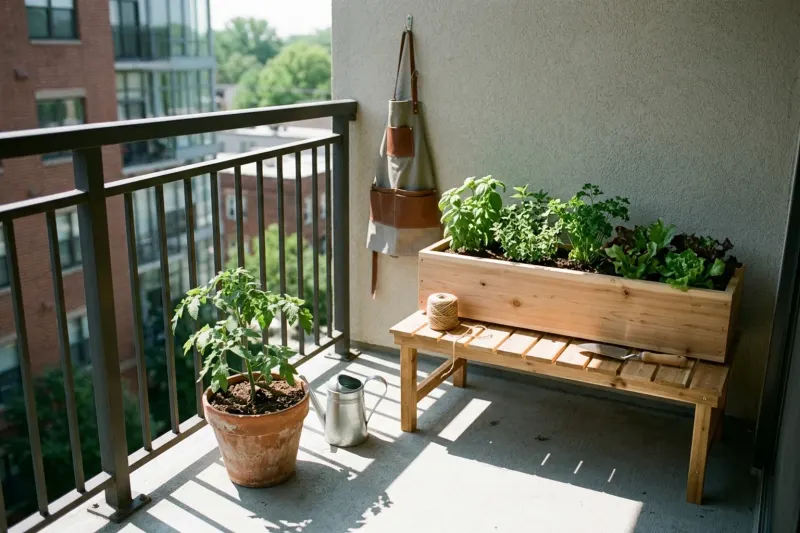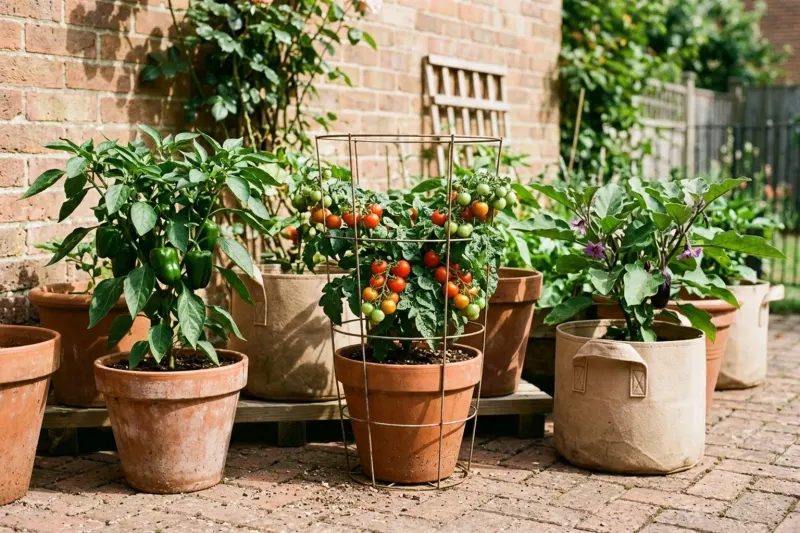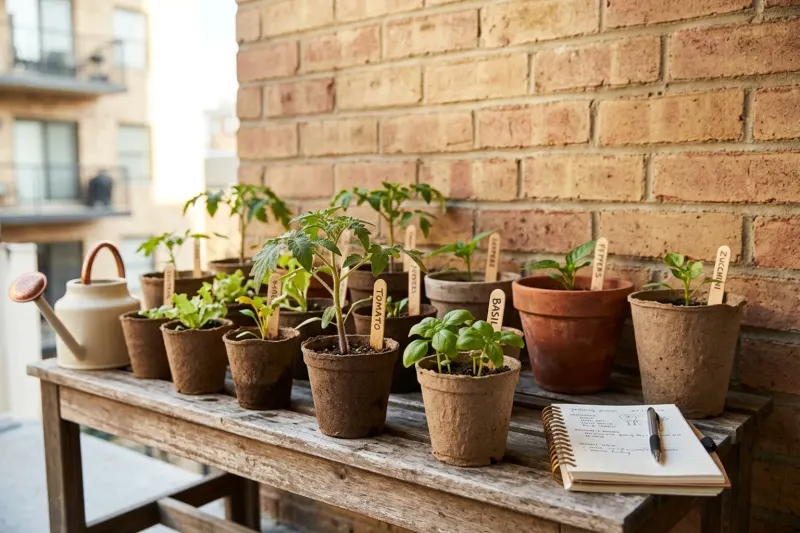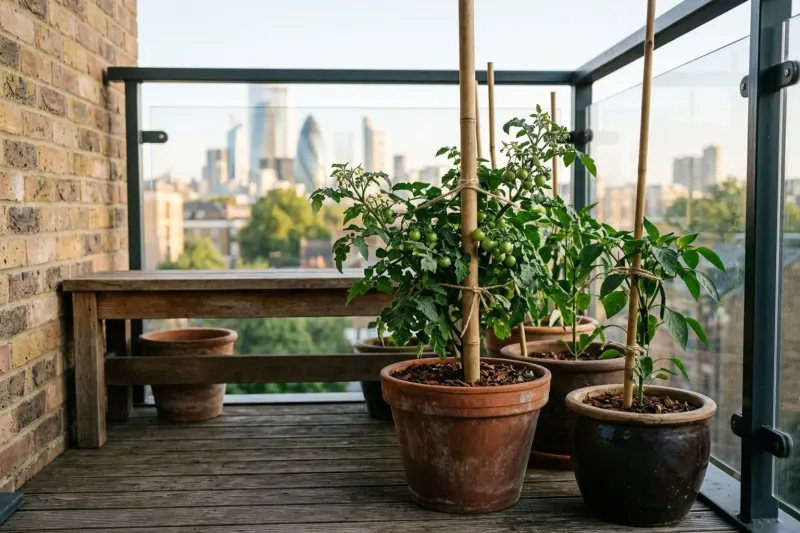
Elevated apartment balconies and high-rise decks present a demanding microclimate for growing vegetables. Air speeds increase as wind moves past multi-story buildings, turning a gentle street-level breeze into strong gusts that can flip top-heavy pots, snap tender stems, and strip foliage of essential moisture. Protecting balcony container crops from wind requires thoughtful planning rather than rigid barricades that act like sails. By choosing broad-bottomed containers, keeping plant profiles low with dwarf varieties, grouping planters against sturdy building walls, and using breathable wind barriers, you can prevent toppling and reduce moisture stress. Wind management on an exposed balcony balances three core factors: the physical shape and ballast of your pots, the mature size and structure of your vegetable varieties, and the protective micro-zones created by your building layout.
Container Shape and Physical Stability
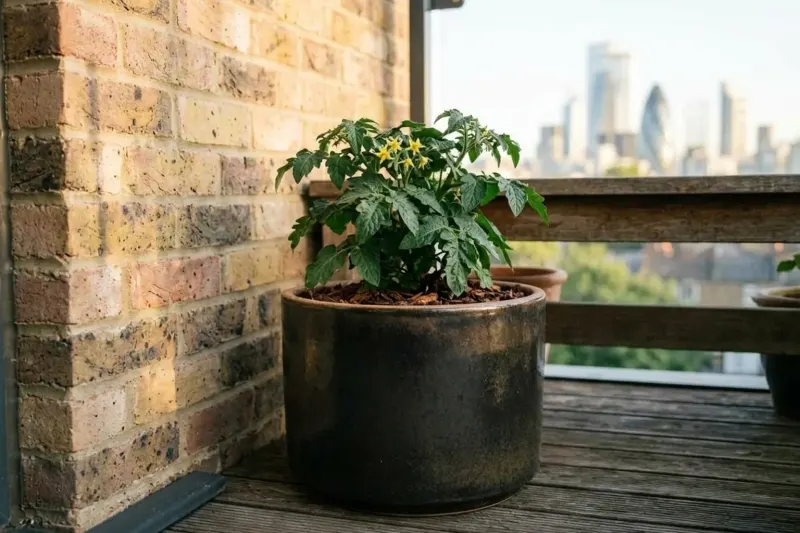
The shape of your planter directly determines how well it stands up to gusty winds, but stability requirements often compete with the root-depth needs of vegetable crops. University of Illinois Extension explains that container geometry plays a major role in tipping risk: square planters provide the greatest stability, while straight-sided cylindrical pots stay upright far better than traditional tapered flowerpots shaped like inverted cones. Tapered containers have narrow bases that create a high center of gravity, leaving them prone to toppling when wind catches the foliage of a mature crop. To minimize tipping from geometry alone, University of Illinois Extension recommends choosing planters with a base broader than the pot height, or securing tall containers with mechanical ties on exposed balconies. However, fruiting vegetables require substantial vertical root space. Penn State Extension specifies that containers for vegetable gardening must be at least as tall as they are wide, recommending minimum pot widths of 20 inches (51 cm) for single tomato plants and at least 14 inches (36 cm) for peppers and eggplants. These proportions create a distinct challenge: making a pot at least as tall as it is wide produces a higher center of gravity than the wind-stability guideline of having a base broader than the pot height. Balcony growers cannot simply switch to shallow, squat containers for tomatoes or eggplants without restricting the root volume needed for healthy crop development. To reconcile these competing requirements, Penn State Extension notes that heavy materials like stone, concrete, and thick glazed stoneware supply the necessary ballast to keep tall, top-heavy plants from blowing over. Alternatively, growers can select extra-wide planters where the base is broader than the height while still maintaining adequate depth, or mechanically anchor tall containers as Illinois Extension suggests. Always verify your balcony structural load limits with building management or an engineer before introducing heavy stone, concrete, or large masonry pots, as elevated structures have strict weight capacities.
Related guide: Mapping Balcony Sun Hours for Container Crops
Substrate Density and Drainage Trade-Offs
The growing medium inside your planters must serve two opposing functions: providing structural ballast against the wind while maintaining porous aeration for root health. Virginia Cooperative Extension points out that lightweight peat-perlite mixes lack the physical density needed to hold roots firmly in place, meaning strong winds can easily topple lightweight pots and tear delicate root systems. To add ballast, Virginia Tech suggests that a growing medium containing one part garden loam, one part peat moss, and one part coarse sand provides the physical heft needed to steady planters during windy conditions. However, adding garden soil to containers introduces serious drainage trade-offs. Penn State Extension warns that unamended garden soil compacts tightly inside container walls, suffocating fine feeder roots and blocking drainage holes. To maintain both wind stability and root health, container gardeners can use double-potting techniques. Plant your vegetables in lightweight plastic nursery pots filled with a porous, well-draining soilless potting blend, then nest those containers inside heavier outer pots made of glazed ceramic or concrete. You can also place clean, dense stones or heavy bricks in the bottom of the outer cachepot, as long as the drainage holes of the inner container remain unobstructed. This strategy lowers the pot center of gravity without restricting drainage or suffocating root systems with compacted yard dirt.
Selecting Naturally Compact Cultivars
Plant breeding and architecture offer some of the most effective protection against wind damage on exposed balconies. Colorado State University Extension notes that taller crops require substantially heavier containers to keep from tipping in the wind. To reduce wind resistance and minimize the need for tall stakes or trellises, CSU Extension recommends selecting vegetable cultivars specifically bred for small spaces, usually identified on seed packets and plant tags by terms like bush, patio, dwarf, or compact. For balcony vegetable growers, Colorado State University Extension highlights compact varieties including 'Patio' and 'Tiny Tim' tomatoes, 'Spacemaster' cucumbers, and 'Morden Midget' eggplants. Determinate dwarf tomatoes develop thick, stocky main stems that generally stay under 24 to 36 inches (61 to 91 cm) in height, keeping their fruit and canopy low to the deck where wind speeds are slower. In contrast, standard indeterminate vining tomatoes produce expansive vertical canopies that catch passing breezes like sails, placing heavy mechanical strain on stakes and frequently pulling over light pots. Bush beans, compact sweet peppers, and dwarf summer squash stay naturally close to the ground, significantly reducing the lateral leverage that wind can exert against container stems.
Balcony Placement and Windbreaks
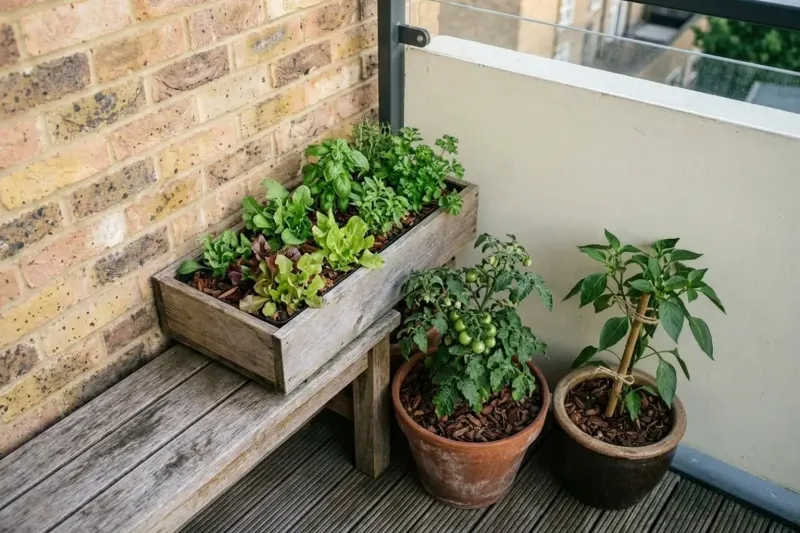
Where you position containers across your balcony determines how much wind pressure your vegetables endure. Wind speeds are consistently highest along the outer perimeter railing and around open corners where gusts whip around the building structure. Placing planters directly against the primary interior building wall takes advantage of the sheltered dead-air boundary layer created by the structure. Grouping multiple pots tightly together creates a communal windbreak, allowing neighboring plant canopies to buffer each other and reducing air movement around the soil surface. How you handle your balcony railing is equally critical. Installing solid sheets of plywood, acrylic, or rigid plastic against an open railing can actually worsen wind problems: solid barriers force incoming airflow up and over the top, generating turbulent downward eddies on the balcony deck. Instead, choose a semi-porous windscreen, such as woven horticultural netting, breathable shade fabric, or reed fencing attached securely to the railing balusters. Semi-permeable screens filter the breeze and reduce air speed without creating turbulent vortices. Arrange containers in tiers: place low-growing, flexible herbs and root crops closest to the railing, and place taller dwarf fruiting vegetables deeper into the sheltered interior near the wall.
Related guide: Vegetables for a Sunny Patio: Choose by Space and Care
Preventing Rapid Wind Desiccation
Wind causes just as much damage through moisture loss as it does through broken stems. Cornell Cooperative Extension explains that moving air significantly accelerates plant water demand, speeding up transpiration through the foliage and causing sudden daytime wilting. On an open balcony, continuous air movement strips away the humid air boundary that normally clings to the leaf surface, pulling moisture out of the root system faster than the plant can absorb it. Clemson Cooperative Extension emphasizes that containers have restricted soil volumes and dry out exceptionally fast under combined heat and air movement. During breezy weather, container soil can dry out completely within hours, even if you watered thoroughly that morning. To slow this water loss, apply a 1-inch (2.5 cm) layer of organic mulch, such as shredded bark, arborist chips, or clean straw, across the surface of the potting mix to suppress surface evaporation. Check container moisture twice a day during windy periods by pressing your finger 2 inches (5 cm) deep into the potting mix. Soak the container thoroughly until excess water runs freely from the drainage holes whenever the top inch feels dry, and avoid letting pots sit in stagnant runoff trays for extended periods.
Related guide: Hardening Off Seedlings on Porches and Balconies
Severe Storm Staging and Relocation
When local weather forecasts warn of severe thunderstorms, high-wind advisories, or approaching gale-force winds, everyday wind precautions are rarely sufficient. Virginia Cooperative Extension recommends temporarily moving container plantings to protected, sheltered locations during severe storms to avoid physical breakage, hail damage, and soil washout. Develop a clear staging routine before bad weather arrives so you can protect your balcony crops quickly and safely. Move portable containers off elevated plant stands and place them flat on the balcony floor, tucked deep into the most sheltered interior corner against the building wall. If you have tall potted vegetables that cannot be brought indoors, an optional grower tactic suggested by experienced balcony gardeners is to lay the containers on their sides along the wall, orienting foliage downwind so gusts blow over rather than snapping main stems; keep in mind that this is an informal practical workaround rather than an extension-verified procedure, and stems must be carefully supported to avoid snapping branches under their own weight. Unhook hanging baskets and take down railing saddle planters, bringing them indoors or setting them on the floor away from drainage scuppers. Check that all bamboo stakes, wire cages, and plant ties are firmly anchored, and secure lightweight trellises to solid balcony walls using removable straps to keep individual branches from flexing to the point of mechanical failure.
Balcony Wind Mitigation Decision Matrix
| Situation | Consider | Why |
|---|---|---|
| Selecting container geometry for tall fruiting crops on an exposed balcony | Use heavy stone or ceramic containers that meet crop depth requirements (at least as tall as wide) and anchor them, or select extra-large troughs with bases broader than their height | Penn State Extension requires pots to be at least as tall as they are wide for proper root volume, whereas University of Illinois Extension notes that tipping risk is minimized when base width is broader than pot height. Heavy ballast or mechanical strapping reconciles root depth with wind stability. |
| Picking crop cultivars for balconies subject to regular gusty winds | Plant compact bush or dwarf varieties like 'Patio' tomato or 'Spacemaster' cucumber | Colorado State University Extension recommends compact cultivars to lower the foliage sail profile and reduce mechanical staking needs. |
| Balancing pot ballast against root aeration in lightweight potting mix | Double-pot into a heavy outer cachepot or place stones in the outer base | Penn State warns against using heavy unamended garden soil that compacts roots, while double-potting provides needed weight without impairing drainage. |
| Filtering strong air currents pushing through an open balcony railing | Fasten semi-porous mesh fabric to the railing and group pots near the inner wall | Permeable screening reduces wind speed without creating the violent downward air turbulence caused by solid plastic or wood barriers. |
Hypothetical Balcony Wind Management Layout
Consider an urban balcony measuring 8 feet wide by 4 feet deep (240 cm by 120 cm) located on an exposed fifth-floor apartment facing afternoon gusts. In this hypothetical layout, two heavy stoneware cylindrical planters measuring 20 inches (51 cm) wide hold dwarf 'Patio' tomatoes, one 18-inch (46 cm) square planter houses a 'Morden Midget' eggplant, and two rectangular trough planters measuring 35 inches long by 12 inches wide (89 cm by 30 cm) contain bush beans and salad greens. The estimated hypothetical cost is $130 to $180 for containers, soilless media, mulch, and seedlings. By placing all large fruiting crops against the solid interior apartment wall and keeping low-profile troughs 12 inches (30 cm) back from the railing, the garden limits wind exposure and requires roughly 10 to 15 minutes of daily moisture checks.
- Low herb trough planter
- Heavy stoneware dwarf tomato pot
- Square compact eggplant container
- Low-profile bush bean trough
- Clustered salad green planter
When this approach is not a good fit
This container wind management strategy is unsuitable for cantilevered balconies with structural weight limits that prohibit heavy stoneware pottery, properties where tenant leases or homeowner associations forbid railing attachments, or high-rise balconies above the fifteenth floor where extreme wind shear requires fully enclosed solariums.
PUT THIS GUIDE TO USE
Work with your own measurements
Sources & further reading
- University of Illinois Extension - Container Size and Stability
- Penn State Extension - Container Vegetable Gardening: Four Keys to Success
- Virginia Cooperative Extension - Vegetable Gardening in Containers
- Colorado State University Extension - Container Gardens
- Cornell CALS - Vegetable Gardening in Containers
- Clemson Cooperative Extension - Container Vegetable Gardening
AI-assisted writing and concept images. Sources and automated checks support the process; they do not replace checking your own measurements.
How we create our guides · Suggest a correction