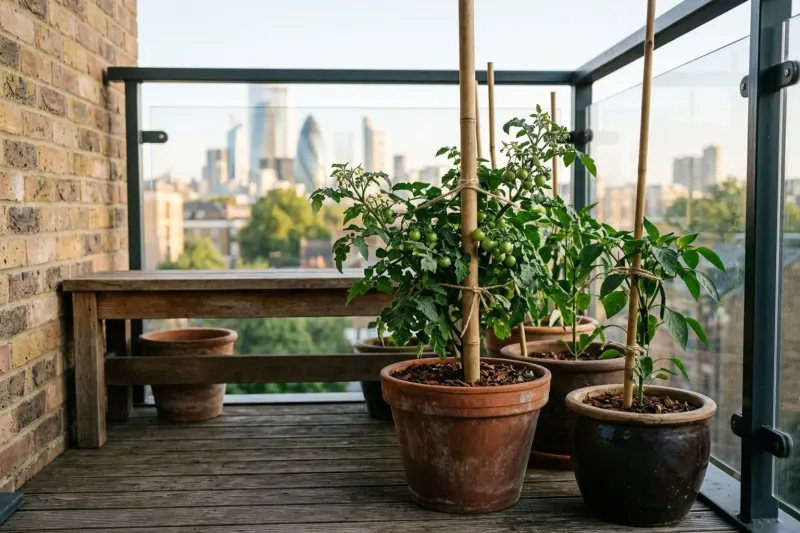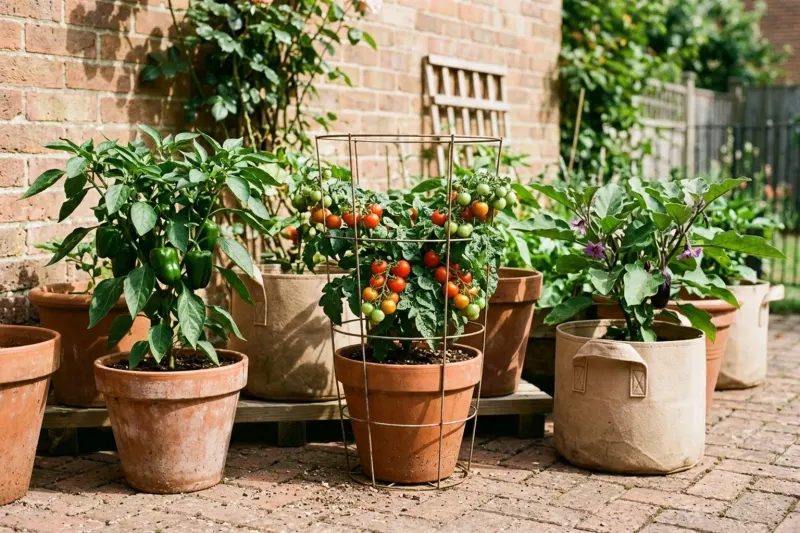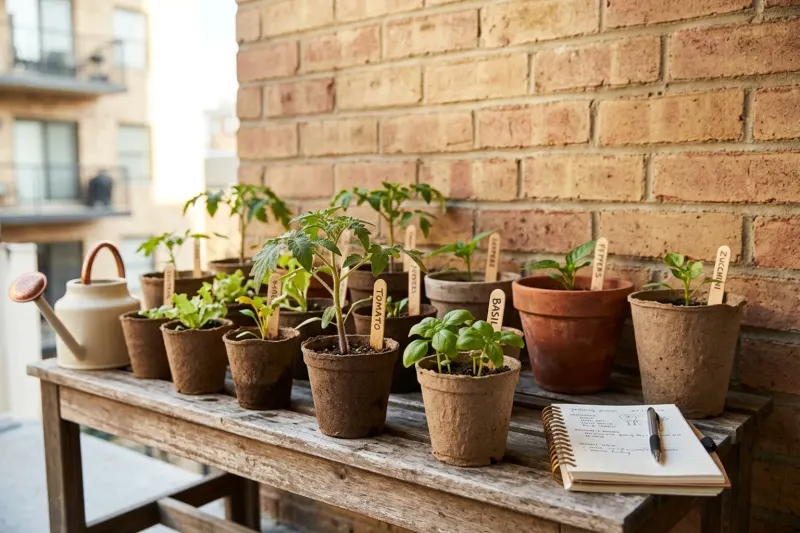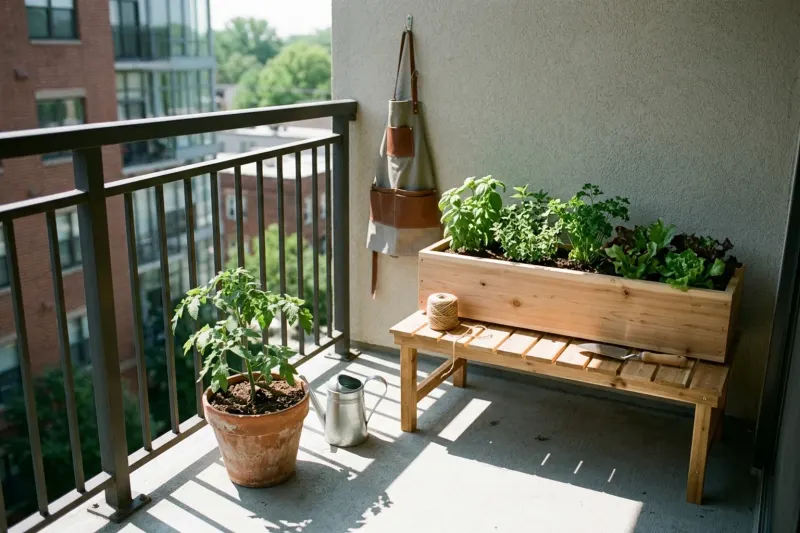
If you want reliable harvests from an apartment balcony, do not rely on compass directions alone. A south-facing deck sounds ideal on paper, but overhead concrete slabs, solid privacy walls, and railing balusters carve the space into distinct light zones. Direct sunlight requires an unobstructed line of sight between the sun and the plant canopy; the bright ambient light under a deep roof overhang cannot trigger flowering in fruiting vegetables. By tracking direct beam sunlight across your floor and railings during a clear day, you can identify your true high-light perimeter, intermediate transition spots, and shaded corners before buying containers or seedlings.
Balcony Geometry Overrides Compass Directions
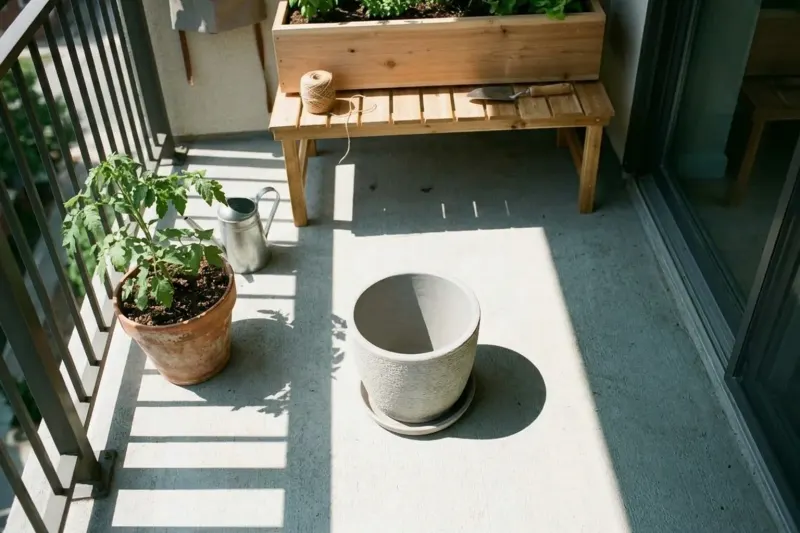
Standard gardening books often tell growers that a south-facing exposure provides full sun, but elevated multi-story buildings create an entirely different light environment. A south-facing balcony might receive eight hours of unbroken sky exposure along its outer top railing, while the deck floor three feet inward receives fewer than two hours of direct beam light. Upper-floor overhangs act like wide visors, cutting off high midday summer sun from reaching the rear wall. At the same time, solid concrete parapets or side divider screens cast long diagonal shadows that move across the deck from morning to evening. Jack LeCroy of Auburn University Extension explains in sunlight assessment guidance that full sun requires at least six hours of direct, unfiltered sunlight hitting plant foliage each day. Diffuse ambient light, reflections from neighboring windows, and bright open shade do not supply the energy needed for heavy flowering and fruit set. Evaluating a balcony means treating the deck as a series of narrow micro-strips rather than a uniform garden bed. Any architectural barrier that sits between the sun and your plant canopy halts direct-sun hours for that container location.
Running a Two-Hour Balcony Photo Audit
The simplest and most accurate way to assess balcony light is to run an audit on a clear, cloudless day in late spring or early summer. Start by clearing items off the deck so floor seams, wall joints, and drainage channels can serve as fixed visual landmarks. Set a timer on your phone for every two hours between 8:00 a.m. and 6:00 p.m. At each checkpoint (8:00, 10:00, 12:00, 2:00, 4:00, and 6:00), stand in the interior doorway and take a photo looking outward toward the railing. In each photo, track where the shadow line falls across the floor and walls. Take note of vertical height as well: a pot resting on the floor behind a 36-inch (91 cm) opaque railing may sit in dense shade all morning, while a planter box secured to the top rail sits in direct sun. When the day ends, tally the direct-sun intervals for each part of the deck. An area illuminated across three consecutive two-hour checks receives roughly six hours of direct sun, qualifying it as full sun. Two consecutive checkpoints indicate about four hours, or partial sun, while zones lit during only one checkpoint or shaded all day fall into the shade category.
Related guide: Hardening Off Seedlings on Porches and Balconies
Matching Edibles to Balcony Light Bands
Once your photo audit defines your light zones, you can match your container crops to their actual requirements. Container gardening guidance from Colorado State University Extension notes that warm-season fruiting vegetables require at least six hours of direct sunlight daily to develop flower buds and mature fruit, with eight hours delivering sturdier stems and better yields. If a dwarf patio tomato, sweet bell pepper, or compact cucumber receives fewer than six direct hours, the plant tends to stretch toward the light, produce weak stems with wide internodes, and drop blossoms before setting fruit. Root vegetables like radishes, small beets, and short-rooted carrots perform well in partial sun zones that receive four to five hours of direct light. Versatile culinary herbs such as parsley, chives, mint, and cilantro also tolerate these intermediate conditions. Leafy greens, including loose-leaf lettuce, spinach, Swiss chard, and Asian brassicas, produce tender leaves with three to four hours of direct light. In fact, placing greens in partial shade during hot summer afternoons often prevents premature heat-induced bolting and bitter flavors. Guidance from Michigan State University Extension also stresses matching mature root volume to container depth so plants in sunny spots do not dry out faster than you can water them.
Related guide: Protecting Balcony Container Vegetables from Wind
Railing Shadows, Plant Stands, and Seasonal Angles
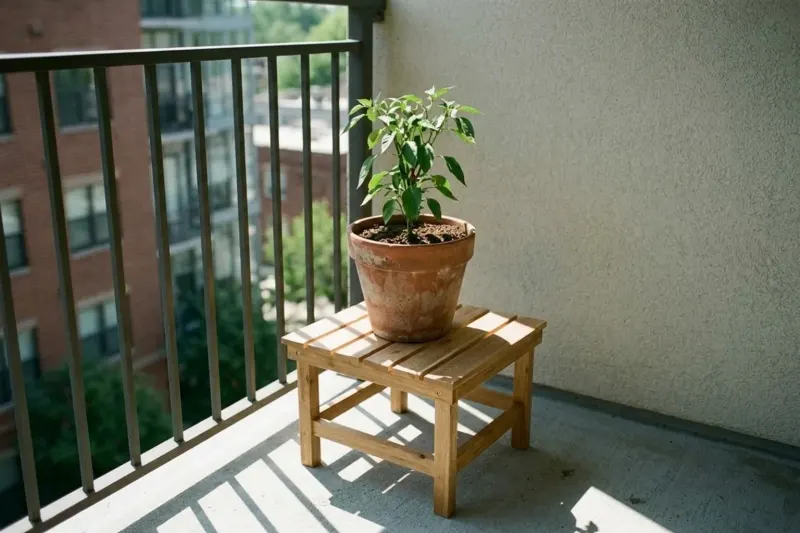
A sun map recorded in May or June shifts as the season progresses because the sun's path changes in the sky. During the summer solstice in late June, the sun reaches its highest solar altitude. On balconies with deep ceiling slabs, this high angle causes an unexpected limitation: the upper floor casts a deep shadow backward toward the apartment doors during the middle of the day, restricting sun penetration to the front edge. As late summer and autumn arrive, the sun rides lower in the sky, casting light deeper into recessed balcony walls while stretching the shadows thrown by outer railings. Solid railings create a permanent shade zone on the deck floor for low containers, blocking early morning and late afternoon light. Slatted metal railings let through moving bands of light, but these intermittent stripes deliver less cumulative energy than steady, open exposure. If your floor audit shows fewer than five hours of direct sun due to railing obstruction, raise your containers. Setting pots on sturdy 12- to 18-inch (30 to 45 cm) plant stands, placing them on stable masonry blocks, or using exterior-rated railing brackets lifts the plant canopy above the railing shadow line into continuous light.
Managing Heat, Drainage, and Root Zone Stress on Hard Surfaces
While direct sun fuels crop growth, hard balcony surfaces transform solar exposure into an intense thermal microclimate. Concrete slabs, brick walls, and metal balustrades absorb heat all day and radiate it outward into surrounding containers well into the night. Virginia Cooperative Extension (Publication 426-336) emphasizes that container plants set directly on hot, paved surfaces face accelerated evaporation and severe thermal root stress, which hinders water and nutrient uptake. Dark plastic pots placed against sun-drenched masonry can heat root zones past safe thresholds, causing tomato and pepper blossoms to abort even when sunlight hours meet published targets. To buffer against heat in full-sun zones, elevate pots on wooden or rubber pot feet to allow cooling airflow beneath the base and ensure unobstructed drainage from bottom holes. Choose lighter-colored containers made of glazed ceramic, light resin, or thick untreated wood to reflect radiant heat. Grouping containers closely together lets broad upper foliage shade container rims, cooling the root zone and stabilizing soil temperatures through the hottest hours of the day.
Related guide: Vegetables for a Sunny Patio: Choose by Space and Care
Placement and Crop Selection by Measured Direct Sun
| Situation | Consider | Why |
|---|---|---|
| Deck railing zone receiving 6 or more hours of direct sun | Plant dwarf tomatoes, sweet peppers, eggplants, or bush beans in containers holding at least 5 to 7 gallons (19 to 26 liters). | Fruiting crops require high light intensity to sustain flowering and fruit set without aborting blossoms. |
| Mid-deck zone receiving 4 to 5 hours of direct sun | Plant root crops such as radishes and beets, or culinary herbs like parsley, chives, and cilantro in 2 to 3 gallon (8 to 11 liter) pots. | Leafy herbs and underground root structures develop reliably in intermediate light without stretching into weak, leggy stems. |
| Interior wall zone receiving 2 to 3 hours of direct morning sun | Grow cut-and-come-again leafy greens, spinach, or Swiss chard in shallow containers at least 6 inches (15 cm) deep. | Greens tolerate light shade and produce crisp leaves while avoiding the premature heat-induced bolting caused by all-day sun. |
| Floor area permanently shaded by an opaque railing or parapet | Elevate pots on 12 to 18 inch (30 to 45 cm) stands or mount exterior-rated railing brackets. | Lifting the container base raises the foliage canopy out of the floor-level shadow and into unobstructed sunlight. |
Worked Sunlight Audit for a Sheltered Balcony
Consider a hypothetical covered balcony measuring 10 feet wide by 5 feet deep (300 cm by 150 cm), facing southwest on an eighth-floor apartment, with an overhead concrete floor slab and a 36-inch (91 cm) solid metal railing. A photo audit conducted on a clear June day produced the following observations: At 8:00 a.m. and 10:00 a.m., the entire deck sat in building shadow. At 12:00 p.m., the sun cleared the adjacent wing, illuminating the top 12 inches (30 cm) of the railing while the floor remained entirely shaded. By 2:00 p.m., direct sun reached a 2-foot (60 cm) strip of floor directly behind the railing, while the rear 3 feet (90 cm) stayed shaded by the ceiling slab. At 4:00 p.m., sunlight penetrated across the front 3.5 feet (105 cm) of the deck floor before dropping behind a neighboring building by 6:00 p.m. This audit revealed 6 hours of direct sun (12:00 p.m. to 6:00 p.m.) along the railing top, roughly 4 hours (2:00 p.m. to 6:00 p.m.) on the front floor, and 0 hours on the rear floor. Based on this hypothetical assessment, the grower hung a railing planter along the top rail for bush beans to capture the full 6 hours, placed an elevated 7-gallon (26-liter) container with a dwarf cherry tomato and a 5-gallon (19-liter) container with a sweet bell pepper along the sunny front railing on 8-inch (20 cm) risers to receive 6 hours of direct light, set root crops and a pot of culinary herbs in the mid-deck 4-hour zone, positioned a shallow trough of loose-leaf lettuce in the shaded transition zone, and reserved the rear wall for potting supplies and watering cans.
- Full-Sun Railing Planter (Bush Beans)
- Full-Sun Dwarf Tomato Container
- Full-Sun Sweet Pepper Container
- Partial-Sun Culinary Herb Pot
- Partial-Sun Root Veg Box
- Deep-Shade Salad Greens Trough
- Storage and Water Staging Bench
When this approach is not a good fit
This sunlight mapping method is unsuitable for enclosed glass solariums or balconies glazed with low-emissivity (low-E) glass, where light wavelengths and heat retention differ drastically from open-air environments. It is also unsuitable for planning winter vegetable crops in cold zones, where freezing soil temperatures, root dormancy, and low sun angles limit plant growth regardless of clear sky hours.
PUT THIS GUIDE TO USE
Work with your own measurements
Sources & further reading
- Auburn University Extension
- Colorado State University Extension
- Virginia Cooperative Extension
- Michigan State University Extension
AI-assisted writing and concept images. Sources and automated checks support the process; they do not replace checking your own measurements.
How we create our guides · Suggest a correction