Before mixing a dose of fertilizer for pale potted greens, verify substrate moisture at the bottom of the container. If the drainage holes weep water and the mix feels dense and cold, yellowing lower leaves signal root suffocation rather than a lack of soil fertility. Adding fertilizer to waterlogged roots increases soluble salt levels and damages struggling root hairs. When the potting mix is aerated, moist, and free-draining, uniform yellowing on older, lower foliage while the center shoots stay pale green indicates classic nitrogen deficiency. Because nitrogen is a mobile nutrient, plants cannibalize reserves from older leaves to sustain new growth. In soilless container mixes, frequent watering leaches soluble nitrates out within weeks. Correcting the deficit requires an immediate half-strength feeding of water-soluble fertilizer to halt leaf loss, followed by a calibrated maintenance routine that balances irrigation with nutrient replenishment.
Distinguishing Nitrogen Hunger from Root Suffocation
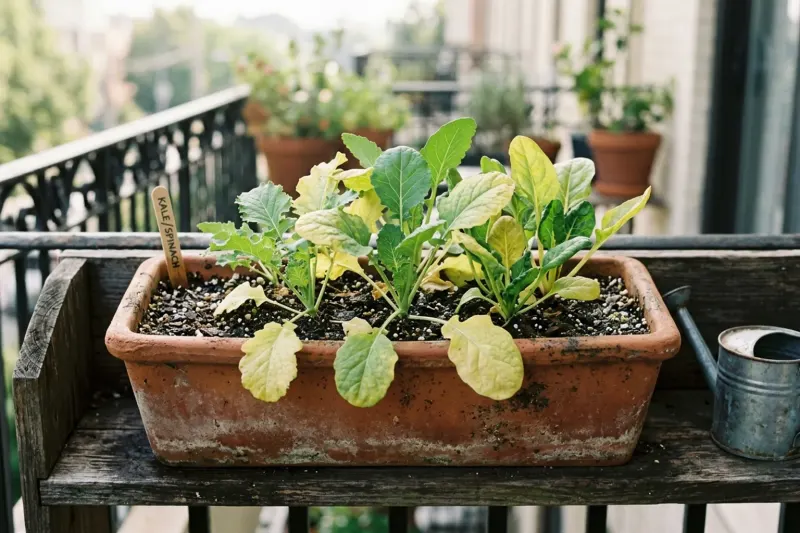
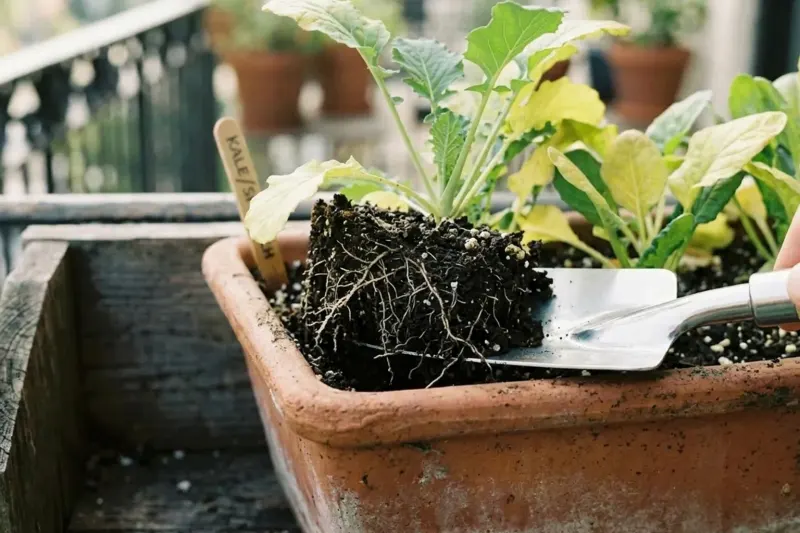
Container-grown greens yellow for two primary reasons: nutrient starvation or root rot caused by poor drainage. Because both issues produce chlorotic foliage, misdiagnosis is common. To differentiate between the two, check root zone moisture and observe leaf patterns. According to the University of California Statewide IPM Program (UC IPM) and Texas A&M AgriLife Extension, nitrogen is mobile within plant tissues. When root uptake fails to meet metabolic demand, the plant mobilizes nitrogen from older, lower leaves and exports it to expanding apical leaves. As a result, nitrogen deficiency produces uniform, pale-green to golden-yellow discoloration that starts strictly at the base of the plant. The veins and the tissue between the veins yellow together without distinct mottling. Younger center leaves remain green, though they often emerge smaller than normal. In contrast, the University of Maine Cooperative Extension highlights that overwatering and compacted potting media restrict oxygen diffusion into the root zone. Root cells require oxygen for cellular respiration to generate the energy needed to take up water and dissolved minerals. When a container lacks drainage or sits in standing runoff saucer water, roots drown and die. Drowning roots cannot transport nitrogen even if the soil contains fertilizer. If the pot feels unusually heavy, the surface smells sour, or the lower leaves turn yellow and drop while feeling soft and limp, the issue is drainage failure. Pull the container gently from its pot or probe the bottom drainage hole. Healthy roots appear crisp, white, or light tan; suffocated roots appear dark brown, slimy, and pull apart easily. If roots are damaged by waterlogging, adding fertilizer will worsen root injury through salt dehydration.
Related guide: Flushing Fertilizer Salts from Container Potting Mix
Mobile Nutrient Dynamics in Small Root Volumes
Unlike garden beds rich in native clay and decomposed humus, container potting mixes are predominantly soilless blends of sphagnum peat moss, coconut coir, perlite, and aged pine bark. While these substrates provide excellent porosity and aeration for rapid root development, they have a low native nutrient-holding capacity and contain virtually no inherent nitrogen. Commercial potting media frequently contain an initial starter fertilizer charge. However, as noted by University of Georgia CAES Extension, this reserve is modest. In small pots subjected to routine warm-weather watering, the available nitrate is depleted or leached out within 2 to 4 weeks of planting. Leafy greens—such as looseleaf lettuce (Lactuca sativa), spinach (Spinacia oleracea), Swiss chard (Beta vulgaris subsp. vulgaris), and kale (Brassica oleracea)—demand consistent nitrogen to fuel rapid cell division and produce tender foliage. When nitrogen drops below critical thresholds in the substrate, greens exhibit predictable physiological changes. Basal leaves fade from dark green to uniform light chartreuse, then turn clear yellow. Stems thin out, and the overall plant canopy becomes loose and upright rather than compact and dense. Oldest leaves dry to a tan, papery texture and shed as the plant diverts its remaining nitrogen into survival. In addition, undernourished leafy greens frequently initiate flowering stalks early when stressed, degrading culinary flavor by concentrating bitter compounds.
Related guide: Can You Reuse Potting Mix for Container Vegetables?
Immediate Liquid Correction Versus Sustained Granular Feeding
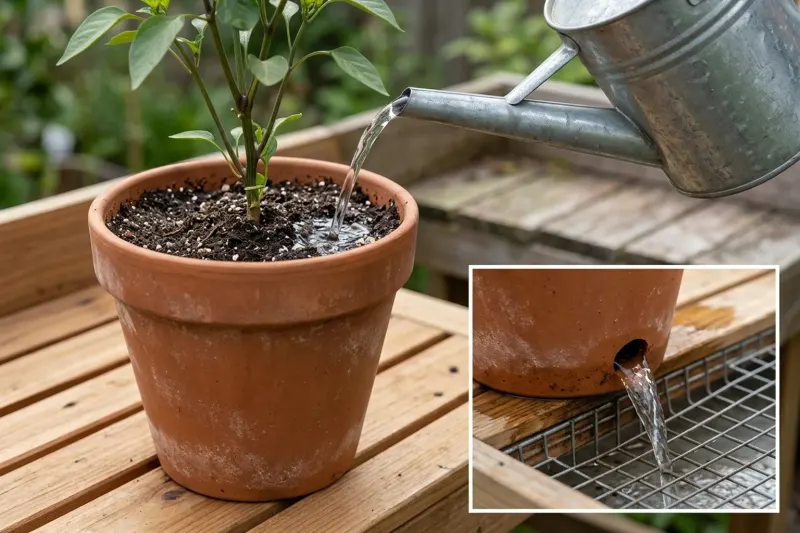
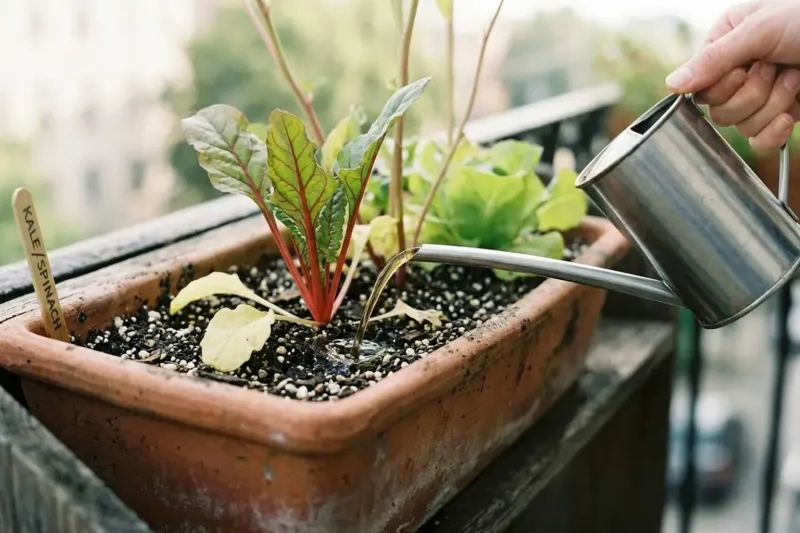
Once you confirm that yellowing is caused by nutrient depletion rather than wet feet, choose a fertilizer based on how fast the plant needs the nitrogen. For an active, visible deficiency where basal leaves are already yellowing, fast-acting water-soluble liquid fertilizers provide the most immediate recovery. Research from Michigan State University Extension and Iowa State University Extension confirms that liquid fertilizers deliver nutrients in an ionized, dissolved form that roots absorb immediately. In contrast, dry granular fertilizers and unrefined organic meals require moisture, time, and soil microbial activity to break down into plant-available nitrate and ammonium. Water-soluble synthetic fertilizers or balanced liquid formulas work rapidly. For container leafy greens, dilute a complete water-soluble fertilizer to half or quarter of the standard maintenance rate specified on the manufacturer label. Apply it thoroughly to moist potting mix until roughly 10 to 15 percent drains freely from the base. Liquid organic options like hydrolyzed fish fertilizer or fish emulsion supply nitrogen in a water-soluble suspension without requiring extensive soil breakdown, though visual greening rates vary depending on ambient temperature, root vitality, and lighting. Controlled-release fertilizers and top-dressings provide long-term release. Polymer-coated granular fertilizers or organic amendments like blood meal or feather meal provide extended feeding. However, Utah State University Extension notes that organic granular sources depend heavily on substrate microbial activity. In cool early-spring container soils below 55 degrees Fahrenheit (13 degrees Celsius), microbially driven nitrogen release drops significantly, making cold-season spring greens reliant on water-soluble forms instead.
Managing Irrigation Leaching and Fertilizer Burn Risks
Small-space container gardening requires balancing nutrient retention with proper drainage flushing. Because nitrogen in the form of nitrate carries a negative electrical charge, it does not bind to negatively charged peat or coir fibers. Every time you irrigate your balcony or patio containers until water runs out the bottom, a fraction of the available nitrate leaches out. However, attempting to prevent leaching by withholding drainage water creates a far worse hazard: soluble salt accumulation. University of Minnesota Extension emphasizes that fertilizing containers without sufficient drainage allows unused fertilizer salts to crystallize in the potting mix. Over time, high electrical conductivity in the root zone pulls moisture backward out of root cells through osmosis, causing fertilizer burn—characterized by brown, scorched leaf margins, root tip death, and stunted growth. To manage this dynamic effectively in container-grown leafy greens, follow three preventive steps. First, never apply fertilizer solutions to bone-dry potting mix. Dry peat and perlite absorb concentrated salts unevenly, burning delicate root hairs. Irrigate with plain water first, allow the pot to drain for fifteen minutes, then apply your diluted liquid fertilizer solution. Second, leafy greens benefit far more from weak, frequent feeding—such as applying quarter-strength fertilizer with every second or third watering—than from large, concentrated monthly doses. Third, once every four weeks during active growth, pour plain, unfertilized water through the container in an amount equal to twice the container volume to flush out accumulated residual salts.
Diagnostic and Corrective Actions for Container Greens
| Situation | Consider | Why |
|---|---|---|
| Substrate is saturated, drainage holes are blocked or resting in water, and lower leaves are soft and yellow. | Clear drainage holes, elevate container on pot feet, and withhold all fertilizer until topsoil dries. | Waterlogged roots are deprived of oxygen and cannot absorb nutrients; adding fertilizer increases salt osmotic stress and root decay (UMaine Extension). |
| Substrate is moist and free-draining, planting is 3 to 6 weeks old, and lower foliage is uniformly chlorotic. | Drench with a half-strength water-soluble liquid fertilizer (synthetic or fish emulsion). | Liquid formulations provide immediately bioavailable nitrates to halt the mobilization of nitrogen from basal leaves (MSU Extension; Iowa State Extension). |
| Substrate temperature is cold (early spring balcony below 50°F / 10°C) with pale yellowing foliage. | Use a water-soluble mineral nitrogen feed rather than raw organic meals (like blood meal). | Soil microbes that mineralize organic nitrogen into plant-usable nitrate remain largely dormant in cold soils (USU Extension). |
| Greens have recovered green color after initial feeding; planning regular maintenance. | Switch to weekly quarter-strength liquid feeds or top-dress with a controlled-release granular fertilizer. | Regular irrigation flushes mobile nitrogen from soilless media, requiring low-concentration, steady replenishment (UMN Extension). |
Hypothetical Recovery Plan for a 60-cm Balcony Trough
Consider a hypothetical scenario involving a rectangular balcony trough measuring 60 cm wide by 20 cm deep by 20 cm tall (roughly 24 in by 8 in by 8 in) with an internal volume of approximately 24 liters (6.3 gallons). The planter holds three mature looseleaf lettuce plants in a commercial peat-perlite mix. After 4 weeks of regular daily watering in late spring, the lowest 3 to 4 leaves on each plant turn uniform pale yellow, while central growth slows. First, probe 5 cm (2 in) deep. The mix is evenly moist but not waterlogged, and excess water drains freely onto pot risers. On Day 1 for immediate correction, mix a water-soluble balanced liquid fertilizer at half the standard container maintenance strength directed by the manufacturer label (for example, 0.5 teaspoon per 3.8 liters or 1 gallon of water, depending on product packaging). Slowly pour 1.5 liters (0.4 gallons) across the substrate surface until roughly 150 ml (5 fl oz) runs from the bottom drainage holes. During Days 3 to 7, maintain normal watering only when the top 2.5 cm (1 in) of mix feels dry to the touch, avoiding complete desiccation. From Day 8 onward for maintenance, switch to a quarter-strength liquid feed every 7 to 10 days, or scratch 15 grams (1 tablespoon) of balanced controlled-release fertilizer granules into the top 2 cm of mix to sustain cut-and-come-again harvesting.
- Butterhead Lettuce
- Oakleaf Lettuce
- Romaine Lettuce
When this approach is not a good fit
This diagnosis and feeding protocol is unsuitable when yellowing occurs primarily on the youngest, uppermost leaves (a classic indicator of immobile micronutrient deficiencies like iron or sulfur), when leaf margins are brittle and brown (indicating fertilizer salt burn or severe drought), or when foliage exhibits patchy viral mosaics, fungal leaf spots, or bacterial soft rot.
PUT THIS GUIDE TO USE
Work with your own measurements
Sources & further reading
- University of California Statewide IPM Program: Nitrogen Deficiency
- Texas A&M AgriLife Extension: Diagnosing Nutritional Deficiencies
- University of Maine Cooperative Extension: Common Problems in Container Gardens
- University of Georgia CAES: Container Gardens Need Good Soil and Nutrients for Success
- University of Minnesota Extension: Fertilizing and Watering Container Plants
- Iowa State University Extension: Mid-Summer Container Plant Nutrition
- Michigan State University Extension: Pros and Cons of Granular and Liquid Fertilizers
- Utah State University Extension: Selecting and Using Organic Fertilizers
AI-assisted writing and concept images. Sources and automated checks support the process; they do not replace checking your own measurements.
How we create our guides · Suggest a correction