Set up physical plant supports before adding potting mix or seedlings to your container. Postponing installation until a tomato, cucumber, or melon vine bends under its own weight forces you to jam stakes through established root balls, tearing fragile feeder roots and destabilizing the planter in brisk winds. Choosing the right support requires matching your vegetable's mature growth habit to container depth and balcony wind exposure. Compact determinate crops thrive inside heavy wire cages, whereas vigorous indeterminate vines and rambling cucurbits require deep stakes or railing trellises to stay upright. For climbing cucurbits and tall vining tomatoes, vertical trellising secured to balcony railings or deep, weighted planters preserves floor space, improves air circulation around the foliage, and keeps top-heavy crops anchored when high-altitude balcony gusts hit.
Matching Growth Habit to Stakes, Cages, and Trellises
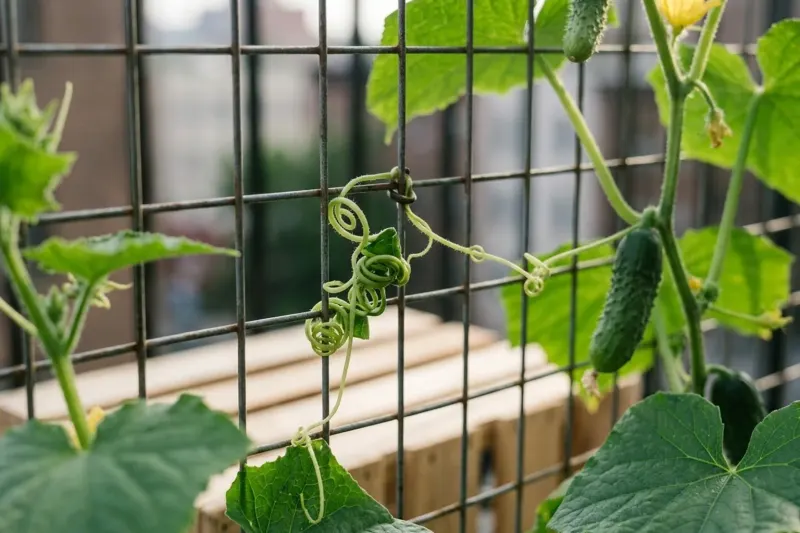
Selecting the right physical support begins by checking the growth habit on the seed packet or plant tag. Fruiting vegetables display distinct physiological growth patterns that dictate their vertical height and weight distribution. Determinate tomatoes produce terminal flower clusters, reach a genetically capped height—typically 2 to 3 feet (0.6 to 0.9 m)—and set fruit over a concentrated period. Clemson University HGIC notes in its container tomato guidance that standard wire cages work well for cultivars under 2 to 3 feet, making them reliable choices for compact patio varieties. Indeterminate tomatoes, by contrast, continue vegetative extension until frost kills the vine, frequently reaching 6 to 10 feet (1.8 to 3.0 m). University of Illinois Extension emphasizes that standard thin-wire retail conical cages topple easily under the sheer mass of indeterminate cultivars, especially when exposed to balcony gusts. For cucurbits like slicing cucumbers and small melons, trellising strategy depends on how the plant climbs. Cucumbers produce fine tendrils that readily curl around netting or slender uprights. Oklahoma State Extension notes that intensive vertical culture allows gardeners to train rambling vine crops upward in small spaces, keeping walking paths clear without demanding larger container diameters.
Related guide: Protecting Balcony Container Vegetables from Wind
Timing Installation to Protect Confined Roots
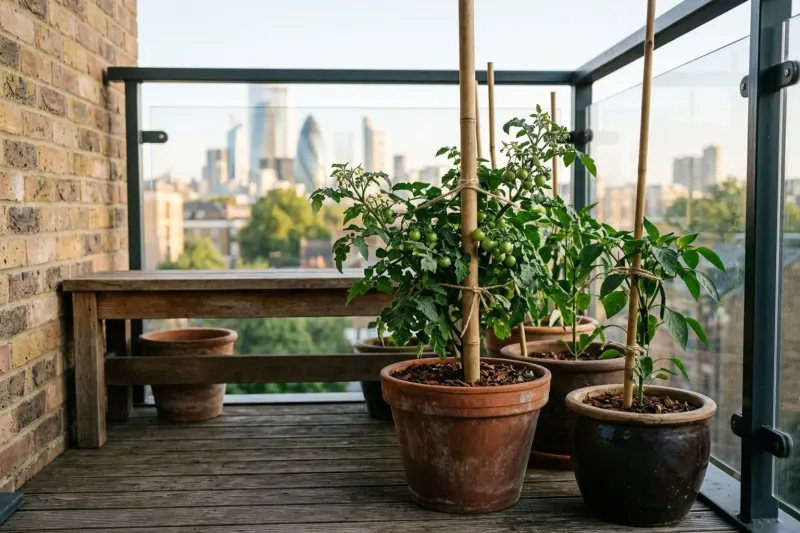
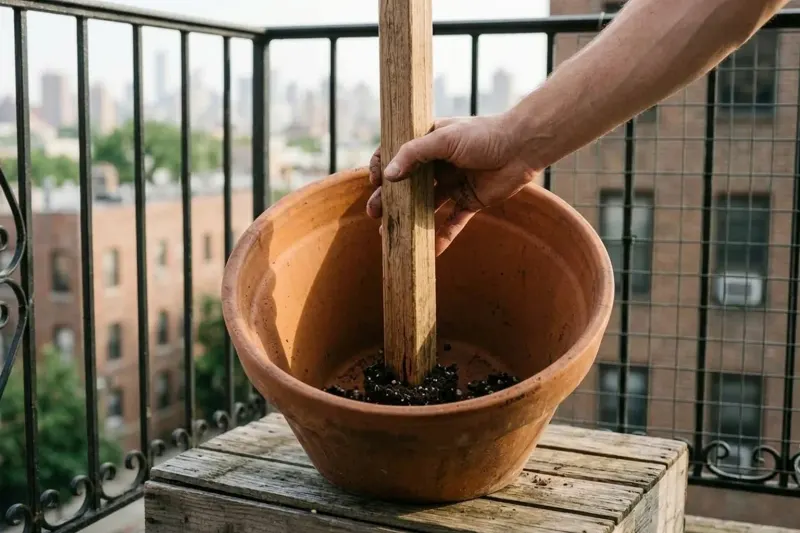
The most common mechanical mistake in balcony gardening is postponing support installation until the plant begins to lean. In a confined container, the root system rapidly colonizes the entire volume of soilless media, weaving a dense web of delicate capillary feeder roots near the container sidewalls and base. Forcing a wooden stake, bamboo cane, or steel cage prong into an established root ball slices directly through vital vascular roots, shocking the plant and creating subterranean entry points for pathogens. University of Illinois Extension recommends inserting stakes directly into the bottom of the empty container before adding potting mix, or immediately at transplanting before roots expand. Anchoring a 4-to-6-foot (1.2 to 1.8 m) stake against the container bottom and filling the media around it seats the base firmly. The dense mass of settled potting substrate holds the lower portion of the stake in place, preventing the lever effect that occurs when a stake is loosely wedged into an already full pot. For caged planters, press cage prongs straight to the base immediately after transplanting and firm media around the legs to prevent shifting.
Pruning and Securing Vines for Wind Stability
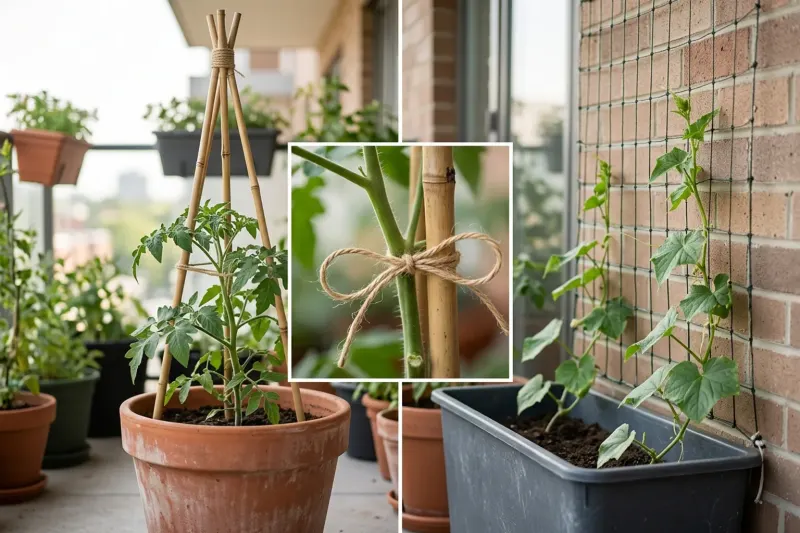
Container plants face aerodynamic forces that ground-level garden plots rarely encounter. Wind speeds increase significantly with building elevation, turning dense foliar canopies into sails that pull stakes loose or tip entire containers off balance. Managing this wind resistance requires deliberate pruning paired with flexible, non-abrasive fasteners. When growing indeterminate tomatoes on a central stake, pruning is essential to maintain structural stability. Allowing every axillary side shoot to develop creates multiple heavy stems that overload a single support rod. University of Illinois Extension advises training staked container tomatoes to a single or double main stem, regularly snapping off non-fruiting lateral suckers while they remain small and tender. This columnar architecture concentrates fruit production close to the vertical center of gravity and minimizes wind drag. Conversely, Penn State Extension notes that cucumbers grown on trellises generally require little to no pruning, as lateral shoots produce harvestable fruit without overtaxing the trellis. Fasten stems at 8-to-12-inch (20 to 30 cm) intervals using soft cloth strips or sisal twine tied in a loose figure-eight pattern to cushion stems and avoid girdling.
Related guide: Mapping Balcony Sun Hours for Container Crops
Vertical Trellising for Melons and Cucurbits
Training heavy cucurbits upward demands sturdy structural considerations. Penn State Extension notes that standard cantaloupe and muskmelon vines naturally spread 6 to 9 feet (1.8 to 2.7 m) in open ground. Moving these crops into containers requires a minimum substrate volume of 5 to 7 gallons (19 to 26 liters) per plant, paired with a rigid vertical framework. Polypropylene netting or wire mesh mounted against a sheltered wall or baluster rail provides the rigid grid required to hold expanding foliage. UGA Extension notes that vertical trellising allows gardeners to produce sprawling vegetables in confined locations where horizontal deck space is unavailable. While cucumber stems hold mature fruit without extra assistance, ripening melons present a distinct risk: mature muskmelons form an abscission zone where the fruit stem separates from the vine. If left suspended in mid-air, a 2-to-4-pound (0.9 to 1.8 kg) melon will detach and drop to the floor before reaching peak sweetness. Fabric cradles crafted from porous mesh or scrap cloth distribute fruit weight across the trellis framework. Tie the sling directly to the rigid trellis frame—never to the vine itself—once fruit reaches baseball size.
Related guide: Vertical Trellising for Potted Vegetables
Airflow, Foliage Separation, and Foliar Blight
Physical trellising serves a critical pathological function beyond saving floor space: it protects balcony crops against destructive foliar blights. In confined patio settings where air movement can stagnate between solid walls and privacy dividers, wet foliage creates ideal conditions for fungal pathogens. University of Minnesota Extension highlights that staking and trellising tomatoes elevates vegetative canopies off the soil, promotes rapid leaf drying after rain or irrigation, and substantially curtails splash-dispersed fungal leaf spots such as Septoria and early blight. Keep the lowest 10 to 12 inches (25 to 30 cm) of container stems pruned clean of foliage once the plant establishes. This open zone prevents leaves from contacting damp potting soil or catching splash-back droplets during irrigation. University of Minnesota Extension notes that trellising functions best as a cultural disease control when combined with strict ground-level watering; applying water directly to the substrate surface keeps foliage dry and curtails spore germination. Always tie, prune, and handle container vines only when foliage is dry to avoid mechanically spreading pathogens from leaf to leaf.
Support Selection Matrix for Balcony Fruiting Crops
| Situation | Consider | Why |
|---|---|---|
| Bush or determinate tomato in a 5-to-7-gallon (19-to-26-liter) container | Heavy-gauge steel wire cage installed at planting | Determinate cultivars reach a genetic ceiling around 2 to 3 feet (0.6 to 0.9 m). A sturdy cage supports multi-stem branching without requiring sucker pruning or tipping. |
| Vigorous indeterminate tomato in a 10-gallon (38-liter) container | Central 5-to-6-foot (1.5-to-1.8-m) hardwood stake placed before potting, pruned to 1–2 stems | Indeterminate vines easily overtop standard retail wire cages. A deep-set center stake and strict lateral pruning minimize wind drag and maintain a narrow center of gravity. |
| Vining slicing cucumbers or compact cantaloupe in a 7-gallon (26-liter) pot | Baluster-mounted vertical wire mesh or horticultural netting | Vines climb upward via tendrils, protecting floor space. Railing mounts transfer structural weight off the container sidewall and improve canopy airflow. |
| Upper-floor windy balcony with heavy fruiting crops | Broad-base container with integrated trellis or direct baluster anchor ties | Tall foliage acts as a sail in strong winds. Broad pot bases and physical railing ties prevent containers from levering and toppling during sudden wind gusts. |
Hypothetical Worked Setup: Equipping a Windy 5 × 7-Foot Balcony
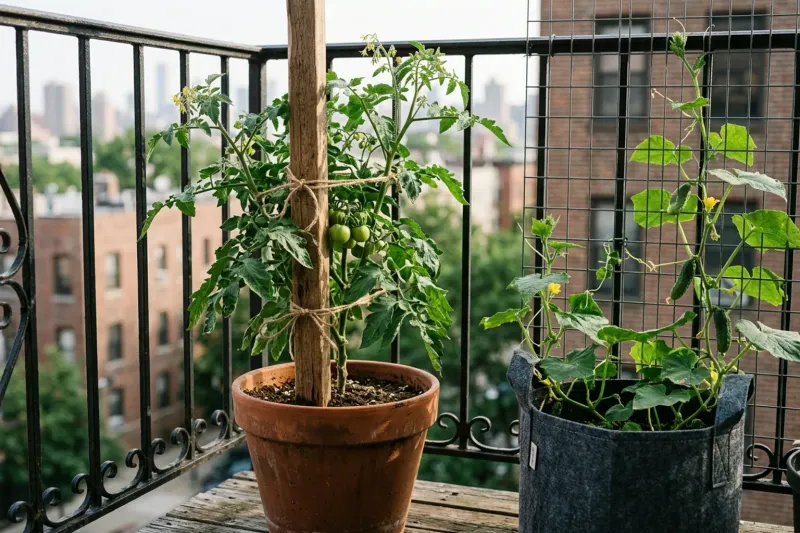
Consider a hypothetical apartment balcony measuring 150 cm wide by 210 cm long (roughly 5 × 7 ft) on a third-floor exposure with steady afternoon wind gusts. The gardener aims to grow one indeterminate slicing tomato ('Early Girl') and two vining pickling cucumbers ('Boston Pickling') while maintaining an unobstructed 60 cm walkway. For containers, a 10-gallon (38-liter, 40 cm diameter, 35 cm deep) food-grade resin pot is selected for the tomato, while a 14-gallon (53-liter, 60 cm wide, 30 cm deep) rectangular planter box holds the two cucumber plants. Total potting media volume equals approximately 90 liters of well-draining soilless peat-perlite mix. For the tomato support, a 180-cm rot-resistant cedar stake (2.5 × 2.5 cm) is seated firmly on the bottom of the empty 10-gallon pot before adding potting mix. Potting media is packed around the base to anchor it. The tomato transplant is positioned 8 cm from the stake, and soft sisal twine ties are added in loose figure-eight loops every 25 cm as the vine extends. Lateral suckers are pinched weekly to maintain a single central leader, reducing wind drag. For the cucumbers, a 120 cm wide by 150 cm tall wire panel (10 × 10 cm grid) is fastened to exterior metal balusters using four UV-resistant zip ties. The planter box rests flush against the railing base. Cucumbers naturally grip the wire via tendrils without manual pruning. Bottom foliage below 25 cm is stripped from the tomato once the vine reaches 1 meter to maximize airflow and prevent soil splash. Water is applied strictly at media level to keep leaves dry. Hardware requirements include an untreated rot-resistant stake, wire mesh panel, zip ties, and sisal twine, with actual material expenses depending on local suppliers and whether salvaged or new items are chosen; routine upkeep requires about 15 minutes weekly for sucker pruning and tie checks.
- Cucumber Planter (Trellis Base)
- Railing Wire Mesh Trellis Anchor
- Indeterminate Tomato 10-Gal Pot
- Pre-Set Center Cedar Stake
- Determinate Patio Tomato Pot
- Open Access Walking Path
When this approach is not a good fit
This vertical support approach is unsuitable for giant, long-season cucurbits such as Hubbard squash, field pumpkins, and large watermelons, which Penn State Extension notes are poorly adapted to container root restrictions and require floor space incompatible with balcony safety. It is also unsuitable for balconies where property rules forbid securing hardware to exterior railings and where available floor containers are under 5 gallons (19 liters), as undersized pots lack the physical mass and ballast needed to keep tall vertical supports upright in outdoor winds.
PUT THIS GUIDE TO USE
Work with your own measurements
Sources & further reading
AI-assisted writing and concept images. Sources and automated checks support the process; they do not replace checking your own measurements.
How we create our guides · Suggest a correction