Automating dividend reinvestment via fractional shares has transitioned from a fringe "fintech experiment" to a foundational strategy for retail wealth building in 2026, much like how professionals are learning to scale their coaching practice by turning complex metabolic data into high-ticket results. By removing the barrier of buying whole share units, this approach allows investors to deploy every cent of a dividend payout back into the underlying asset, effectively neutralizing "cash drag" and accelerating the mechanics of compound interest in environments where capital inflows are granular rather than institutional.
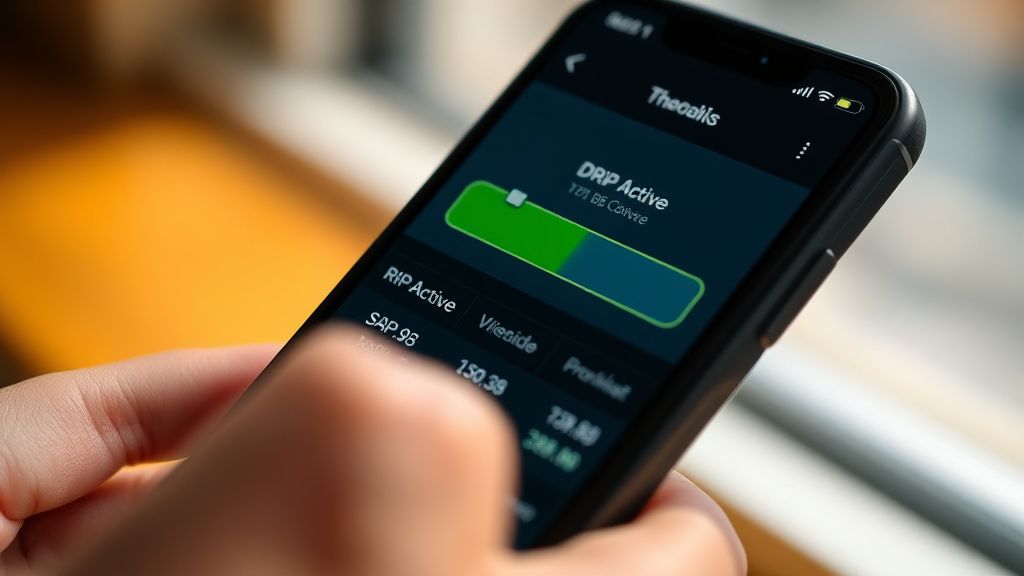
The Mechanics of Fractional DRIPs (Dividend Reinvestment Plans)
Traditionally, Dividend Reinvestment Plans (DRIPs) were hampered by the "whole share" constraint. If you owned $45 worth of a stock trading at $50, your $1.50 dividend payout sat idle in a settlement account—a cash drag that compounds negatively over decades.
In the current 2026 landscape, the plumbing of brokerage platforms has matured. When a company issues a dividend, the brokerage’s backend ledger identifies the election of the DRIP. Instead of transferring cash, the system triggers a market order for a fractional amount of the asset equivalent to the cash value. This process relies on the brokerage acting as a principal-trader, essentially grouping thousands of retail fractional orders into one "block trade" to execute at the market price, then allocating the bits back to individual accounts.
The Hidden Operational Cost: Execution Quality
While the user experience (UX) looks like a seamless "set it and forget it" interface, the operational reality is a complex web of internal matching. Because these fractional trades are not executed directly on public exchanges like the NYSE or NASDAQ (which generally do not support sub-share increments), they are executed "off-book" by the brokerage.
- The Spread Risk: Critics argue that because you aren't choosing your entry price, you are at the mercy of the brokerage’s internal pricing engine during the reinvestment window.
- Tax Fragmentation: Every fractional reinvestment creates a new "tax lot." If you hold a stock for 20 years and reinvest quarterly, you could be looking at 80 distinct tax lots for a single ticker. In 2026, while software handles the cost-basis tracking, the potential for "capital gains washing" or complex tax harvesting maneuvers becomes a nightmare during divestment.
Field Report: The "Rounding Error" Trap
In a recent analysis of retail investor communities on platforms like Discord and Reddit, a recurring theme emerged from a thread titled "Why is my cost basis reporting so chaotic?" (User: MarketJunkie2024).
The user discovered that their fractional reinvestment plan was triggering trades at slightly different price points than the daily average, despite the brokerage's claim of "time-weighted average pricing." The investigation revealed that during high-volatility events, the brokerage’s internal algorithm prioritized institutional liquidity providers over the retail fractional "sweep" orders.
"It works great until you actually scale it. When you have a portfolio yielding four figures in dividends, the slippage on fractional reinvestment starts to look like a management fee you never signed up for." — Disgruntled Investor, r/Bogleheads.
This highlights the core tension: you are trading control for automation. If you are a "set and forget" investor, this is negligible, but it is worth noting that for those running a home-based business, failing to manage your environment can lead to issues like why your messy home network is draining your mental energy. If you are an optimizer, the lack of control over when that fractional share is bought—often hours or days after the dividend ex-date—can be a source of frustration.

Compound Growth: Hype vs. Mathematical Reality
The math behind fractional reinvestment is straightforward: it minimizes the time money sits in a zero-interest settlement account, just as freelancers transitioning to an LLC in 2026 must master their own financial math to optimize for the future. Over 30 years, the difference between reinvesting $10 and waiting for it to grow to $100 before buying a share can amount to thousands of dollars in long-term total return.
However, the "hype" often ignores the Tax Friction. In a taxable brokerage account, a dividend payment is a taxable event, regardless of whether you take the cash or reinvest it.
- The Drag: You receive $10. If your tax rate is 15%, you owe $1.50.
- The Reinvestment: You reinvest the full $10.
- The Failure Point: Many users in 2026 are failing to account for the tax liability generated by these automatic reinvestments. They see the share count growing and assume the total return is net, when in reality, they are under-funding their tax obligations.
Why Platforms Struggle with Scaling
If you look at GitHub issues or developer forums for major brokerage APIs, you’ll notice a recurring bottleneck: End-of-Quarter Stress.
On dividend payment dates (often the 15th or 30th of the month), brokerage backends face massive compute spikes. Systems that manage fractional ledger updates frequently slow down, resulting in "pending" statuses that can last 48 hours. This isn't just a UI bug; it's a structural limitation of legacy mainframe databases attempting to interact with modern, high-frequency settlement layers.
Strategy: The "Hybrid" Approach to Automation
To mitigate the risks of "automated blindness," sophisticated retail investors have moved toward a hybrid model:
- Core Portfolio: High-yield ETFs (like VYM or SCHD) are set to automatic fractional DRIP. The stability of these assets makes the "timing" aspect less critical.
- Satellite Portfolio: Individual growth stocks are handled manually. Investors take the cash payouts, wait for a broader market pullback (a 2-3% dip), and then manually reinvest the lump sum of accumulated dividends.
This approach acknowledges that while automation is excellent for removing emotional interference in blue-chip holdings, it is suboptimal for volatile individual equities where "buying the dip" can significantly lower your cost basis over a decade.

The "Broken Promise" of Platform Portability
One of the most persistent issues in 2026 is the ACATS (Automated Customer Account Transfer Service) Problem.
If you decide to move your portfolio from Broker A to Broker B, fractional shares are rarely transferred. Broker A will sell your fractional units, convert them to cash, and transfer only the whole shares. This triggers a taxable event—a massive headache if you’ve been accumulating for years.
- The Conflict: The industry touts "seamless movement," but the reality is that the fractional ledger is proprietary. If you choose to automate, you are effectively "locking in" to that specific platform. Leaving becomes a chore that could cost you thousands in unplanned capital gains taxes.
Debating the "Efficient Market" Narrative
There is a loud debate in the financial community about whether fractional reinvestment creates a "feedback loop." By automating buying pressure on dividend-paying stocks, are retail investors essentially propping up the valuations of mature companies?
Some market analysts argue that the massive, automated, recurring buy orders from millions of fractional DRIP accounts create a "floor" for blue-chip stocks. This creates a fascinating contradiction: the more popular this automation becomes, the less "efficient" the market pricing might be for those specific stocks, as buy orders are decoupled from valuation and tied strictly to dividend yields.
Practical Advice for the 2026 Investor
- Audit Your Tax Lots: Every six months, download your realized gain/loss report. If you see hundreds of fractional lines, realize that your future tax filing will require a CPA or high-end tax software (like TaxBit or CoinTracker, even for stocks).
- Monitor the Execution Price: Don't just check your share count. Check your "Average Price Paid" versus the daily volume-weighted average price (VWAP) of the stock on the dividend payment date. If the brokerage is consistently filling your fractional trades 0.5% above market, you are losing money.
- Opt-Out of DRIP for "High Tax" Periods: If you are in a year where you expect your income to be abnormally high, it might be worth toggling off DRIP to keep cash in a High-Yield Savings Account (HYSA) to cover your tax liability, rather than compounding your tax burden through reinvestment.

Sıkça Sorulan Sorular
Does fractional share reinvestment affect my voting rights?
Can I turn off DRIP for just one stock, or is it global?
Why do some of my dividends arrive as cash and some as shares?
Is the "Spread" on fractional trades actually significant?
Why does my portfolio look so cluttered with "fractional sell" entries?
Is there a "best time" to enable automatic reinvestment?
Concluding Thoughts: The Illusion of "Free"
The push toward automated fractional reinvestment is the hallmark of the "Platformization of Wealth." It provides a powerful tool for the retail investor to leverage the same compound growth machines as institutional funds, but it comes with a silent cost: the loss of control and the accumulation of tax-reporting complexity.
The systems are, by design, meant to be "sticky." They encourage you to keep your capital within their ecosystem by making it theoretically impossible to move your fractional "pile" without triggering tax consequences. As an investor, you must treat your fractional DRIP not as a "set and forget" utility, but as a component of your tax and portfolio architecture that requires annual maintenance, careful auditing, and a skeptical eye toward the execution quality of your brokerage's internal algorithms.
Automation is a force multiplier, but only if you are the one steering the machine.