Quick Answer: DeWalt 20V Max saw blade wobble is almost always caused by one of four things: a loose arbor nut, a damaged or dirty arbor flange, a bent blade, or a worn spindle bearing. In most cases, you can diagnose and fix the problem in under 30 minutes without professional service — if you know exactly where to look.
There's a particular sound that experienced woodworkers learn to dread. It's not loud, exactly. It's more of a rhythmic flutter — a faint, oscillating hiss that shouldn't be there. You hear it the moment you spin up your DeWalt 20V Max circular saw or miter saw, and something in your gut knows, before your brain catches up, that the blade isn't running true.
Blade wobble on a cordless power tool is one of those problems that sits in an uncomfortable middle ground; much like Why Your Philips Hue Bridge Keeps Disconnecting (And How to Fix It), it is serious enough to ruin your results, dangerous enough to become a safety hazard, but subtle enough that many people ignore it for weeks. The forum threads on ContractorTalk and the DeWalt subreddit are littered with posts from people who noticed the flutter and kept cutting, similar to those who struggle with Peloton Heart Rate Sync Issues? Why Your Sensor Keeps Dropping Connection, only to face a destroyed workpiece or a failed blade.
This guide isn't going to tell you blade wobble is always catastrophic. Sometimes it's a piece of sawdust jammed behind a flange. But it's also not going to pretend this is a trivial aesthetic issue. Wobble introduces lateral stress into the blade that it was not engineered to absorb. Over time, that stress concentrates at the gullets between teeth, and that's where blades crack.
Let's get into the actual mechanics.
Why DeWalt 20V Max Tools Are Particularly Susceptible to Arbor and Spindle Issues
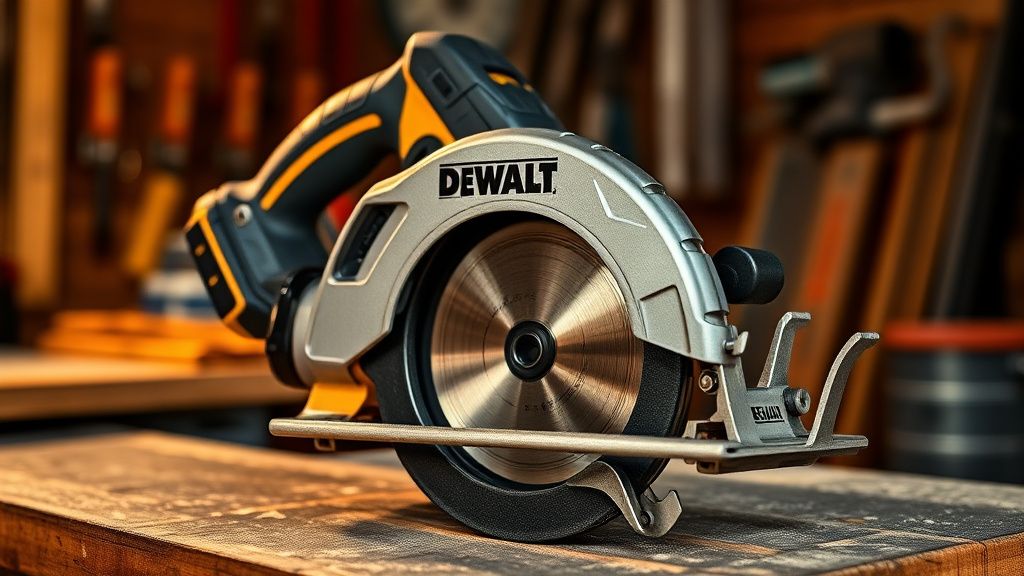
DeWalt's 20V Max platform is genuinely impressive engineering for its price tier and form factor. The DCS570, DCS575, DCS565 — these are tools that professional framers and finish carpenters actually rely on, not just weekend warrior purchases. But the cordless constraint creates real engineering compromises that directly relate to blade wobble problems.
In a corded circular saw, you have a relatively large, heavy motor that provides flywheel mass and rotational stability. The spindle bearing housing can be made larger and more robust because weight is a secondary concern. In the 20V Max platform, the entire tool has been optimized around battery weight, balance, and runtime — which means the spindle assembly is necessarily more compact, the tolerances are tighter, and there is less engineering margin before problems start to appear.
This isn't a defect, just as the technical hurdles encountered when you Stop Wi-Fi 7 Dead Zones: The Pro Guide to Perfect Mesh Node Placement are simply part of the trade-off for high-speed performance. It does mean these parts require maintenance, much like users who learn How to Fix Ghosting and Motion Blur on Your Samsung QLED TV to keep their hardware performing correctly.
The mechanical reality: The outer diameter of the 20V Max spindle bearing is smaller than what you'd find on a worm-drive saw. A small amount of wear that would be unnoticeable on a larger spindle becomes a measurable runout problem on a compact spindle. This is physics, not manufacturing failure.
Diagnosing the Wobble: What You're Actually Looking For
Before you start taking anything apart, you need to understand your specific issue, similar to how you would troubleshoot Why Your Wi-Fi 7 Mesh Nodes Keep Dropping (And How to Fix It). There are fundamentally different failure modes, and they have different causes, different fixes, and different urgency levels.
Lateral Runout vs. Radial Runout in Circular Saw Blades
Lateral runout is the side-to-side movement of the blade as it spins — what most people mean when they say "wobble." The blade is oscillating left and right relative to the plane of the cut. This is the most common problem and usually the most fixable.
Radial runout is when the blade's outer edge isn't perfectly circular relative to the axis of rotation — essentially, the blade is slightly eccentric. This is rarer in new blades but happens with bent or warped blades. It manifests as a rhythmic vibration rather than a visible side-to-side flutter.
The distinction matters because the fixes are different. Lateral runout is almost always an arbor assembly problem. Radial runout is almost always a blade problem.
The Pencil Test for Blade Wobble Measurement
You do not need a dial indicator to get a useful preliminary diagnosis. Here's the field method used by actual finish carpenters:
- Ensure the tool is completely unpowered — battery removed, not just switched off.
- Install the blade you want to test.
- Hold a pencil or a scribe against a fixed reference point (the lower blade guard, a piece of clamped wood, anything solid) so the tip just barely doesn't touch the blade flat at about the midpoint between the arbor and the blade's outer edge.
- Slowly rotate the blade by hand through a full revolution.
- Watch the gap between the pencil tip and the blade.
If the blade moves toward the pencil and then away during the rotation, you have lateral runout. If the gap stays constant, you don't — even if the tool feels rough when running.
A gap variation of 1-2mm is already significant for finish work. More than 2mm is a problem even for rough framing cuts. More than 4mm and you should stop using the tool until the issue is resolved.
Step-by-Step: The Systematic Diagnosis and Repair Process
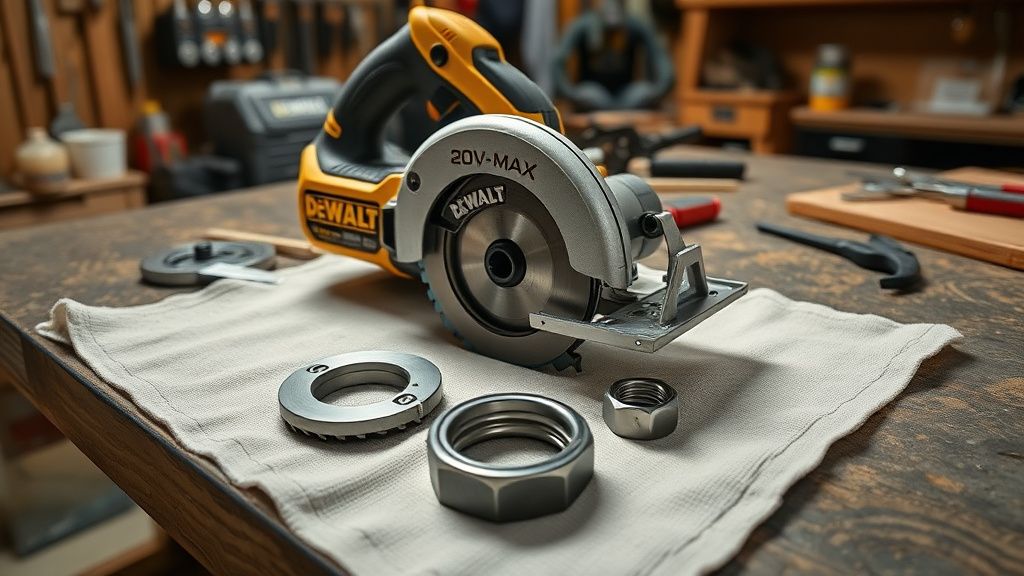
Step 1: Remove the Battery First — Every Single Time
This is not perfunctory advice. The DeWalt 20V Max platform's trigger mechanism has a relatively light actuation force compared to many corded saws. There have been documented cases in the OSHA incident database and in forum incident reports of users accidentally activating the trigger during blade work. Battery out. Every time. Non-negotiable.
For miter saw variants like the DWS779 or the DHS790, also engage the blade lock and use the spindle lock button — but still disconnect the power.
Step 2: Clean the Arbor Assembly Before Assuming Anything Is Broken
This step is skipped by approximately 80% of people who post "blade wobble" questions in tool forums, based on informal observation of threads. Before you do anything diagnostic, take a stiff brush — a parts cleaning brush or even an old toothbrush — and remove every visible particle of sawdust and resin from:
- The arbor shaft
- Both faces of the inner flange (the outer flange that came with the saw)
- Both faces of the outer flange (the washer that sits between the blade and the nut)
- The arbor nut threads
- The bore of the blade itself
Resin buildup on the inner flange is extremely common after cutting pressure-treated lumber, MDF, or any composite material. A layer of hardened resin that's only 0.3mm thick on one side of the flange will create visible wobble. This isn't a worn-out tool — it's a dirty tool.
Use a dedicated blade and bit cleaner (CMT Formula 2050 or the equivalent), or in a pinch, WD-40 applied with a rag, to dissolve the resin. Let it soak for a minute, then scrub. Wipe everything dry before reassembly.
Step 3: Inspect the Inner Flange for Damage
The inner flange — the part that's pressed onto or threaded onto the spindle and is not meant to be removed during normal blade changes — is the single most critical component for blade runout. It provides the reference surface that the blade sits against.
Look at the inner flange face with a raking light source — a flashlight held at a shallow angle works well. You're looking for:
- Raised burrs or dings from a blade that contacted the guard housing or was installed and removed with inadequate care
- Uneven wear — a visible polished arc on part of the flange face and a matte surface elsewhere, suggesting the blade was rocking rather than sitting flat
- Cracks — rare but not impossible, especially if the saw has been dropped
- Warp — this is the most insidious one. A flange that is slightly concave or convex will cause wobble that no amount of cleaning will fix
For most DeWalt 20V Max models, the inner flange is a replaceable part. The part number varies by model — for the DCS570B, it's typically part 5140088-83 or the current equivalent, but always verify against the current parts diagram on DeWalt's own parts portal (dewalt.com/accessories/power-tool-parts) because DeWalt has quietly updated several flange designs without announcement over the product lifecycle.
Step 4: Check the Arbor Nut Torque and Thread Condition
The arbor nut on DeWalt circular saws has a reverse-thread on models designed for clockwise blade rotation — which is most of them. This is intentional: the cutting forces tighten the nut during normal operation. But this also means that when you're removing the nut, you turn it clockwise (rightie-tightie logic is reversed).
A nut that isn't properly seated, or that has developed slight thread damage, will allow the outer flange and blade to shift position under load, creating intermittent wobble that appears fine during the hand-rotation test but shows up during cutting. This is one of the more frustrating diagnostic scenarios because it's inconsistent.
Check the nut by:
- Reinstalling it without the blade, finger-tight
- Verifying it threads smoothly without catching or requiring unusual force
- Checking the nut face with a straightedge for flatness
Replacement arbor nuts for most DeWalt 20V Max circular saws are available from multiple third-party suppliers for under $8. If the nut shows any damage, replace it. Don't try to fix a damaged arbor nut.
Step 5: Test a Known-Good Blade
This step is consistently underutilized. Before blaming the tool, test a blade you know is straight — ideally a brand-new blade still in the packaging, or a blade from a different saw that you've verified runs true.
If the known-good blade runs without wobble, your original blade is bent. If it still wobbles, the problem is in the tool.
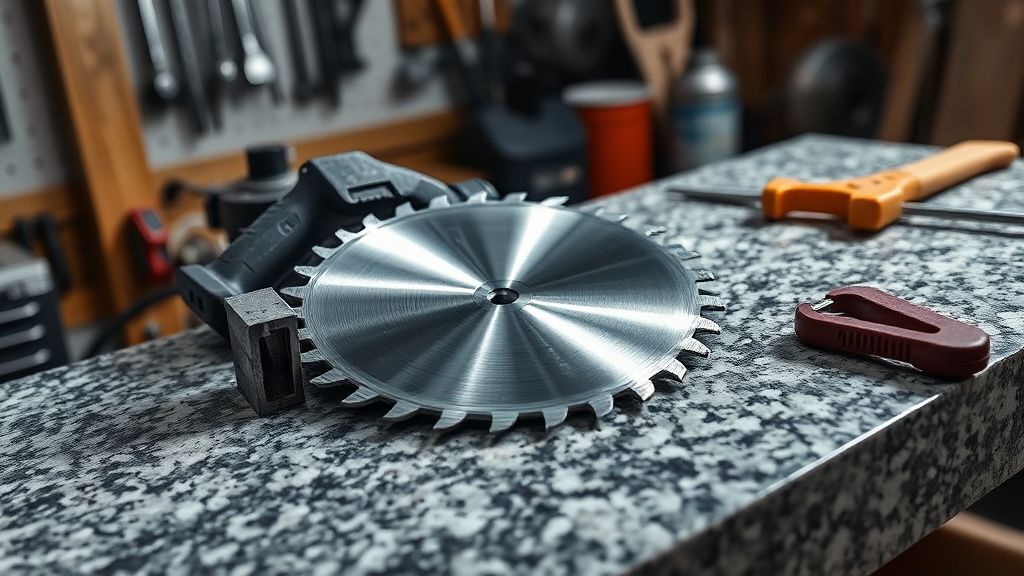
Blade straightness test without mounting it: Hold the blade flat on a known-flat surface (a table saw table or a piece of verified-flat granite). Any daylight visible under the blade when you press it flat indicates warp. Rotate it 90 degrees and check again. A truly flat blade will sit completely flush on a flat surface.
The warped blade reality check: Blades warp from heat. The most common cause is forcing a cut — binding the blade so the gullets overheat — or cutting without sufficient support so the kerf closes and pinches the blade. Carbide-tipped blades in the 6.5" to 7.25" range used on 20V Max circular saws are not particularly expensive (most quality blades are in the $25-60 range), and a bent blade should be retired, not re-flattened. Re-flattening carbide-tipped circular saw blades requires professional equipment and even then is generally not cost-effective.
Step 6: Inspect the Spindle Bearing
If you've cleaned everything, replaced the blade, checked the flanges, verified the arbor nut, and still have wobble — you're dealing with either a damaged spindle bearing or a bent spindle shaft. Both of these require partial disassembly of the tool.
Testing the bearing without disassembly:
- Battery removed. Blade installed.
- Grip the blade with both hands at 3 o'clock and 9 o'clock positions (the sides, not the teeth).
- Apply lateral force — gently, but deliberately — first left, then right.
- If you feel any play whatsoever between the blade and the body of the tool, the spindle bearing is worn.
A healthy spindle bearing should have zero perceptible play in the lateral direction. The spindle can feel slightly stiff or slightly loose in the rotational direction depending on the design, but it should not move sideways at all.
If the bearing is worn: This is a legitimate repair decision point. Spindle bearings on DeWalt 20V Max tools are replaceable by a competent user with bearing pullers and the correct press tools, or by a DeWalt authorized service center. The bearing itself is often less than $15 (these are typically standard 608 or 6001 series bearings, though verify against the service manual). The labor at an authorized service center is typically $60-120. The tool, new, is $150-250 depending on current pricing.
The economic math here isn't always obvious. If the tool is out of warranty and you're comfortable with basic mechanical work, a DIY bearing replacement is very achievable. If you're not, and the tool is more than two years old, it's worth calling DeWalt's service line (1-800-4-DEWALT) to get a service estimate before deciding whether repair or replacement makes more sense for your situation.
Reassembly Protocol: Getting the Torque Right
Reassembly is where a lot of DIY blade wobble repairs fail. The blade wobble is fixed during diagnosis, but then the user reinstalls everything incorrectly and the problem returns.
Correct torque for the arbor nut: DeWalt's official service documentation specifies torque values for arbor nuts, but the company does not publish these in user-facing manuals (a longstanding frustration documented in multiple threads on the DeWalt contractor forums). The general industry standard for 7.25" circular saw arbor nuts in this size class is approximately 20-25 Nm (15-18 ft-lbs). Using a torque wrench here is genuinely useful if you have one. Most people don't, and "snug plus a firm quarter turn" is the practical field standard — but don't overtighten, because excessive torque on the arbor nut can warp the inner flange itself.
Installation sequence:
- Inner flange on spindle (already in position if you haven't removed it)
- Blade installed, stamped side facing outward on most DeWalt designs (verify this on your specific model — the arrow indicating rotation direction on the blade should match the rotation arrow on the blade guard)
- Outer flange (washer) on top of blade
- Arbor nut, remember reverse thread on most models
- Torque to spec or snug plus firm quarter turn
After reassembly, perform the pencil test again before running the tool. If the wobble is gone in the static test, reinstall the battery and make a test cut in scrap material before returning to your actual work.
Real Field Reports: What's Actually Happening Out There
The Reddit thread r/Dewalt contains a recurring seasonal spike in wobble complaints — particularly in late summer and early fall, which correlates with heavy deck-building and exterior trim season when tools are running hard in dusty, hot conditions. The pattern is consistent enough that several experienced users have noted it explicitly.
One contractor — posting under the handle framinglife_PDX — described the exact failure mode that illustrates this perfectly: "Ran the DCS575 hard for three weeks on a timber frame project. Blade wobble started showing up on day 16. I thought the bearing was going. Turned out the inner flange had a ring of hardened pitch built up on one edge from the Douglas fir. Cleaned it with CMT cleaner and it was perfect. Three years later I still have that saw."
This is the most common resolution in the field: not a worn bearing, not a bent blade, but accumulated contamination on a surface that should be clean and flat.
However, there are also genuine failure cases. A post on the ContractorTalk forum from a finish carpenter documented a DCS565 that developed spindle bearing play after approximately 18 months of daily professional use. The bearing replacement cost her $22 in parts plus four hours of her own time. She noted that DeWalt's service center quoted $145 for the repair — and that the tool itself had cost her $189 on sale. "The math on warranty repair for out-of-warranty tools from this brand basically always pushes you to DIY or replace," she wrote. "Which is fine if you know what you're doing, but it's not fine that they've made the service documentation so hard to find."
That last observation is worth pausing on. DeWalt's service manual access is not straightforward. The company maintains service documentation primarily for authorized service centers, not end users. You can find many of these documents through third-party hosting sites (ManualsLib has a reasonable