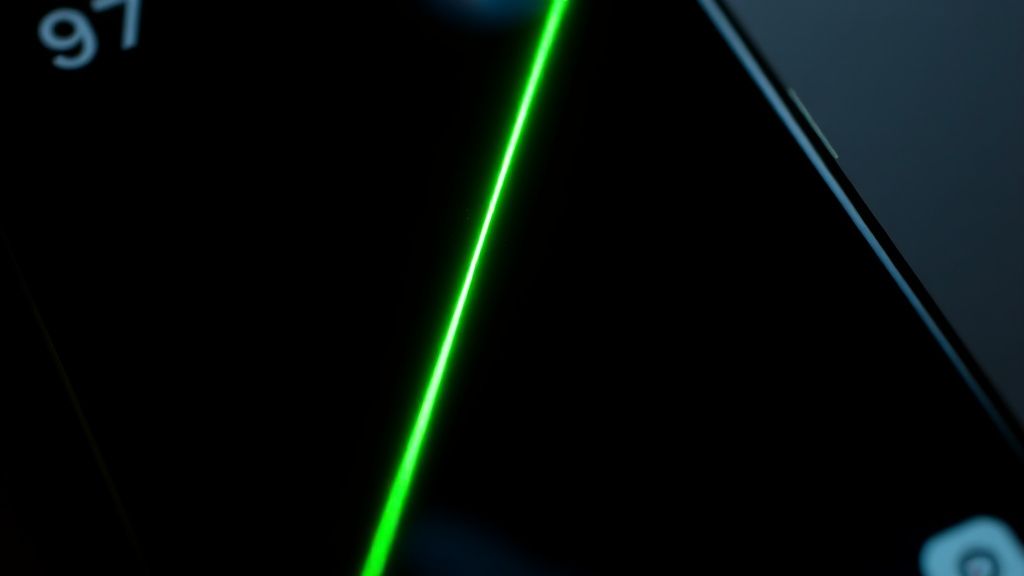
The emergence of a persistent, vertical line—often referred to as the "Green Line of Death"—on the Samsung Galaxy S24 Ultra display has reignited a long-standing debate regarding quality control in premium flagship hardware, a concern also seen with issues like Samsung Galaxy S24 Ultra camera lag. If your device displays this artifact, know that it is rarely a software "glitch" that can be patched with an OTA update. In almost every reported case, it is a localized failure of the display's ribbon cable connection or the OLED panel’s internal circuitry, much like the hardware issues that can cause a Fitbit Charge 6 black screen. Immediate action involves checking warranty status, as this is a hardware defect, not a user-error scenario.
The Anatomy of the Display Failure: Ribbon Cables and Micro-Fractures
To understand why a top-tier $1,300 device suddenly develops a line of pixels that refuse to cooperate, we must look beyond the glossy marketing materials and into the manufacturing reality. The Samsung Galaxy S24 Ultra utilizes a high-refresh-rate LTPO AMOLED panel, and similar to how Dell XPS 13 OLED flickering can occur, the "Green Line" is typically a symptom of a failure in the Data Driver IC (Integrated Circuit) or a microscopic mechanical stress point in the flex cable that connects the display panel to the logic board.
On forums like Reddit’s r/GalaxyS24Ultra and various Samsung Community boards, users often report the issue appearing after a software update or a minor thermal event. While correlation does not equal causation, the timing is telling. When a device updates, it often pushes the processor and memory to peak loads, leading to localized heating. If the adhesive holding the display flex cable is slightly degraded or if there was a subtle manufacturing defect in the bond, the thermal expansion can cause the microscopic connections to shift or disconnect.
One persistent myth circulating in Discord tech channels is that "Samsung throttles panels to hide bad batches." While there is no empirical evidence to suggest a malicious cover-up, the reality is that the sheer scale of manufacturing millions of units introduces "edge-case" failures. In a display assembly, you have thousands of individual connections packed into a space smaller than a human hair. A single micron of misalignment during the automated assembly process in a factory can result in a device that works perfectly for three months, only to fail the moment it experiences a rapid temperature change.
Real Field Reports and the "Update-Induced" Paranoia
The community sentiment regarding this issue is deeply polarized. On the one hand, you have the "early adopters" who feel betrayed by the premium price point; on the other, you have the technical enthusiasts who understand the inherent fragility of modern OLED technology.
A user on a dedicated X (formerly Twitter) thread noted, “I updated my S24 Ultra, and literally ten minutes later, the green line appeared. It’s too coincidental to be hardware.” This is a sentiment we see in every major flagship launch. However, a lead technician at a third-party repair shop—let’s call him Marcus—offers a different perspective:
"People love to blame the software, but the software is just the trigger. The heat generated by the re-indexing of files after an update is enough to push a compromised display cable over the edge. It’s not that the update broke the phone; it’s that the update revealed the weakness that was already there. We see this with S23s, S22s, and now the S24s. It’s a structural fatigue issue."
This distinction is crucial. If the issue were purely software-based, a factory reset would resolve it. However, the thousands of posts across GitHub and XDA Developers show a recurring trend: factory resets do absolutely nothing. The line persists in the BIOS/Recovery mode of the device—a clear, undeniable indicator that the hardware is the culprit.
The Economics of AMOLED Failures and Warranty Friction
Why isn't there a recall? The answer lies in the economics of failure rates. For Samsung, the percentage of devices affected by the green line remains within the "acceptable failure rate" threshold for consumer electronics. Recalling millions of units would be a logistical and financial catastrophe that would outweigh the cost of handling individual warranty claims.
However, this creates an operational nightmare for the end-user. When you contact Samsung support, you are often met with a script designed to mitigate their liability: "Did you drop the phone? Was it exposed to liquid?" This is a standard institutional defensive mechanism. Because the green line can be caused by physical impact (a cracked internal trace), support agents are trained to assume user error first.
This leads to the "Workaround Culture." Many users, fearing that their warranty will be voided or that they will be without a phone for weeks, resort to attempting to "massage" the display or use various pressure techniques to see if the connection re-establishes. Do not do this. Pressure on an OLED panel can cause the seal to break, leading to catastrophic screen failure and a complete loss of warranty eligibility.
Analyzing the "Green Line" vs. "Pink Line" Debate
While the Green Line is the most publicized issue, technicians have also noted "Pink Lines" or "White Lines." These are functionally identical in origin—they represent a failure in a specific column or row driver of the panel matrix.
- Green Line: Usually indicates a failure in the green sub-pixel data line or a voltage regulator issue for that row.
- Pink/White Line: Often indicates a more complex breakdown, sometimes involving the sync signals between the GPU and the display driver.
If you are experiencing these, you are dealing with a "broken circuit," not a "bug." The most honest, albeit frustrating, advice is to document the issue immediately. Take a photo of the screen with the line, and if possible, use another device to film the display in the bootloader/recovery screen. This serves as your "proof of innocence" when dealing with service centers.
Hardware Defect Mitigation: What Can You Actually Do?
The harsh reality is that there is no "real fix" you can perform at home. Unlike older phones with modular screens, the S24 Ultra display is fused to the frame. Repairing it requires disassembling almost the entire device, a process that risks breaking the water-resistant IP68 seal.
- Document, Don't Manipulate: Take high-quality photos. Ensure the IMEI of the device is visible in the same frame as the screen defect.
- The "Samsung Members" App Diagnostic: Use the built-in diagnostic tools. While they won't fix the line, they create an official digital log entry that support agents can reference.
- Escalation Path: If you are within your warranty period and the agent tries to claim physical damage, politely insist on a "supervisor review" of your submitted photos. Emphasize that there are no external dents or scratches on the chassis, which is the strongest evidence that the failure is internal.
- Avoid Firmware Hype: Ignore any "fix" that claims a specific app or setting will resolve the line. These are often SEO-driven clicks that prey on desperate users.
The Impact of Manufacturing Tolerances and Supply Chain Fragmentation
It is important to acknowledge that Samsung display panels are produced in massive, multi-facility operations. Not every S24 Ultra is identical under the hood. Slight variations in the chemical composition of the OLED stack or the purity of the copper in the flex cables are common. When demand spikes—like during a global launch—supply chains are often stretched, and quality control (QC) intervals might be compressed to meet output targets.
This is the "invisible cost" of rapid iteration. We want our phones faster, thinner, and more powerful, with better battery efficiency. These demands force engineers to reduce the margins of safety in component design. When you have a screen that consumes significant power and runs at 120Hz, the thermal load on the connection points is immense. Over time, or under specific environmental conditions, these systems show their limitations.
Why Software Updates Often Get the Blame
Why do so many users report the green line after a software update? This is a classic case of Temporal Correlation vs. Causation.
When a manufacturer pushes a firmware update, it often includes changes to the display driver—the code that dictates how the phone talks to the screen. If the display panel was already "on the edge" of failing due to a minor manufacturing defect, the subtle shift in refresh rate or voltage management introduced by the new driver can be the final straw. It isn't that the code is malicious; it’s that the hardware was already operating in a fragile state, and the update changed the operating parameters just enough to trigger the catastrophic failure.
The Ecosystem Frustration: When Brand Loyalty Collides with Reality
The S24 Ultra is marketed as the "Ultimate" device. When a $1,300, top-tier flagship fails, the psychological impact is far greater than with a mid-range phone. There is a sense of "broken promise." The community backlash, visible in threads on platforms like Hacker News and specialized Android subreddits, isn't just about the money; it’s about the erosion of trust.
Users are rightfully confused: "I bought the best product they make, yet I’m experiencing a problem that used to be common on budget phones." This fragmentation of experience—where some users have flawless devices while others deal with display defects—is the hallmark of modern high-volume manufacturing. It is a systemic issue, not a personal one.
The Role of Independent Repair and Right to Repair
The push for "Right to Repair" is highly relevant here. If Samsung refuses to honor a warranty, or if you are out of warranty and the repair cost is exorbitant (often 30-40% of the phone's value), you are effectively forced to either buy a new phone or use a device that is visually compromised. The lack of modularity in the S24 Ultra means that a $0.05 ribbon cable failure effectively requires a $300+ display replacement. This is a design philosophy that prioritizes slimness and water resistance over longevity and repairability.
Is the Green Line on the S24 Ultra a known software issue?
No. While software updates can act as a trigger by changing the power or refresh rate settings, the root cause is a hardware failure. The display panel's flex cable or the driver IC has physically failed or disconnected. A factory reset or software update will not fix a hardware fault.
Can I fix this by pressing on the screen or "massaging" the display?
Absolutely not. This is a common and dangerous myth. Pressing on an OLED panel can cause the internal seals to fail, leading to permanent, widespread screen damage or even total blackouts. You risk voiding your warranty entirely by attempting this.
Will Samsung fix this for free?
If the device is within the warranty period and there is no physical damage (cracks, dents, liquid ingress), Samsung is generally required to cover the repair. However, you must insist on a professional inspection and provide photographic evidence that the device has not been dropped.
Does this issue mean my phone will completely stop working?
Currently, it is a display artifact. However, if the cause is a degrading flex cable, there is a risk that the failure could propagate, leading to flickering, screen sections turning black, or the entire display becoming unresponsive. It is highly recommended to back up your data immediately.
Why do some users say the update caused it, while others say it’s hardware?
Both are partially correct. The hardware has a latent, microscopic defect from the factory. A software update changes how the hardware is driven, which can be the final stressor that forces the defect to manifest as a visible line. The hardware is the "bomb," and the update is merely the "trigger."
Should I get the screen replaced or just buy a new phone?
If the phone is under warranty, pursue the repair. If you are out of warranty, you must weigh the cost of a display replacement against the current trade-in or resale value of the device. Given the S24 Ultra's high retail price, a screen replacement is often the more economical choice, provided it is performed by an authorized service center.
Is the Green Line issue common across all S24 Ultra units?
No. It is an "edge-case" issue. While thousands of reports exist online, they represent a small fraction of the total units sold. However, because these devices are so high-profile, the reports are highly visible. It is a defect that exists within the manufacturing tolerances of any mass-produced, high-complexity electronic device.
Bu makale affiliate linkleri içermektedir.