
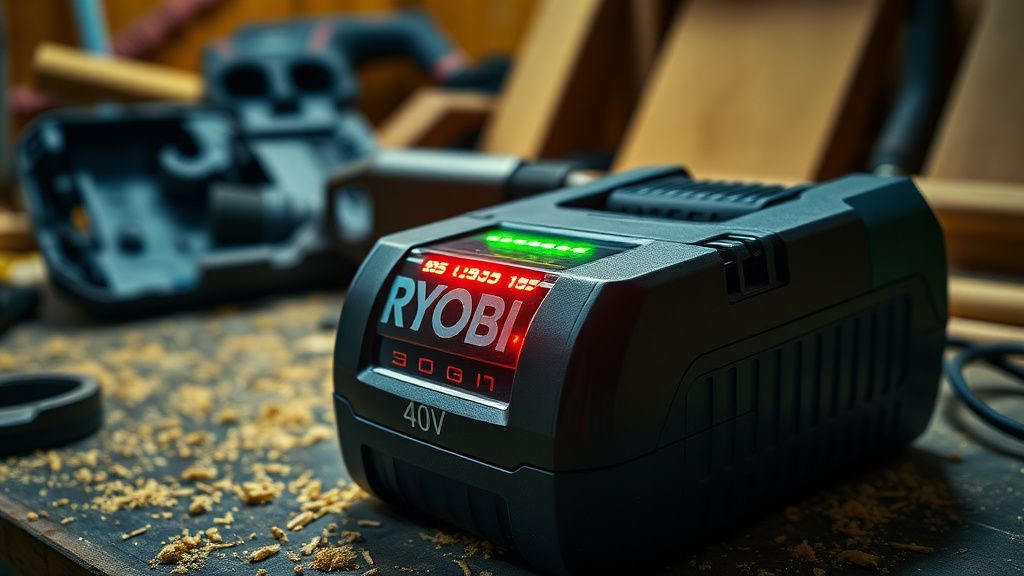
If your Ryobi 40V battery charger is flashing red and green, or showing a solid red light that won't transition to green (indicating Why Your Ryobi 40V Battery Stopped Charging), the internal Battery Management System (BMS) has likely tripped a safety lockout. Often, this isn't a dead battery, but a voltage protection trigger caused by deep discharge or thermal stress, a common issue across power tool batteries, similar to when your DeWalt 20V Battery Is Dead. Perform a 'hard reset' by disconnecting power and checking contact oxidation, a technique often employed when a device like a Theragun Pro Gen 5 Is Not Turning On.
The ecosystem of Ryobi’s 40V platform is perhaps one of the most successful, yet operationally frustrating, case studies in the modern lithium-ion power tool market. Millions of homeowners transitioned from gas-powered leaf blowers and lawnmowers to this high-voltage platform, lured by the promise of cordless convenience and universal battery compatibility. However, the "40V" designation acts as a double-edged sword: the higher voltage allows for significant power density, but it also creates a remarkably fragile environment for the internal lithium cells and their associated monitoring electronics.
When you see that dreaded flashing red-green sequence on your charger—often referred to by frustrated users on Reddit’s r/ryobi as the "blinking light of death"—you are witnessing a software-level intervention by the BMS. The battery is effectively "bricked" to prevent a thermal runaway event.
The Anatomy of the BMS Safety Lockout
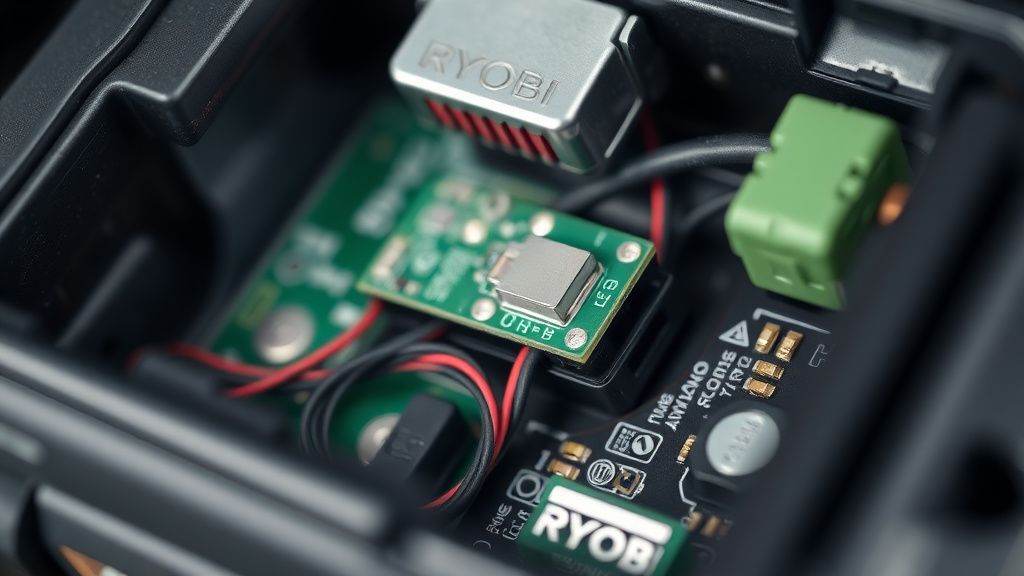
At the heart of every Ryobi 40V pack sits a sophisticated—if somewhat temperamental—BMS. This printed circuit board (PCB) is tasked with monitoring the voltage of every individual 18650 or 21700 cell within the pack. If one cell drops below a certain voltage threshold (typically around 2.5V to 3.0V, depending on the revision), the BMS triggers an "undervoltage lockout."
This is not a failure of the cells themselves; it is a defensive posture. If the charger attempted to force a high-amperage charge into a cell that had dropped below the chemical safety threshold, the risk of lithium plating and internal shorting becomes non-zero. The charger refuses to charge to protect your house from fire. The operational reality, however, is that users often view this as a defect, leading to a massive secondary market for "reconditioned" or "refurbished" batteries that are, in many cases, just reset by a simple bypass.
Troubleshooting Flow: Moving Beyond the Manual
Most manufacturer manuals suggest a generic "unplug and re-plug" technique. In the field, we know this rarely works for deep-cycle exhaustion. If your battery is cold, the thermistor—the sensor responsible for temperature monitoring—might be sending a "too cold to charge" signal to the charger.
- Thermal Conditioning: If the battery was stored in an unheated garage during winter, the internal resistance is too high. Bring the pack inside and let it reach room temperature (roughly 70°F/21°C) for at least 4 hours. Do not use external heat sources; you risk damaging the plastic casing or the sensors.
- Contact Oxidation Analysis: The 40V rails are sensitive to electrical resistance. Inspect the spring-loaded contacts on the charger and the battery. If you see white or bluish-green corrosion, this is high-impedance contact resistance. Clean them with 99% Isopropyl alcohol and a brass wire brush. A bad connection makes the charger think the battery is missing or unstable.
- The Voltage "Jump Start" Workaround: This is a controversial, advanced, and potentially dangerous method widely discussed on forums like Hacker News and various DIY Discord channels. Some users attempt to "wake up" the BMS by connecting a working 40V battery in parallel with the "dead" one for a few seconds using a multimeter lead. Warning: This can lead to massive current spikes if the voltages are significantly mismatched, potentially melting cables or worse. We do not officially recommend this, but acknowledging its existence is crucial to understanding the "workaround culture" that defines Ryobi user behavior.

The "Operational Reality" of 40V Thermal Stress
Industry analysts from The Information have noted that the push for higher power (more torque for blowers and mowers) forces manufacturers to push lithium-ion chemistry to its absolute limits. In high-demand scenarios—like cutting thick, wet grass—a 40V battery can reach temperatures exceeding 140°F (60°C).
When you pull a hot battery off a mower and immediately slot it into a fast charger, you are creating an "operational friction" point. The charger will often refuse to start the cycle because of the thermal cutoff. If you try to force it by cycling the power, you are essentially training the BMS to be hyper-sensitive. Over time, the internal logic of the battery can become "confused" by these rapid thermal fluctuations, leading to intermittent charging issues that no amount of cleaning will solve.
Counter-Criticism: Is the BMS Overly Protective?
There is an ongoing debate within the tool community regarding whether Ryobi’s BMS sensitivity is a legitimate safety feature or a form of planned obsolescence. Critics argue that the "lockout" thresholds are set unnecessarily high to force users into buying expensive, branded replacement packs.
On the other hand, engineers in the battery industry—often found debating on GitHub issues for open-source power tool projects—argue that with the increased energy density of modern 40V packs, the margin for error is razor-thin. A malfunctioning cell in a series-connected 40V stack can quickly destroy the entire pack if the BMS doesn't intervene. The contradiction here is that the very systems meant to extend the life of your battery are often the reason the battery dies prematurely after a heavy work season.
Scaling Issues and Platform Fragmentation
One of the biggest issues facing the Ryobi 40V ecosystem is "ecosystem fragmentation." Over the last decade, Ryobi has iterated on the BMS hardware inside the packs at least four major times. An older charger from the original 40V launch might struggle to handshake properly with a new "40V HP" (High Performance) battery, which uses different cell chemistries and communication protocols.
If you have a mixed fleet of batteries—some 3-4 years old and some brand new—you are likely to experience inconsistent charging. The newer batteries require higher charging currents and have different safety parameters. If you are using an older, "dumb" charger, it may mistake the higher resistance of a new battery for a fault, causing it to blink red.
Managing Battery Health: The "Hidden" Manual
If you want your 40V investment to last, you must treat these batteries like a high-end electric vehicle battery, not like an old AA.
- Storage Voltage: Never store a Ryobi 40V battery at 100% capacity for more than two weeks. Lithium-ion chemistry prefers to "rest" at around 40-60% state of charge. Keeping them fully charged in a hot garage is the fastest way to induce internal chemical degradation, which eventually leads to the BMS tripping because the cells can no longer hold the required voltage under load.
- The "Slow Charge" Advantage: If you have the option, use the standard, slower charger rather than the "Rapid Charger." High-current charging generates heat, and heat is the enemy of the BMS. The rapid chargers are great for commercial crews who need to rotate batteries every hour, but for the average homeowner, they are overkill and potentially detrimental to the long-term cycle life of the pack.
When to Abandon Ship: Understanding Failure Points
Sometimes, the BMS is simply faulty. We see reports on Ars Technica and various power-tool forums of "ghost" charging issues where the battery shows full voltage with a multimeter but refuses to output power to the tool. This usually indicates a blown internal fuse on the PCB or a failing FET (Field Effect Transistor) that controls the output.
When you hear a "clicking" sound coming from the battery when it is slotted into a tool, that is the sound of the BMS trying to enable the power output and failing. This is the hardware equivalent of a system crash. At this point, the battery is technically "dead." Refurbishing these requires specialized equipment to reset the firmware on the BMS chip—a service some third-party repair shops offer, but which is generally not viable for the average user given the cost of shipping and labor compared to a replacement unit.
Why does my Ryobi 40V battery flash red and green immediately when I put it on the charger?
This specific light pattern usually indicates that the charger and the battery are failing to "handshake." This is often caused by dirty terminals. Clean the contacts on both the charger and the battery with Isopropyl alcohol, then let them dry completely before attempting to charge again. If it continues, the BMS has triggered a permanent safety lockout.
Can I bypass the BMS to "revive" my dead battery?
Technically, yes, but it is dangerous. Bypassing the BMS removes all thermal and overcurrent protection, which significantly increases the risk of fire or battery explosion during the charging process. We strongly advise against attempting to "hardwire" or bridge the BMS connections.
Does the "High Performance" (HP) battery require a special charger?
While all Ryobi 40V chargers are technically backward compatible, the HP batteries perform best with newer, "smart" chargers that can handle the increased communication load required for the high-draw tools. If you are using a first-generation charger, it may misdiagnose your HP battery as faulty.
Why does my battery work in the blower but not the mower?
This is a classic symptom of a "weak" cell. The mower has a higher current draw than the blower. As soon as the mower demands high power, the weak cell drops below the voltage threshold, and the BMS cuts off the power to prevent damage. The blower draws less power, allowing the battery to stay above the cutoff limit. The battery is dying—it’s time to replace it.
Is it safe to leave my Ryobi batteries on the charger all the time?
No. While the chargers have a "trickle charge" feature, leaving them on the charger 24/7 is a bad practice. It keeps the battery at 100% state of charge, which leads to "floating" voltage stress and internal chemical oxidation. Store them in a cool, dry place at approximately 50% capacity.
What should I do if the battery is hot to the touch?
Immediately remove it from the tool or charger and place it in a non-flammable area (like a concrete floor). Let it cool down to room temperature naturally. Do not attempt to force-charge it while it is hot, as this will trigger the thermal lockout and potentially accelerate the degradation of the internal cells.
Are third-party "knock-off" batteries reliable?
In short: No. Most third-party 40V batteries lack the sophisticated BMS communication found in authentic Ryobi packs. They often use lower-grade cells that struggle with the high-voltage demands of the 40V platform. While they are cheaper, they are a frequent source of "charger incompatibility" issues and rarely last more than a single season of heavy use.